Complete firstBounded subject
The scope and purpose of Pretotyping are stated as a concrete question.
Without scope, pretotype evidence card becomes arbitrary.
A practical method guide: clarify prerequisites and materials, understand the complete process, and look up outputs, pitfalls, and stop criteria.
What needs to be finished first
The scope and purpose of Pretotyping are stated as a concrete question.
Idea and target segment, observable commitment, ethical and operational boundaries and domain decision makers are available.
What needs to be ready before start
Idea and target segment, observable commitment, ethical and operational boundaries, shared workspace, source links, and decision log.
Idea owner · Research/Growth · builder · Risk/Legal as needed
Collect Idea and target segment, observable commitment, ethical and operational boundaries in advance and mark open assumptions.
1 day to 2 weeks
Prepare XYZ hypothesis plus Mechanical Turk, Pinocchio, Fake Door, or concierge pretotype visibly and calibrate assessment terms before starting.
The one question this method answers
Does the target audience show real behaviour for this idea before we build it?
Phases with goal, actions, output and pitfall
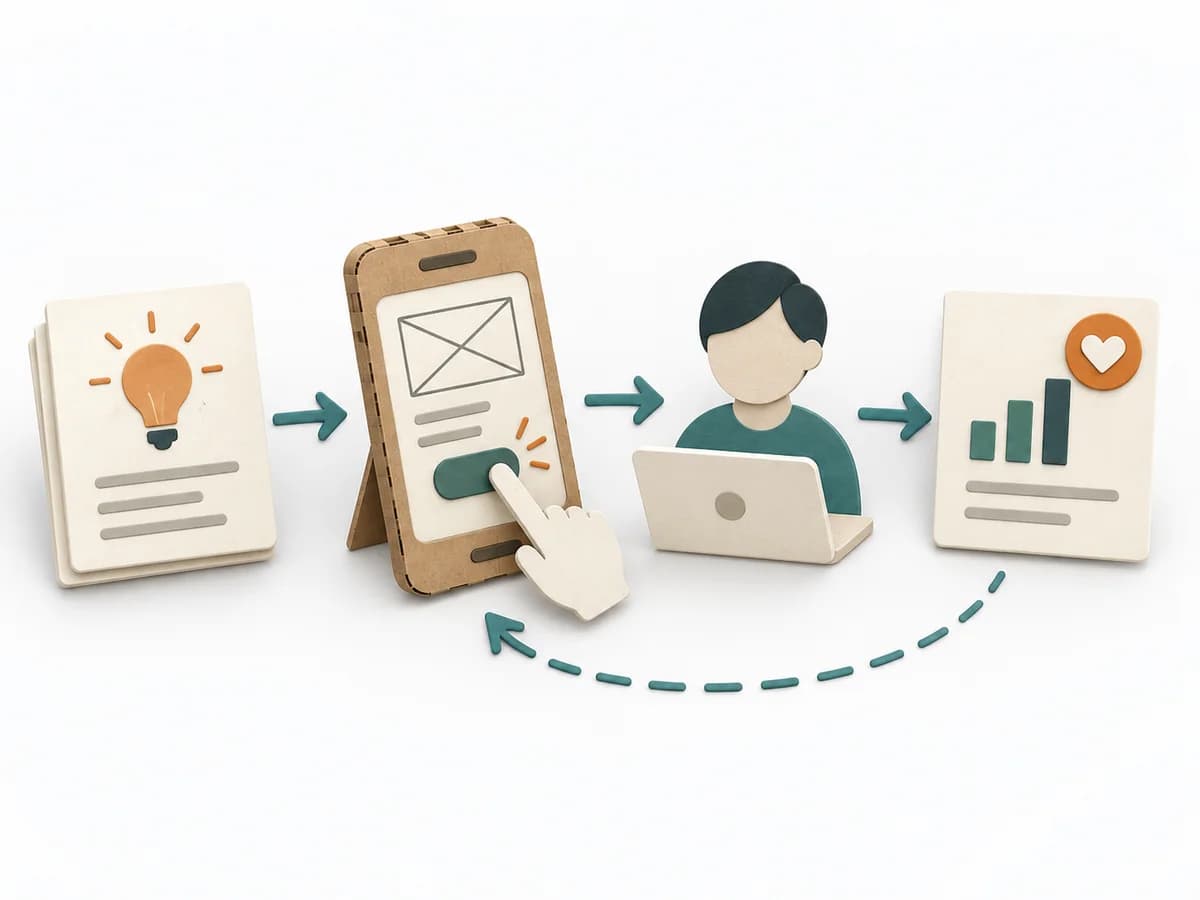
Pretotyping first asks whether the right thing is being built. A hypothesis, skin-in-the-game behaviour, XYZ statement, and preset threshold limit self-deception.
Fictional worked example
XYZ hypothesis plus Mechanical Turk, Pinocchio, Fake Door, or concierge pretotype as a precise working structure with a fictional example.
XYZ hypothesis information to record
≥3/20 qualifizierte Teams reservieren in 10 Tagen.
Pretotype information to record
Fake Door mit erstattbarer 50-€-Reservierung.
Commitment/denominator information to record
4 gültige Reservierungen von 20.
Threshold/decision information to record
Schwelle erreicht: Pilot bauen.
The example demonstrates the domain logic of Pretotyping; worksheets remain blank.
XYZ hypothesis
Goal
Produce XYZ statement so the core question “Does the target audience show real behaviour for this idea before we build it?” can be answered with stronger support.
Inputs for this step
Actions
Output
XYZ statement
XYZ statement · source · uncertainty · next decision
Quality check
Is behaviour stronger than opinion?
Pitfall
Costless clicks are treated as demand or the test violates trust and consent. Choose stronger commitment, qualify the audience, and plan debriefing, privacy, and refunds.
Timing: 10–20 minutes
Choose pretotype
Goal
Produce pretotype design so the core question “Does the target audience show real behaviour for this idea before we build it?” can be answered with stronger support.
Inputs for this step
Actions
Output
pretotype design
pretotype design · source · uncertainty · next decision
Quality check
Does the test avoid unnecessary build?
Pitfall
Costless clicks are treated as demand or the test violates trust and consent. Choose stronger commitment, qualify the audience, and plan debriefing, privacy, and refunds.
Timing: 10–20 minutes
Run test
Goal
Produce behaviour data so the core question “Does the target audience show real behaviour for this idea before we build it?” can be answered with stronger support.
Inputs for this step
Actions
Output
behaviour data
behaviour data · source · uncertainty · next decision
Quality check
Is the denominator complete?
Pitfall
Costless clicks are treated as demand or the test violates trust and consent. Choose stronger commitment, qualify the audience, and plan debriefing, privacy, and refunds.
Timing: 10–20 minutes
Decide
Goal
Produce pretotype decision so the core question “Does the target audience show real behaviour for this idea before we build it?” can be answered with stronger support.
Inputs for this step
Actions
Output
pretotype decision
pretotype decision · source · uncertainty · next decision
Quality check
Was the rule set before seeing data?
Pitfall
Costless clicks are treated as demand or the test violates trust and consent. Choose stronger commitment, qualify the audience, and plan debriefing, privacy, and refunds.
Timing: 10–20 minutes
What comes out at the end
Sketch: what the artifact looks like
Versioned pretotype evidence card with date, sources, owners, and next review.
Retain date, source, assumption state, and decision for every version of pretotype evidence card.
Plan Pretotyping around its domain steps and the concrete decision question.
To be confirmed
To be confirmed
Establish and review the practice Time: 1 day to 2 weeks
Complete this worksheet on paper or in your own document during the work.
XYZ hypothesis information to record
...
Pretotype information to record
...
Commitment/denominator information to record
...
Threshold/decision information to record
...
Enter only real input, sources, and decisions.
Expected artifact: XYZ statement
XYZ statement · source · uncertainty · next decision
Entry:
...
Expected artifact: pretotype design
pretotype design · source · uncertainty · next decision
Entry:
...
Expected artifact: behaviour data
behaviour data · source · uncertainty · next decision
Entry:
...
Expected artifact: pretotype decision
pretotype decision · source · uncertainty · next decision
Entry:
...
...
Method guide: https://methodatlas.meierhoff-systems.de/en/methods/pretotyping/run-sheet
Concrete filled scenario, fictional example
Fictional example for orientation. Counts and timings describe this case and are not universal requirements.
Concrete filled scenario, fictional example
XYZ: at least 3 of 20 qualified teams place a refundable €50 reservation for audit export within ten days. A fake door explains that pilot places start in four weeks. Result: five reservations, four valid after eligibility review.
Recognize symptoms and steer against them
Quick overview, the full text is in the matching phase in the flow
Costless clicks are treated as demand or the test violates trust and consent.
Choose stronger commitment, qualify the audience, and plan debriefing, privacy, and refunds.
Costless clicks are treated as demand or the test violates trust and consent.
Choose stronger commitment, qualify the audience, and plan debriefing, privacy, and refunds.
Costless clicks are treated as demand or the test violates trust and consent.
Choose stronger commitment, qualify the audience, and plan debriefing, privacy, and refunds.
Costless clicks are treated as demand or the test violates trust and consent.
Choose stronger commitment, qualify the audience, and plan debriefing, privacy, and refunds.
When to pause, resolve prerequisites, or choose another approach
Go to the profile for purpose, similar methods, and sources or continue to the next method in the catalog.