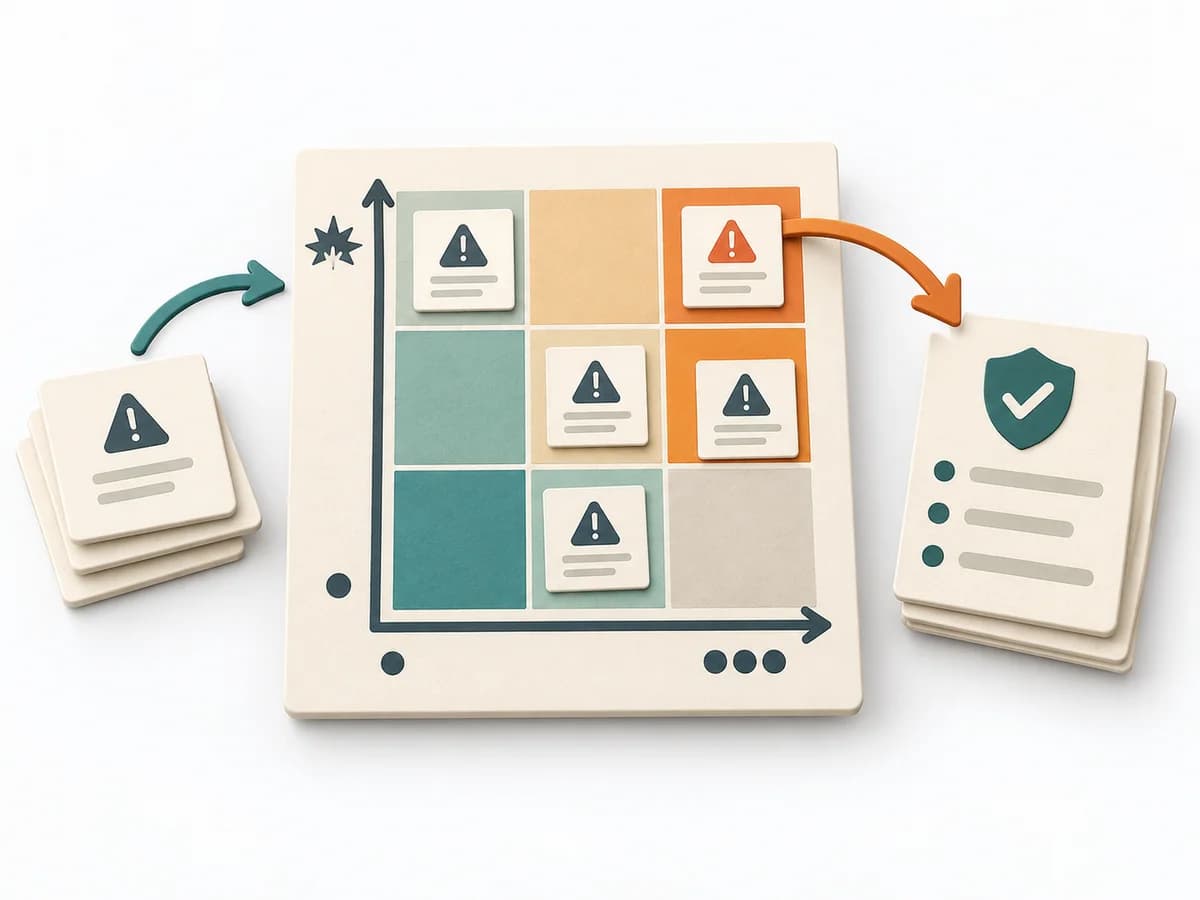
Complete firstDecision subject
Set one time-sensitive decision with an observation window, room to act, and guardrails.
Without a clear boundary, cases and signals become mixed.
A practical method guide: clarify prerequisites and materials, understand the complete process, and look up outputs, pitfalls, and stop criteria.
What needs to be finished first
Set one time-sensitive decision with an observation window, room to act, and guardrails.
Decision horizon, signal sources, assumption log, action options, effect signals, and timestamps
What needs to be ready before start
Decision horizon, signal sources, assumption log, action options, effect signals, and timestamps
Decision owner · people with situational knowledge · execution owners · scribe for signals and assumptions
Set one time-sensitive decision with an observation window, room to act, and guardrails.
30–90 minutes for the first cycle; further cycles follow the cadence of observable effects.
Divide the workspace into Observe · Orient · Decide · Act · Feed back; keep sources, assumptions, and decisions separate.
The one question this method answers
Which action will we test from the current situation, and which feedback starts the next OODA cycle?
Phases with goal, actions, output and pitfall
Beobachtungen werden laufend mit Kontext und möglichem Gegenwind abgeglichen, bevor die nächste Aktion gewählt wird. Der kurze Zyklus erzeugt einen Lernrhythmus, der Anpassung in unsicheren oder wettbewerbsintensiven Lagen beschleunigt. Entscheidend ist die Geschwindigkeit des Nachjustierens.
Fictional example
Fictional values demonstrate the method-specific fields.
Collect raw signals from the system, environment, and unfolding interaction with source and timestamp; separate observation from interpretation.
Saturday 09:00–12:00: p80 wait 18 minutes; 12 bookings from 10 to 11; inventory sync 22 minutes old.
Connect signals to the goal, capacity, experience, new information, and assumptions; test at least one alternative interpretation.
Interpretation A: booking cluster exceeds eight handoffs per hour. B: stale inventory extends every search.
Choose one option as a testable hypothesis; record expected effect, guardrail, owner, and review time.
Cap at eight slots per hour for two Saturdays; expect p80 below 15 minutes; stop above 10% rejection.
Execute the chosen action within scope and log deviations, side effects, and new signals.
Lea applies the cap on 9 and 16 Nov; Support marks rejected bookings; Warehouse measures wait.
Compare effect and guardrails with the hypothesis; feed surprises into the next cycle as new observations.
p80 drops to 12 minutes, rejection is 7%; warehouse calls remain high. Next cycle observes sync and search time.
All values are fictional.
Observe

Goal
Source-bound situation picture: Collect raw signals from the system, environment, and unfolding interaction with source and timestamp; separate observation from interpretation.
Inputs for this step
Actions
Output
Source-bound situation picture
Collect raw signals from the system, environment, and unfolding interaction with source and timestamp; separate observation from interpretation.
Quality check
Are signal, source, time, and uncertainty visible without already claiming a cause?
Pitfall
The situation picture says the warehouse is overloaded but contains no measurable signals. Split claims into observed values, source, timestamp, and open uncertainty.
Timing: 10–20 minutes
Orient
Goal
Orientation with alternatives: Connect signals to the goal, capacity, experience, new information, and assumptions; test at least one alternative interpretation.
Inputs for this step
Actions
Output
Orientation with alternatives
Connect signals to the goal, capacity, experience, new information, and assumptions; test at least one alternative interpretation.
Quality check
Are context, assumptions, and at least two plausible interpretations separated?
Pitfall
The first familiar explanation is treated as fact. Expose formative experience and assumptions, then formulate a competing interpretation.
Timing: 15–25 minutes
Decide
Goal
Decision hypothesis: Choose one option as a testable hypothesis; record expected effect, guardrail, owner, and review time.
Inputs for this step
Actions
Output
Decision hypothesis
Choose one option as a testable hypothesis; record expected effect, guardrail, owner, and review time.
Quality check
Does the decision state action, expected signal, guardrail, and review time?
Pitfall
The decision only says optimise slots and omits effect and boundary. Add one concrete change, measure, stop rule, owner, and date.
Timing: 10–15 minutes
Act
Goal
Executed test: Execute the chosen action within scope and log deviations, side effects, and new signals.
Inputs for this step
Actions
Output
Executed test
Execute the chosen action within scope and log deviations, side effects, and new signals.
Quality check
Does execution match the decision, with deviations and timestamps recorded?
Pitfall
Additional variables change during execution without being logged. Preserve the original decision and stop or explicitly record extra changes and their effect.
Timing: One or two operating cycles
Feed back
Goal
Next OODA cycle: Compare effect and guardrails with the hypothesis; feed surprises into the next cycle as new observations.
Inputs for this step
Actions
Output
Next OODA cycle
Compare effect and guardrails with the hypothesis; feed surprises into the next cycle as new observations.
Quality check
Are result, deviation, and open signals fed back into Observe?
Pitfall
The action is closed as a success although a relevant signal is unchanged. Check all signals and phrase the main residual uncertainty as the next observation.
Timing: 15–20 minutes
What comes out at the end
Sketch: what the artifact looks like
Versioned OODA log containing observations, orientation, decision hypothesis, action, and feedback.
Record date, owner, evidence state, decision, and review; preserve earlier cycles.
Set subject, evidence, roles, flow, and review.
To be confirmed
To be confirmed
Complete run Time: 30–90 minutes for the first cycle; further cycles follow the cadence of observable effects.
Complete this worksheet on paper or in your own document during the work.
Collect raw signals from the system, environment, and unfolding interaction with source and timestamp; separate observation from interpretation.
...
Connect signals to the goal, capacity, experience, new information, and assumptions; test at least one alternative interpretation.
...
Choose one option as a testable hypothesis; record expected effect, guardrail, owner, and review time.
...
Execute the chosen action within scope and log deviations, side effects, and new signals.
...
Compare effect and guardrails with the hypothesis; feed surprises into the next cycle as new observations.
...
The blank worksheet contains prompts only.
Reference · original teaching example
Expected artifact: Source-bound situation picture
Collect raw signals from the system, environment, and unfolding interaction with source and timestamp; separate observation from interpretation.
Entry:
...
Expected artifact: Orientation with alternatives
Connect signals to the goal, capacity, experience, new information, and assumptions; test at least one alternative interpretation.
Entry:
...
Expected artifact: Decision hypothesis
Choose one option as a testable hypothesis; record expected effect, guardrail, owner, and review time.
Entry:
...
Expected artifact: Executed test
Execute the chosen action within scope and log deviations, side effects, and new signals.
Entry:
...
Expected artifact: Next OODA cycle
Compare effect and guardrails with the hypothesis; feed surprises into the next cycle as new observations.
Entry:
...
...
Method guide: https://methodatlas.meierhoff-systems.de/en/methods/ooda-loop/run-sheet
Concrete filled scenario, fictional example
Fictional example for orientation. Counts and timings describe this case and are not universal requirements.
Concrete filled scenario, fictional example
Saturday 09:00–12:00: p80 wait 18 minutes; 12 bookings from 10 to 11; inventory sync 22 minutes old.
Interpretation A: booking cluster exceeds eight handoffs per hour. B: stale inventory extends every search.
Cap at eight slots per hour for two Saturdays; expect p80 below 15 minutes; stop above 10% rejection.
Lea applies the cap on 9 and 16 Nov; Support marks rejected bookings; Warehouse measures wait.
p80 drops to 12 minutes, rejection is 7%; warehouse calls remain high. Next cycle observes sync and search time.
Recognize symptoms and steer against them
Quick overview, the full text is in the matching phase in the flow
The situation picture says the warehouse is overloaded but contains no measurable signals.
Split claims into observed values, source, timestamp, and open uncertainty.
The first familiar explanation is treated as fact.
Expose formative experience and assumptions, then formulate a competing interpretation.
The decision only says optimise slots and omits effect and boundary.
Add one concrete change, measure, stop rule, owner, and date.
Additional variables change during execution without being logged.
Preserve the original decision and stop or explicitly record extra changes and their effect.
The action is closed as a success although a relevant signal is unchanged.
Check all signals and phrase the main residual uncertainty as the next observation.
When to pause, resolve prerequisites, or choose another approach
Go to the profile for purpose, similar methods, and sources or continue to the next method in the catalog.