Complete firstConcrete tasks
Tasks have a visible completion point and broadly fit daily capacity.
Six tasks are a ceiling, not a quota or capacity guarantee.
A practical method guide: clarify prerequisites and materials, understand the complete process, and look up outputs, pitfalls, and stop criteria.
What needs to be finished first
Tasks have a visible completion point and broadly fit daily capacity.
What needs to be ready before start
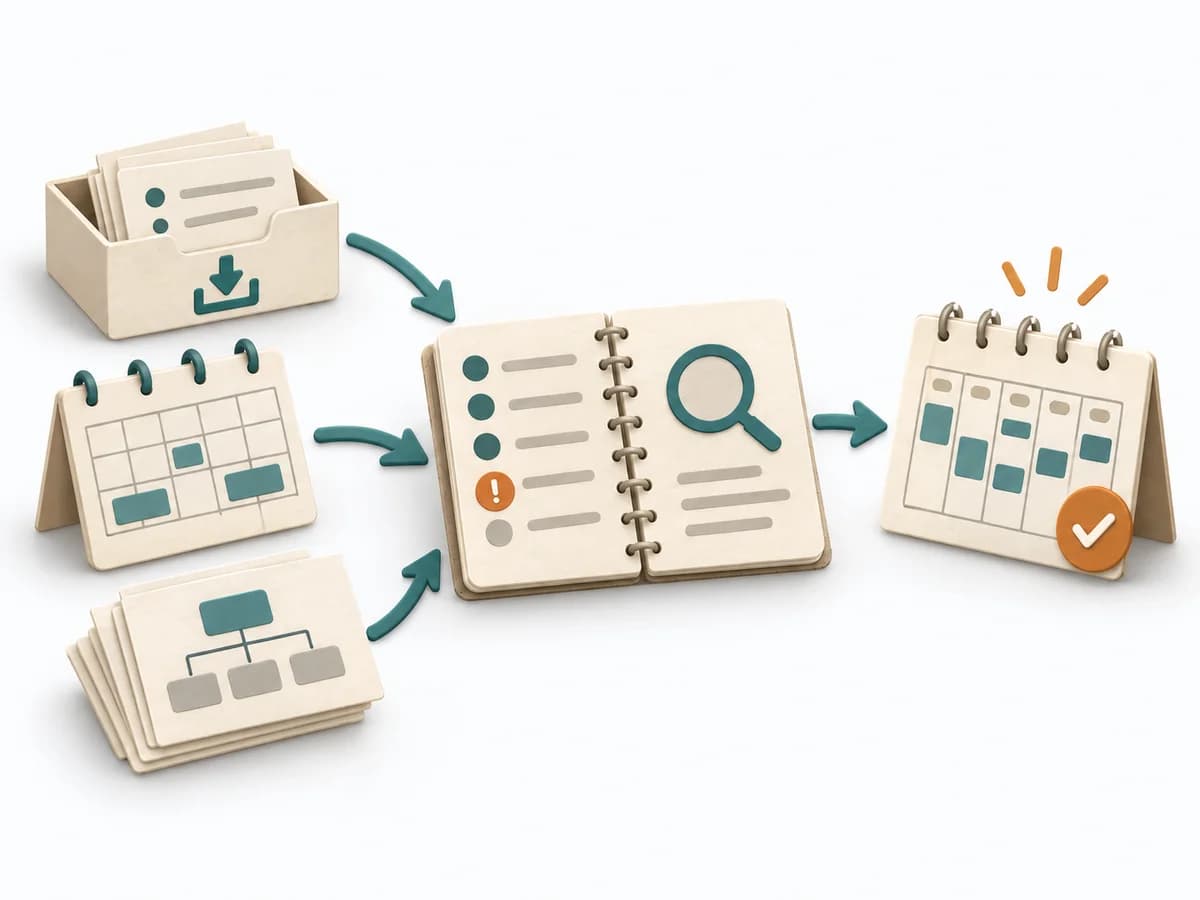
A numbered list with at most six slots, task pool and calendar for checking capacity.
Person prioritising their own work; responsible requesters when commitments conflict.
Review commitments, deadlines and tomorrow’s available time; select only concrete, executable tasks.
5–10 minutes evening planning; execution the next day
Place an empty list with six numbered slots beside the task pool and calendar; do not carry over tasks automatically.
The one question this method answers
Which at most six tasks deserve my attention tomorrow and in what order?
Phases with goal, actions, output and pitfall
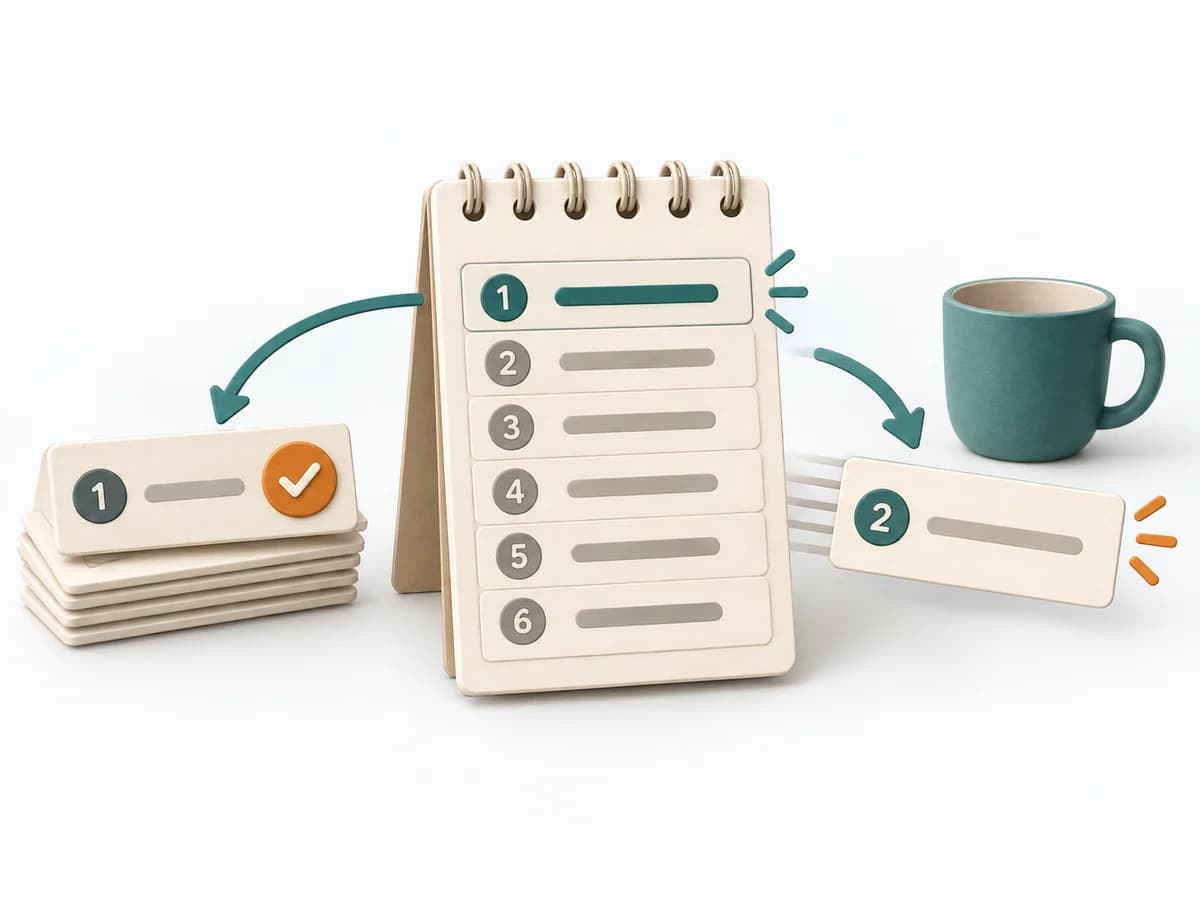
At the end of a workday, at most six important tasks are listed and strictly ordered for the next day. Work begins with number one the following day and follows the order; unfinished work is reprioritised in the evening.
Fictional example
At the end of a workday, at most six important tasks are listed and strictly ordered for the next day. Work begins with number one the following day and follows the order; unfinished work is reprioritised in the evening.
Which task comes first and how is completion recognised?
Fictional: hand the proposal draft to Lea for review.
Which task follows completion of number one?
Correct the invoice address and confirm the change.
Which further result takes priority over the following ones?
Complete the export test record.
Which task follows if time and capacity allow?
Confirm two interview appointments.
Which additional important task still fits the day? Leave blank if unnecessary.
Add the new registration question to the support FAQ.
Which final task is included? At most six; fewer are allowed.
Check the workshop materials list.
What is complete and what rank will open tasks receive tomorrow?
1–3 complete. Interview appointments become rank 1 tomorrow; FAQ rank 3. Materials review returns to the task pool after reassessment.
All example details are fictional and illustrate the application.
Select at most six
Goal
Bounded daily selection
Inputs for this step
Actions
Output
Bounded daily selection
Are there at most six realistically actionable tasks?
Quality check
Are there at most six realistically actionable tasks?
Pitfall
Six huge projects replace a usable daily list. Split projects into daily outcomes and choose fewer if needed.
Timing: 2–4 minutes
Rank unambiguously
Goal
Committed sequence
Inputs for this step
Actions
Output
Committed sequence
Is it clear what comes first and next?
Quality check
Is it clear what comes first and next?
Pitfall
Every task receives rank one. Compare tasks pairwise and commit to an order.
Timing: 2–3 minutes
One at a time
Goal
Progress along the sequence
Inputs for this step
Actions
Output
Progress along the sequence
Does work stay with one task until its outcome?
Quality check
Does work stay with one task until its outcome?
Pitfall
Easy tasks are brought forward on the side. Return to the sequence or record a reasoned reorder.
Timing: 30–120 minutes
Decide again in the evening
Goal
New prioritised daily list
Inputs for this step
Actions
Output
New prioritised daily list
Was unfinished work reassessed for importance?
Quality check
Was unfinished work reassessed for importance?
Pitfall
Unfinished work grows into an endless daily list. Return unselected tasks to the task pool.
Timing: 3–5 minutes
What comes out at the end
Sketch: what the artifact looks like
Ordered daily list with at most six concrete tasks and an evening decision on unfinished work.
Record date and scope; retain the previous version and reason when changing it.
Review commitments, deadlines and tomorrow’s available time; select only concrete, executable tasks.
To be confirmed
To be confirmed
Complete cycle Time: 5–10 minutes evening planning; execution the next day
Complete this worksheet on paper or in your own document during the work.
Which task comes first and how is completion recognised?
...
Which task follows completion of number one?
...
Which further result takes priority over the following ones?
...
Which task follows if time and capacity allow?
...
Which additional important task still fits the day? Leave blank if unnecessary.
...
Which final task is included? At most six; fewer are allowed.
...
What is complete and what rank will open tasks receive tomorrow?
...
Answer the prompts with your own information. Explicitly mark unknowns and assumptions.
James Clear: The Ivy Lee Method
Expected artifact: Bounded daily selection
Are there at most six realistically actionable tasks?
Entry:
...
Expected artifact: Committed sequence
Is it clear what comes first and next?
Entry:
...
Expected artifact: Progress along the sequence
Does work stay with one task until its outcome?
Entry:
...
Expected artifact: New prioritised daily list
Was unfinished work reassessed for importance?
Entry:
...
...
Method guide: https://methodatlas.meierhoff-systems.de/en/methods/ivy-lee-method/run-sheet
Concrete filled scenario, fictional example
Fictional example for orientation. Counts and timings describe this case and are not universal requirements.
Concrete filled scenario, fictional example
1 · Highest priority: Fictional: hand the proposal draft to Lea for review.
2 · Next task: Correct the invoice address and confirm the change.
3 · Third task: Complete the export test record.
4 · Fourth task: Confirm two interview appointments.
5 · Fifth task: Add the new registration question to the support FAQ.
6 · Sixth task: Check the workshop materials list.
Evening review: 1–3 complete. Interview appointments become rank 1 tomorrow; FAQ rank 3. Materials review returns to the task pool after reassessment.
Recognize symptoms and steer against them
Quick overview, the full text is in the matching phase in the flow
Six huge projects replace a usable daily list.
Split projects into daily outcomes and choose fewer if needed.
Every task receives rank one.
Compare tasks pairwise and commit to an order.
Easy tasks are brought forward on the side.
Return to the sequence or record a reasoned reorder.
Unfinished work grows into an endless daily list.
Return unselected tasks to the task pool.
When to pause, resolve prerequisites, or choose another approach
Go to the profile for purpose, similar methods, and sources or continue to the next method in the catalog.