Complete firstBounded subject
The scope and purpose of Futures Wheel are stated as a concrete question.
Without scope, futures wheel becomes arbitrary.
A practical method guide: clarify prerequisites and materials, understand the complete process, and look up outputs, pitfalls, and stop criteria.
What needs to be finished first
The scope and purpose of Futures Wheel are stated as a concrete question.
Precise change or trend, stakeholder and system knowledge, horizon and scenario boundary and domain decision makers are available.
What needs to be ready before start
Precise change or trend, stakeholder and system knowledge, horizon and scenario boundary, shared workspace, source links, and decision log.
Foresight facilitator · diverse domain/stakeholder experts
Collect Precise change or trend, stakeholder and system knowledge, horizon and scenario boundary in advance and mark open assumptions.
60–120 minutes
Prepare central event with causally linked first- to third-order consequence rings visibly and calibrate assessment terms before starting.
The one question this method answers
Which direct and indirect consequences might this change trigger for different actors?
Phases with goal, actions, output and pitfall
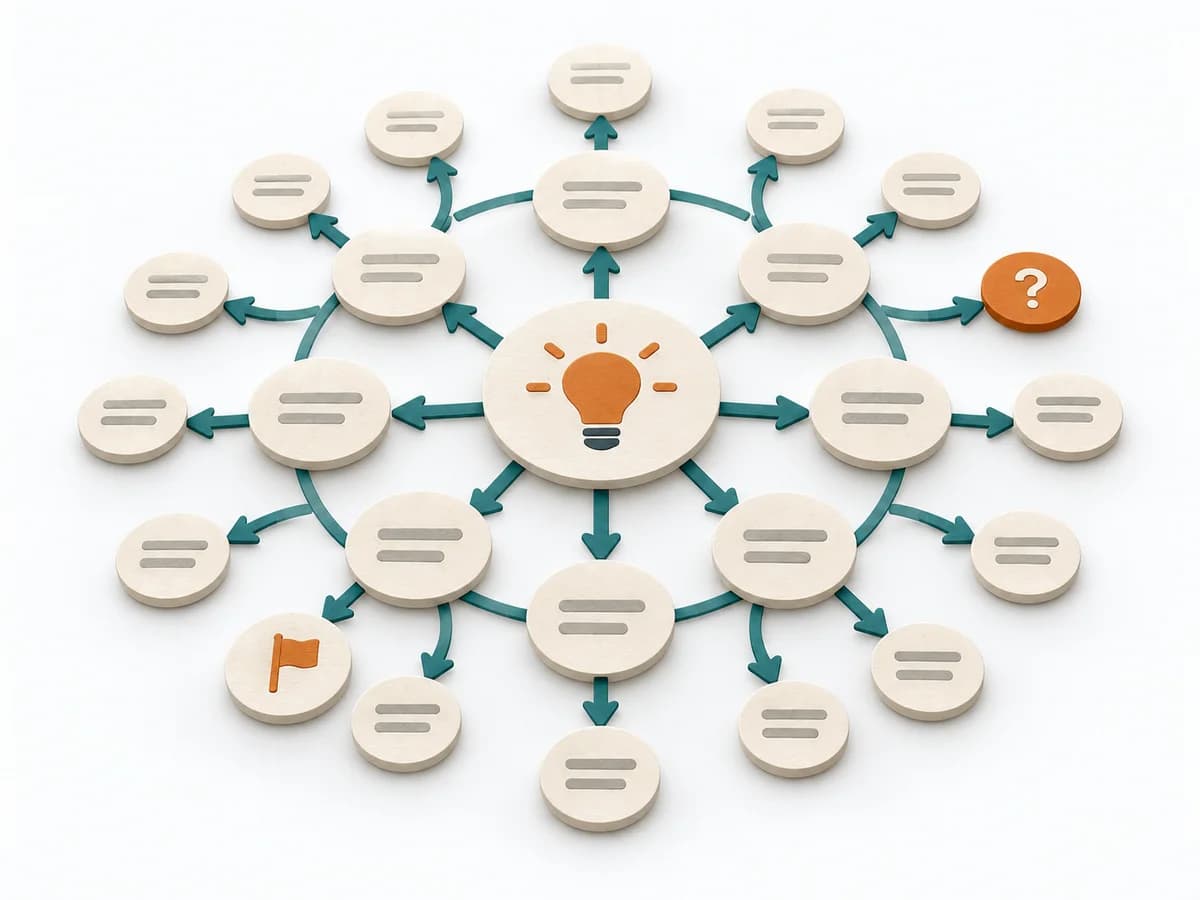
A futures wheel places a clear change in the centre, collects first-order consequences, and derives second- and third-order consequences. Links receive direction, horizon, and assumption.
Fictional causal chains
Two concrete causal chains from the central change to third order; every consequence names parent, mechanism, and uncertainty.
| Consequence node | Node | Parent node | Order | Consequence | Mechanism | Uncertainty/signpost |
|---|---|---|---|---|---|---|
| Consequence 1Test one real consequence with its causal parent. | A1: Logging cost | Provenance duty from 2028 | 1 | Logging and storage effort rises. | Every AI answer needs source and model evidence. | Medium; monitor draft technical standards. |
| Consequence 2Test one real consequence with its causal parent. | A2: Shared service | A1: Logging cost | 2 | Small providers pool provenance infrastructure. | Fixed cost exceeds own scale advantage. | High; first managed services are a signpost. |
| Consequence 3Test one real consequence with its causal parent. | A3: Market concentration | A2: Shared service | 3 | A few provenance providers become critical dependencies. | Shared demand concentrates data and switching cost. | High; monitor provider shares and portability standards. |
| Consequence 4Test one real consequence with its causal parent. | B1: Answers blocked | Provenance duty from 2028 | 1 | Unsupported AI answers are stopped before release. | A compliance gate checks the complete source chain. | Medium; monitor enforcement guidance. |
| Consequence 5Test one real consequence with its causal parent. | B2: Longer response time | B1: Answers blocked | 2 | Users wait more often for verified answers. | Retrieval and source checks add processing steps. | Medium; measure P95 latency in pilot. |
| Consequence 6Test one real consequence with its causal parent. | B3: Auditability decides | B2: Longer response time | 3 | Buyers accept latency only for visibly higher trust. | Procurement weighs traceable provenance against speed. | High; monitor tender criteria and win/loss data. |
Order means distance from the central change, not importance.
Change
Goal
Produce central change so the core question “Which direct and indirect consequences might this change trigger for different actors?” can be answered with stronger support.
Inputs for this step
Actions
Output
central change
central change · source · uncertainty · next decision
Quality check
Is the change unambiguous and timed?
Pitfall
Consequences are collected without causal parent, mechanism, or horizon. State every consequence as cause, actor, effect, and horizon and add counter-effects.
Timing: 10–20 minutes
First order
Goal
Produce first ring so the core question “Which direct and indirect consequences might this change trigger for different actors?” can be answered with stronger support.
Inputs for this step
Actions
Output
first ring
first ring · source · uncertainty · next decision
Quality check
Is every consequence directly derived?
Pitfall
Consequences are collected without causal parent, mechanism, or horizon. State every consequence as cause, actor, effect, and horizon and add counter-effects.
Timing: 10–20 minutes
Further orders
Goal
Produce outer rings so the core question “Which direct and indirect consequences might this change trigger for different actors?” can be answered with stronger support.
Inputs for this step
Actions
Output
outer rings
outer rings · source · uncertainty · next decision
Quality check
Does every causal chain remain visible?
Pitfall
Consequences are collected without causal parent, mechanism, or horizon. State every consequence as cause, actor, effect, and horizon and add counter-effects.
Timing: 10–20 minutes
Implications
Goal
Produce implication set so the core question “Which direct and indirect consequences might this change trigger for different actors?” can be answered with stronger support.
Inputs for this step
Actions
Output
implication set
implication set · source · uncertainty · next decision
Quality check
Does every priority have a signpost?
Pitfall
Consequences are collected without causal parent, mechanism, or horizon. State every consequence as cause, actor, effect, and horizon and add counter-effects.
Timing: 10–20 minutes
What comes out at the end
Sketch: what the artifact looks like
Versioned futures wheel with date, sources, owners, and next review.
Retain date, source, assumption state, and decision for every version of futures wheel.
Plan Futures Wheel around its domain steps and the concrete decision question.
To be confirmed
To be confirmed
Establish and review the practice Time: 60–120 minutes
Complete this worksheet on paper or in your own document during the work.
| Consequence node | Record Node | Record Parent node | Record Order | Record Consequence | Record Mechanism | Record Uncertainty/signpost |
|---|---|---|---|---|---|---|
| Consequence 1 | ||||||
| Consequence 2 | ||||||
| Consequence 3 | ||||||
| Consequence 4 | ||||||
| Consequence 5 | ||||||
| Consequence 6 |
Do not record a consequence without parent node and justified mechanism.
The Millennium Project: Futures Research Methodology
Expected artifact: central change
central change · source · uncertainty · next decision
Entry:
...
Expected artifact: first ring
first ring · source · uncertainty · next decision
Entry:
...
Expected artifact: outer rings
outer rings · source · uncertainty · next decision
Entry:
...
Expected artifact: implication set
implication set · source · uncertainty · next decision
Entry:
...
...
Method guide: https://methodatlas.meierhoff-systems.de/en/methods/futures-wheel/run-sheet
Concrete filled scenario, fictional example
Fictional example for orientation. Counts and timings describe this case and are not universal requirements.
Concrete filled scenario, fictional example
Change: provenance duty from 2028. First order: logging costs rise; unsupported answers are blocked. Second order: smaller providers use shared provenance services; users wait longer. Third order: auditability becomes a buying criterion and new insurance products emerge. Every edge names assumption and 1/3/5-year horizon.
Recognize symptoms and steer against them
Quick overview, the full text is in the matching phase in the flow
Consequences are collected without causal parent, mechanism, or horizon.
State every consequence as cause, actor, effect, and horizon and add counter-effects.
Consequences are collected without causal parent, mechanism, or horizon.
State every consequence as cause, actor, effect, and horizon and add counter-effects.
Consequences are collected without causal parent, mechanism, or horizon.
State every consequence as cause, actor, effect, and horizon and add counter-effects.
Consequences are collected without causal parent, mechanism, or horizon.
State every consequence as cause, actor, effect, and horizon and add counter-effects.
When to pause, resolve prerequisites, or choose another approach
Go to the profile for purpose, similar methods, and sources or continue to the next method in the catalog.

