Complete firstExplanation
Name one concept and the intended listener. Close the source before producing the first explanation from memory.
Choose one concept and one explanation purpose.
A practical method guide: clarify prerequisites and materials, understand the complete process, and look up outputs, pitfalls, and stop criteria.
What needs to be finished first
Name one concept and the intended listener. Close the source before producing the first explanation from memory.
Create four areas: plain explanation, example, marked gaps, and revised version. Introduce technical terms only after a plain explanation.
What needs to be ready before start
Blank sheet or document, original source, pen, optional recorder, and one transfer example.
Learner as explainer · optional non-expert test listener · reliable source for gap checks
Name one concept and the intended listener. Close the source before producing the first explanation from memory.
20–60 minutes per clearly bounded concept; use several loops for large subjects.
Create four areas: plain explanation, example, marked gaps, and revised version. Introduce technical terms only after a plain explanation.
The one question this method answers
Can I explain this concept without skipping a step or hiding behind jargon?
Phases with goal, actions, output and pitfall
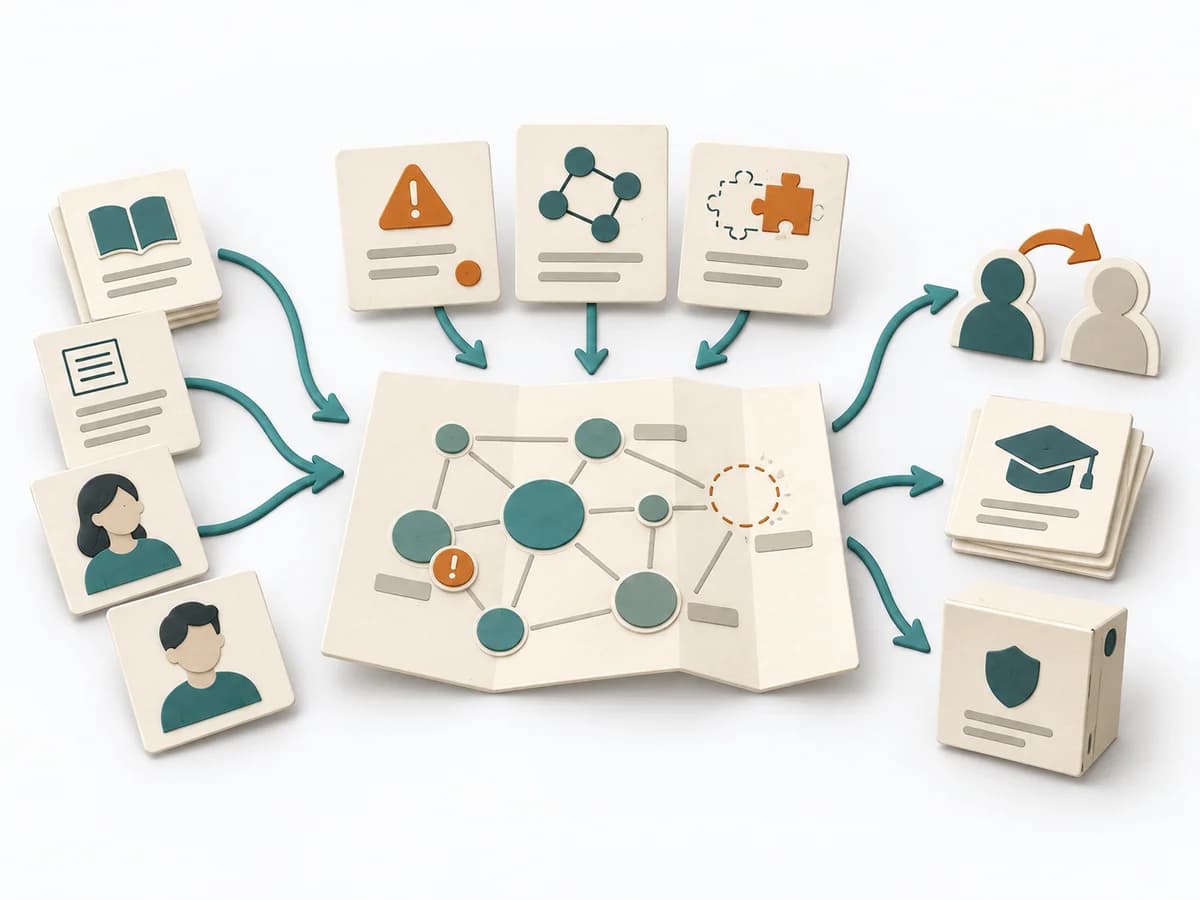
The Feynman Technique asks one person to explain a bounded concept in their own everyday language. Sticking points are marked, checked against sources, and used to improve the explanation.
Fictional example
Fictional explanation of HTTP caching for a new colleague.
What exactly are you explaining, to whom, and for what purpose?
HTTP caching for a new frontend colleague so she can diagnose stale responses.
How does it work without unexplained jargon?
A cache keeps an earlier response. Before reusing it, the browser checks rules supplied by the server.
Where does the explanation jump or rely on an unexplained term?
Open: when must the browser ask the server again even though it has a copy?
Which source closes exactly this gap?
Check MDN on Cache-Control; restate max-age and revalidation in plain language.
Which new situation must the explanation predict?
Why can a response after max-age be refreshed with 304 rather than a full payload?
The explanation is deliberately short and is not a complete HTTP specification.
Concept

Goal
Bounded learning target: Choose one concept, audience, and purpose for the explanation.
Inputs for this step
Actions
Output
Bounded learning target
Bounded learning target
Quality check
Is the concept small enough to explain fully with one example?
Pitfall
The subject is Machine Learning and too broad for a testable explanation. Return to “Bound topic” and repeat this method step: Choose one concept, audience, and purpose for the explanation.
Timing: 3–5 minutes
Explanation
Goal
First explanation in own words: Explain in your own words with an example and intermediate steps.
Inputs for this step
Actions
Output
First explanation in own words
First explanation in own words
Quality check
Does the text explain mechanism and relationship rather than list definitions?
Pitfall
The text copies definitions or replaces explanation with technical terms. Return to “Write simply” and repeat this method step: Explain in your own words with an example and intermediate steps.
Timing: 8–15 minutes
Gap
Goal
Marked understanding gaps: Mark every place where jargon, omission, or uncertain claim carries the explanation.
Inputs for this step
Actions
Output
Marked understanding gaps
Marked understanding gaps
Quality check
Are jumps, jargon, and uncertain claims explicitly marked?
Pitfall
Hesitation is polished away instead of marked as a knowledge gap. Return to “Mark sticking points” and repeat this method step: Mark every place where jargon, omission, or uncertain claim carries the explanation.
Timing: 5–10 minutes
Source
Goal
Source-checked corrections: Use a primary or reliable technical source to resolve and learn marked gaps.
Inputs for this step
Actions
Output
Source-checked corrections
Source-checked corrections
Quality check
Does the source answer the exact marked gap, with the correction restated in the learner's own words?
Pitfall
The entire source is reread without resolving the specific gap. Return to “Check understanding” and repeat this method step: Use a primary or reliable technical source to resolve and learn marked gaps.
Timing: 5–20 minutes
Simplification
Goal
Simplified, tested explanation: Rewrite, test the example, and name remaining uncertainty.
Inputs for this step
Actions
Output
Simplified, tested explanation
Simplified, tested explanation
Quality check
Can a test listener follow the example and correctly predict a new case?
Pitfall
The version sounds simple but is tested with neither a listener nor a transfer case. Return to “Explain again” and repeat this method step: Rewrite, test the example, and name remaining uncertainty.
Timing: 5–10 minutes
What comes out at the end
Sketch: what the artifact looks like
Versioned explanation in the learner's own words with example, marked knowledge gaps, source corrections, and transfer question.
Version the simplified, tested explanation with date, owner, source state, and review date. Preserve earlier observations and append changes with their reason.
Plan the question, inputs, complete run, and review with clear ownership.
To be confirmed
To be confirmed
Complete run Time: 20–60 minutes per clearly bounded concept; use several loops for large subjects.
Complete this worksheet on paper or in your own document during the work.
What exactly are you explaining, to whom, and for what purpose?
...
How does it work without unexplained jargon?
...
Where does the explanation jump or rely on an unexplained term?
...
Which source closes exactly this gap?
...
Which new situation must the explanation predict?
...
Close the source for the first explanation; inspect gaps afterwards.
Farnam Street · original teaching example
Expected artifact: Bounded learning target
Bounded learning target
Entry:
...
Expected artifact: First explanation in own words
First explanation in own words
Entry:
...
Expected artifact: Marked understanding gaps
Marked understanding gaps
Entry:
...
Expected artifact: Source-checked corrections
Source-checked corrections
Entry:
...
Expected artifact: Simplified, tested explanation
Simplified, tested explanation
Entry:
...
...
Method guide: https://methodatlas.meierhoff-systems.de/en/methods/feynman-technique/run-sheet
Concrete filled scenario, fictional example
Fictional example for orientation. Counts and timings describe this case and are not universal requirements.
Concrete filled scenario, fictional example
HTTP caching for a new frontend colleague so she can diagnose stale responses.
A cache keeps an earlier response. Before reusing it, the browser checks rules supplied by the server.
Open: when must the browser ask the server again even though it has a copy?
Check MDN on Cache-Control; restate max-age and revalidation in plain language.
Why can a response after max-age be refreshed with 304 rather than a full payload?
The explanation is deliberately short and is not a complete HTTP specification.
Recognize symptoms and steer against them
Quick overview, the full text is in the matching phase in the flow
The subject is Machine Learning and too broad for a testable explanation.
Return to “Bound topic” and repeat this method step: Choose one concept, audience, and purpose for the explanation.
The text copies definitions or replaces explanation with technical terms.
Return to “Write simply” and repeat this method step: Explain in your own words with an example and intermediate steps.
Hesitation is polished away instead of marked as a knowledge gap.
Return to “Mark sticking points” and repeat this method step: Mark every place where jargon, omission, or uncertain claim carries the explanation.
The entire source is reread without resolving the specific gap.
Return to “Check understanding” and repeat this method step: Use a primary or reliable technical source to resolve and learn marked gaps.
The version sounds simple but is tested with neither a listener nor a transfer case.
Return to “Explain again” and repeat this method step: Rewrite, test the example, and name remaining uncertainty.
When to pause, resolve prerequisites, or choose another approach
Go to the profile for purpose, similar methods, and sources or continue to the next method in the catalog.