Complete firstBounded subject
The scope and purpose of Family Tree Analysis are stated as a concrete question.
Without scope, event family tree becomes arbitrary.
A practical method guide: clarify prerequisites and materials, understand the complete process, and look up outputs, pitfalls, and stop criteria.
What needs to be finished first
The scope and purpose of Family Tree Analysis are stated as a concrete question.
Event register, chronologies and causal analyses, taxonomy for comparison attributes and domain decision makers are available.
What needs to be ready before start
Event register, chronologies and causal analyses, taxonomy for comparison attributes, shared workspace, source links, and decision log.
Investigator · quality/safety analyst · process owner
Collect Event register, chronologies and causal analyses, taxonomy for comparison attributes in advance and mark open assumptions.
90–180 minutes
Prepare form an event family using fixed attributes and compare common causal and barrier patterns visibly and calibrate assessment terms before starting.
The one question this method answers
Which recurring condition connects related events, and which systemic action is missing?
Phases with goal, actions, output and pitfall
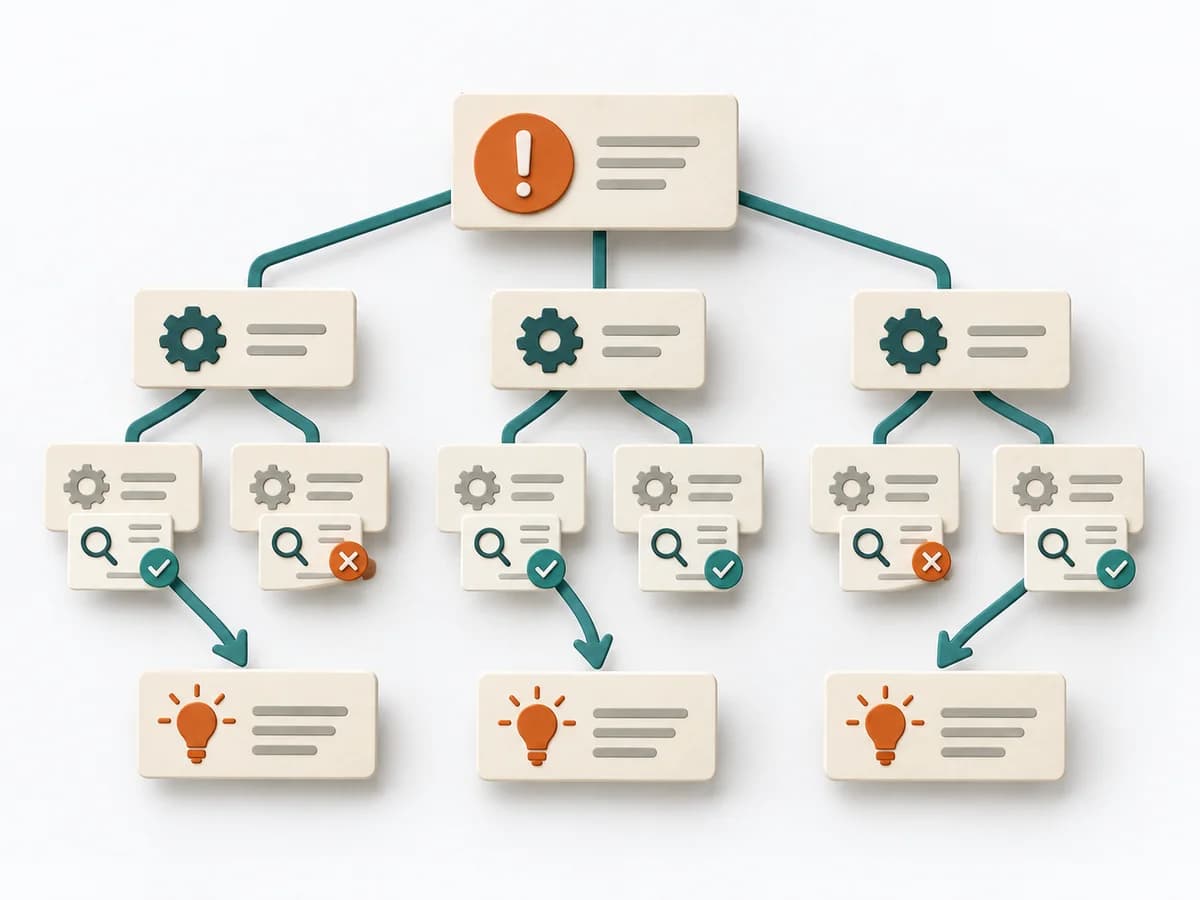
Family tree analysis groups similar events using a transparent relationship criterion and compares event chains. Recurring factors are derived only from evidenced commonalities.
Fictional worked example
form an event family using fixed attributes and compare common causal and barrier patterns as a precise working structure with a fictional example.
Attribute · horizon · exclusion
Faulty data leave review; six months.
Chain · conditions · barriers
Manual CSV; mandatory-field test missing.
Commonality · n/N · counterexample
4/5 share transformation; one different cause.
System change · exposure · effectiveness
Validator before export; errors per 100 exports.
The example demonstrates the domain logic of Family Tree Analysis; worksheets remain blank.
Define family

Goal
Produce family rule so the core question “Which recurring condition connects related events, and which systemic action is missing?” can be answered with stronger support.
Inputs for this step
Actions
Output
family rule
family rule · source · uncertainty · next decision
Quality check
Can membership be decided reproducibly?
Pitfall
Only superficially similar events are forced into one causal family. Set the relationship criterion before review, retain counterexamples, and capture exposure separately.
Timing: 10–20 minutes
Map events
Goal
Produce event profiles so the core question “Which recurring condition connects related events, and which systemic action is missing?” can be answered with stronger support.
Inputs for this step
Actions
Output
event profiles
event profiles · source · uncertainty · next decision
Quality check
Do unknown data remain marked unknown?
Pitfall
Only superficially similar events are forced into one causal family. Set the relationship criterion before review, retain counterexamples, and capture exposure separately.
Timing: 10–20 minutes
Compare patterns
Goal
Produce pattern tree so the core question “Which recurring condition connects related events, and which systemic action is missing?” can be answered with stronger support.
Inputs for this step
Actions
Output
pattern tree
pattern tree · source · uncertainty · next decision
Quality check
Is the pattern supported by several independent events?
Pitfall
Only superficially similar events are forced into one causal family. Set the relationship criterion before review, retain counterexamples, and capture exposure separately.
Timing: 10–20 minutes
Correct system
Goal
Produce system action so the core question “Which recurring condition connects related events, and which systemic action is missing?” can be answered with stronger support.
Inputs for this step
Actions
Output
system action
system action · source · uncertainty · next decision
Quality check
Does the action apply across the family?
Pitfall
Only superficially similar events are forced into one causal family. Set the relationship criterion before review, retain counterexamples, and capture exposure separately.
Timing: 10–20 minutes
What comes out at the end
Sketch: what the artifact looks like
Versioned event family tree with date, sources, owners, and next review.
Retain date, source, assumption state, and decision for every version of event family tree.
Plan Family Tree Analysis around its domain steps and the concrete decision question.
To be confirmed
To be confirmed
Full workshop Time: 90–180 minutes
Complete this worksheet on paper or in your own document during the work.
Attribute · horizon · exclusion
...
Chain · conditions · barriers
...
Commonality · n/N · counterexample
...
System change · exposure · effectiveness
...
Enter only real input, sources, and decisions.
U.S. Department of Energy: Accident Investigation Program
Expected artifact: family rule
family rule · source · uncertainty · next decision
Entry:
...
Expected artifact: event profiles
event profiles · source · uncertainty · next decision
Entry:
...
Expected artifact: pattern tree
pattern tree · source · uncertainty · next decision
Entry:
...
Expected artifact: system action
system action · source · uncertainty · next decision
Entry:
...
...
Method guide: https://methodatlas.meierhoff-systems.de/en/methods/family-tree-analysis/run-sheet
Concrete filled scenario, fictional example
Fictional example for orientation. Counts and timings describe this case and are not universal requirements.
Concrete filled scenario, fictional example
Family criterion: incorrect or incomplete data leave the review process. Four of five events share manual CSV transformation, missing mandatory-field test, and month-end time pressure. One event has a different cause and is not forced into the core family. System action: shared validation before export.
Recognize symptoms and steer against them
Quick overview, the full text is in the matching phase in the flow
Only superficially similar events are forced into one causal family.
Set the relationship criterion before review, retain counterexamples, and capture exposure separately.
Only superficially similar events are forced into one causal family.
Set the relationship criterion before review, retain counterexamples, and capture exposure separately.
Only superficially similar events are forced into one causal family.
Set the relationship criterion before review, retain counterexamples, and capture exposure separately.
Only superficially similar events are forced into one causal family.
Set the relationship criterion before review, retain counterexamples, and capture exposure separately.
When to pause, resolve prerequisites, or choose another approach
Go to the profile for purpose, similar methods, and sources or continue to the next method in the catalog.