Complete firstConcrete frame
Situation, purpose, and sources are named.
Without a frame, the artifact is arbitrary.
A practical method guide: clarify prerequisites and materials, understand the complete process, and look up outputs, pitfalls, and stop criteria.
What needs to be finished first
Situation, purpose, and sources are named.
What needs to be ready before start
Empathy map with Says, Thinks, Does, Feels, research quotes, source markers, and evidence labels.
Facilitation, research or UX with source access, plus product and service roles; 4–8 people.
Prepare the research question, selected user type, interview quotes, and observations with source markers.
30–60 minutes per map; validation and further research follow.
One map covers one user type in one concrete situation. Keep direct statements and observed behaviour distinguishable from interpretation and assumptions.
The one question this method answers
What does this user type say, think, do, and feel, what is evidenced, and which assumption needs testing?
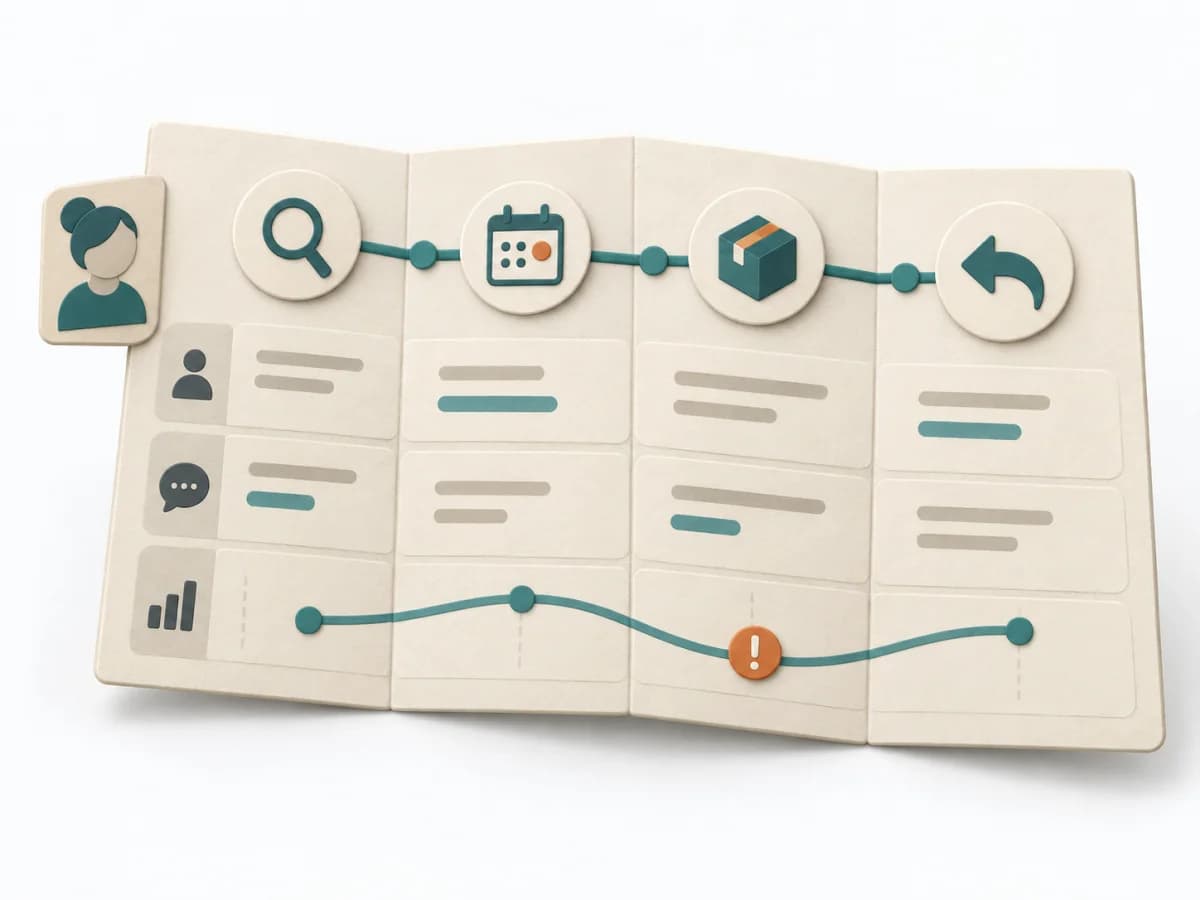
Phases with goal, actions, output and pitfall
Empathy mapping places statements, observations, and cautious assumptions in Says, Thinks, Does, and Feels. It separates evidence from interpretation and surfaces open questions.
Fictional teaching example, not research.
Four perspectives for one concrete user type.
Direct words or quotes.
"I do not know whether it worked."
Inferred thoughts must be evidenced or labelled.
Assumption: "What happens next?"
Observable behaviour.
Checks the status again.
Feeling with source and context.
A source is needed or leave it open.
Frame

Goal
Everyone shares the same user perspective.
Inputs for this step
Actions
Output
User type, situation, and purpose
Evidence, context, and source
Quality check
Does the map focus on one user type?
Pitfall
A user type is mixed with another: keep one type per map. Name one user type and situation.
Timing: 5–10 minutes
Collect evidence
Goal
Every note can be traced to evidence.
Inputs for this step
Actions
Output
Quotes, observations, and source markers
Evidence, context, and source
Quality check
Is each note linked to a source?
Pitfall
A note has no source: leave it open or mark it as an assumption. Add a source marker or label the note.
Timing: 10–20 minutes
Map perspectives
Goal
Evidence and interpretation remain distinct.
Inputs for this step
Actions
Output
Says · Thinks · Does · Feels · source
Evidence, context, and source
Quality check
Are interpretations clearly labelled?
Pitfall
Thoughts or feelings are asserted without evidence. Label the inference or leave the field open.
Timing: 10–20 minutes
Derive gaps
Goal
The map leads to testable follow-up work.
Inputs for this step
Actions
Output
Pattern · tension · research gap · next action
Evidence, context, and source
Quality check
Is every follow-up tied to a visible gap?
Pitfall
The map is treated as user truth. Record evidence status and the next validation.
Timing: 5–10 minutes
What comes out at the end
Sketch: what the artifact looks like
Empathy Map with user type, four perspectives, source markers, assumptions, and research gaps.
Record user type, situation, date, and sources for each map. New evidence creates a traceable revision instead of silently replacing prior interpretation.
Prepare the user perspective, evidence, and open interpretations for one focused empathy map.
To be confirmed
To be confirmed
Create one empathy map Time: 30–60 minutes
Complete this worksheet on paper or in your own document during the work.
Direct words or quotes.
...
Inferred thoughts must be evidenced or labelled.
...
Observable behaviour.
...
Feeling with source and context.
...
Expected artifact: User type, situation, and purpose
Evidence, context, and source
Entry:
...
Expected artifact: Quotes, observations, and source markers
Evidence, context, and source
Entry:
...
Expected artifact: Says · Thinks · Does · Feels · source
Evidence, context, and source
Entry:
...
Expected artifact: Pattern · tension · research gap · next action
Evidence, context, and source
Entry:
...
...
Method guide: https://methodatlas.meierhoff-systems.de/en/methods/empathy-mapping/run-sheet
Concrete filled scenario, fictional example
Fictional example for orientation. Counts and timings describe this case and are not universal requirements.
Concrete filled scenario, fictional example
All details are invented and are not research. The map represents a household preparing a repair.
The map proves no frequency. Alex tests in real interviews whether availability certainty affects pickup.
Recognize symptoms and steer against them
Quick overview, the full text is in the matching phase in the flow
A user type is mixed with another: keep one type per map.
Name one user type and situation.
A note has no source: leave it open or mark it as an assumption.
Add a source marker or label the note.
Thoughts or feelings are asserted without evidence.
Label the inference or leave the field open.
The map is treated as user truth.
Record evidence status and the next validation.
When to pause, resolve prerequisites, or choose another approach
Go to the profile for purpose, similar methods, and sources or continue to the next method in the catalog.