methodatlas
Session Builder

Plan my session

Plan a concrete work block with agenda, roles, preparation, and a copyable result artifact.

Method session5-20 minWorkshopEffort Heatmap

Session: Dot Estimation

The plan translates the method into a concrete facilitated work block. Your inputs flow directly into the session brief and work artifact.

Derived automatically

Method session with 3-20. The plan uses the existing method logic and the runsheet.

Runsheet
Participation logic
Team round, shared work and alignment

Use the session for shared understanding. Contributions are collected visibly, assumptions are aligned, and open differences remain traceable in the artifact.

Outcome logic
Finish artifact

The session works directly toward Effort Heatmap. After the session, the artifact should be shareable, reviewable, or reusable.

  1. 1

    0-3 min: Clarify point meaning

    3 min

    Facilitator explains: points represent one concrete dimension (effort, risk, uncertainty, not preference). Announce points per person. Clarify questions. Hint: If meaning is unclear, participants mix dimensions. It is better to run two rounds with different colors (red=risk, blue=effort) than one mixed-meaning round.

    FacilitatorEffort Heatmap
  2. 2

    3-8 min: Distribute points

    5 min

    Everyone distributes their points simultaneously and silently. Points may be stacked (multiple on one item) or spread across items depending on the rule. Hint: If someone places points before everyone else, this influences the group when everyone distributes simultaneously. For online boards: use hidden voting mode if available.

    FacilitatorRisk Signals
  3. 3

    8-13 min: Interpret heatmap

    5 min

    Order items by point count. Identify top-3 heat points and clusters. Mark items with 0 points as 'unestimated.' Hint: Top items are discussion candidates, not automatically real risks. A high point count is a signal of perception, not objective reality.

    FacilitatorDiscussion Targets
  4. 4

    13-20 min: Discuss top items

    7 min

    Briefly for each top item: who assigned points and why. Capture assumptions or concrete risks. Name follow-up action (spike, splitting, additional discovery). Hint: If discussion goes beyond 5 minutes per item, the method is over-stretched. Dot Estimation is triage, not deep analysis. Go deeper with Planning Poker or Three-Point afterward.

    OwnerEffort Heatmap
  5. 5

    Publish artifact

    10 min

    Check the artifact for completeness, define location, set version or status, and name review recipients.

    OwnerEffort Heatmap
Usable artifact

Session Brief

For invitations, boards, tickets, PR descriptions, or workshop notes.

session-brief.md

Session Brief: Dot Estimation

Goal

Artifact: Effort Heatmap

Working Question

Which items does the group indicate as especially effortful, risky, or unclear, and where are clusters or outliers that need discussion or discovery?

Context

List of items as cards or stickies; point meaning definition (for example, 'points for effort, more points = more effort'); number of points per person (typically 5-10).

Setup

  • Format: Method session
  • Duration: 5-20 min
  • Mode: Workshop
  • Participants: One facilitator who defines point meaning and evaluates heatmap; 3-20 participants with context on the items; one scribe for cluster notes and follow-up tasks.
  • Owner: One facilitator who defines point meaning and evaluates heatmap
  • Participation mode: Team round, shared work and alignment
  • Outcome logic: Finish artifact

Participation Logic

Use the session for shared understanding. Contributions are collected visibly, assumptions are aligned, and open differences remain traceable in the artifact.

Outcome Logic

The session works directly toward Effort Heatmap. After the session, the artifact should be shareable, reviewable, or reusable.

Input

Whiteboard or Miro board with all items visible; sticky dots (physical) or voting tool (Mentimeter, Miro, FigJam); point meaning definition visible on the wall; timer.

Preparation

Place items in rows or groups on the wall. Make point meaning visible as a banner: 'Place points on items you assess as [effortful/risky/unclear]'. Set points per person. Enforce silence during distribution.

Agenda

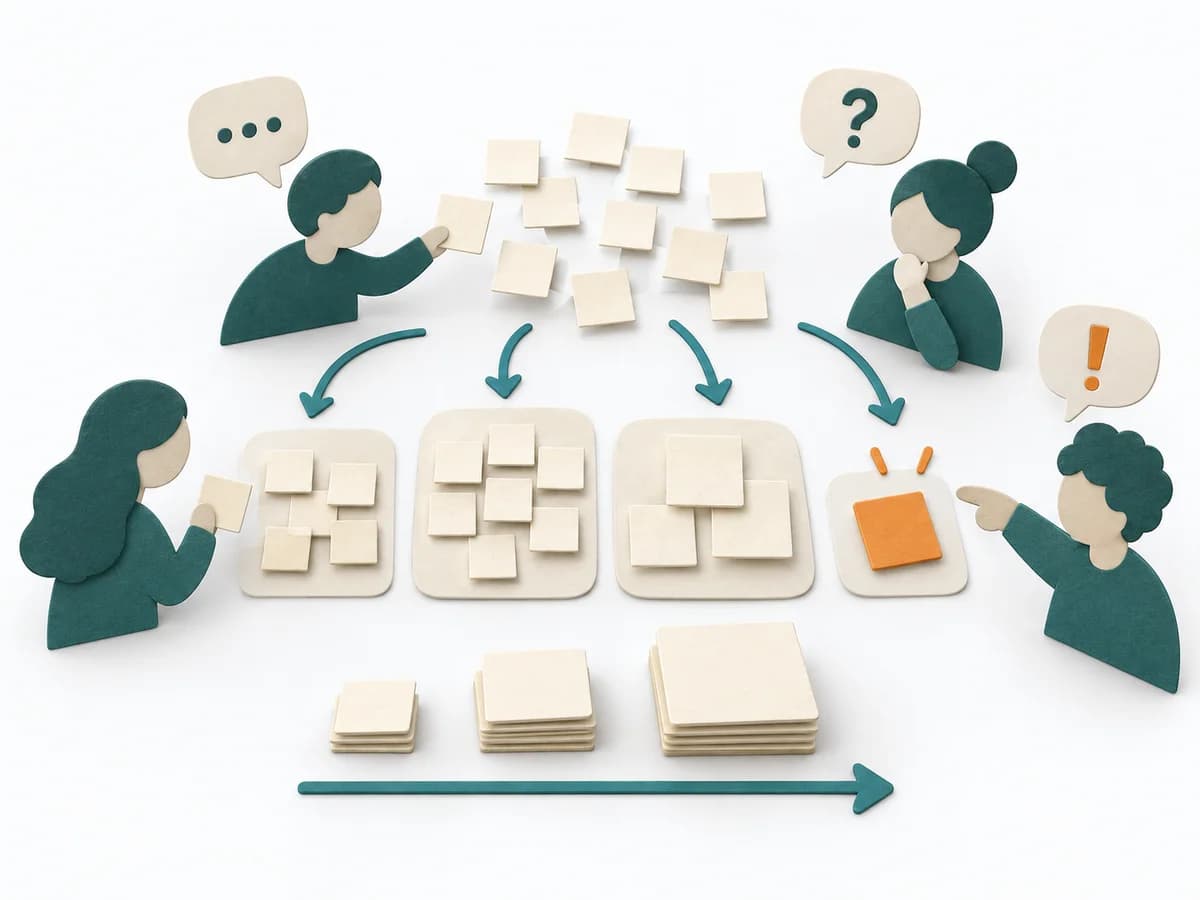
  1. 0-3 min: Clarify point meaning (3 min) Owner: Facilitator Action: Facilitator explains: points represent one concrete dimension (effort, risk, uncertainty, not preference). Announce points per person. Clarify questions. Hint: If meaning is unclear, participants mix dimensions. It is better to run two rounds with different colors (red=risk, blue=effort) than one mixed-meaning round. Output: Effort Heatmap

  2. 3-8 min: Distribute points (5 min) Owner: Facilitator Action: Everyone distributes their points simultaneously and silently. Points may be stacked (multiple on one item) or spread across items depending on the rule. Hint: If someone places points before everyone else, this influences the group when everyone distributes simultaneously. For online boards: use hidden voting mode if available. Output: Risk Signals

  3. 8-13 min: Interpret heatmap (5 min) Owner: Facilitator Action: Order items by point count. Identify top-3 heat points and clusters. Mark items with 0 points as 'unestimated.' Hint: Top items are discussion candidates, not automatically real risks. A high point count is a signal of perception, not objective reality. Output: Discussion Targets

  4. 13-20 min: Discuss top items (7 min) Owner: Owner Action: Briefly for each top item: who assigned points and why. Capture assumptions or concrete risks. Name follow-up action (spike, splitting, additional discovery). Hint: If discussion goes beyond 5 minutes per item, the method is over-stretched. Dot Estimation is triage, not deep analysis. Go deeper with Planning Poker or Three-Point afterward. Output: Effort Heatmap

  5. Publish artifact (10 min) Owner: Owner Action: Check the artifact for completeness, define location, set version or status, and name review recipients. Output: Effort Heatmap

Closeout

  • Update result artifact: Effort Heatmap
  • Define location, version, and review recipients.
  • Define owner, next step, and review date.
Usable artifact

Work artifact

Pre-filled starting point based on the matching template.

work-artifact.md

Effort Heatmap: Dot Estimation

Working Question

Which items does the group indicate as especially effortful, risky, or unclear, and where are clusters or outliers that need discussion or discovery?

Context

List of items as cards or stickies; point meaning definition (for example, 'points for effort, more points = more effort'); number of points per person (typically 5-10).

Participants

  • Owner: One facilitator who defines point meaning and evaluates heatmap
  • Participants: One facilitator who defines point meaning and evaluates heatmap; 3-20 participants with context on the items; one scribe for cluster notes and follow-up tasks.

Input

Whiteboard or Miro board with all items visible; sticky dots (physical) or voting tool (Mentimeter, Miro, FigJam); point meaning definition visible on the wall; timer.

Template

Dot Estimation Canvas

Context

What is this method used for?

Core question

Which question should be answered at the end?

Input

Which data, observations, or materials are available?

Working area

  • Area 1:
  • Area 2:
  • Area 3:
  • Relationships / patterns:

Output artifacts

  • Effort Heatmap:
  • Risk Signals:
  • Discussion Targets:

Open questions

  • ...

Next step

Owner, date, success signal.

Completion Check

  • Effort Heatmap is complete enough for review:
  • Location:
  • Version / status:
  • Review by:
  • Next step:

Next Step

  • Review result
  • Mark open questions
  • Schedule review or decision
Template base

Dot Estimation Working Template

View templateCompact working template for Dot Estimation with context, input, output artifacts, and next step.
canvas

dot-estimation-working-template.md

Compact working template for Dot Estimation with context, input, output artifacts, and next step.

Dot Estimation Canvas

Context

What is this method used for?

Core question

Which question should be answered at the end?

Input

Which data, observations, or materials are available?

Working area

  • Area 1:
  • Area 2:
  • Area 3:
  • Relationships / patterns:

Output artifacts

  • Effort Heatmap:
  • Risk Signals:
  • Discussion Targets:

Open questions

  • ...

Next step

Owner, date, success signal.

Ready to use when
  • Working question, owner, and target artifact are visible.
  • The result fits Effort Heatmap.
  • Archive heatmap as dated snapshot. For repeated triage, create a new heatmap as a new version; do not overwrite. Move follow-up actions into backlog with status.
  • Open questions are noted as follow-ups.
  • The next review or decision point is scheduled.