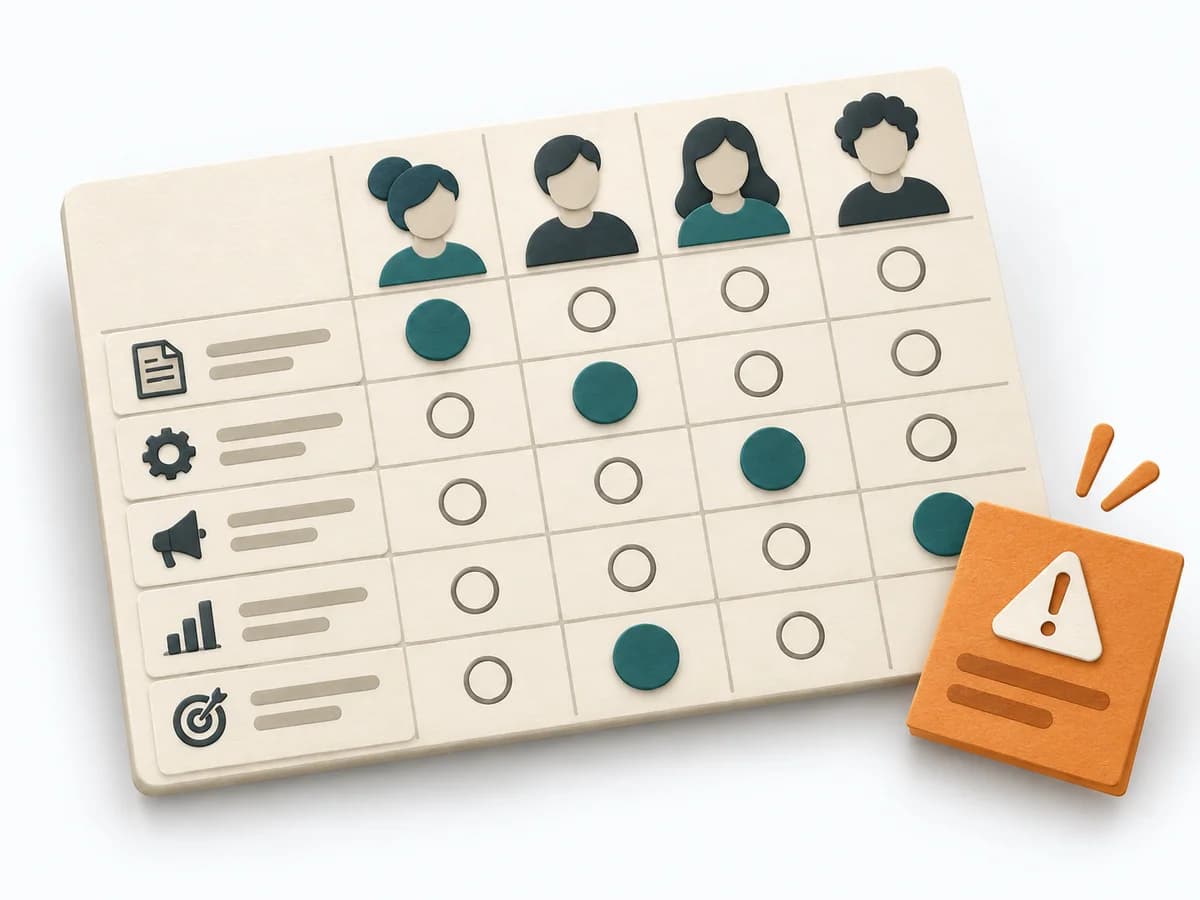
Complete firstDecision-ready scope
Core question, decision authority, and scope are clear.
Without clear scope, the result becomes an arbitrary collection without decision value.
A practical method guide: clarify prerequisites and materials, understand the complete process, and look up outputs, pitfalls, and stop criteria.
What needs to be finished first
Core question, decision authority, and scope are clear.
Affected domain and user perspectives are represented.
What needs to be ready before start
consensus workshop chart, timer, notes, and decision log.
Facilitator · diverse participants · decision/process owner
Collect existing evidence and constraints in advance.
90–150 minutes
Prepare the canonical blank structure and make timeboxes visible.
The one question this method answers
What shared picture emerges from our different answers to the focus question?
Phases with goal, actions, output and pitfall
The ToP Consensus Workshop follows context, brainstorm, cluster, name, and resolve. Consensus means a workable shared interpretation; minority concerns and open tensions are not facilitated away.
Fictional worked example
Original cards, clusters, consensus, and dissent remain traceably distinct.
Which open question is answered and how will the result be used?
What do teams need so review decisions remain usable later?
Which concrete individual responses exist?
Owner; due date; rationale; evidence link; findability.
Which cards belong together semantically and what message does the cluster carry?
Committed responsibility: owner + due date. Traceable context: rationale + evidence.
Which shared statement can the group support?
Every decision needs a responsible person, time, and verifiable context.
Which objection remains and how will it be addressed?
Due date for principle decisions open; policy owner checks by 15 October.
Consensus is a workable common ground, not forced unanimity.
Context

Goal
Produce focus frame so “What shared picture emerges from our different answers to the focus question?” can be answered with evidence.
Inputs for this step
Actions
Output
focus frame
focus frame with evidence, owner, and next decision.
Quality check
Is the question open and answerable by everyone?
Pitfall
The question leads to yes/no or contains the desired answer. Aim the question at concrete experience and open content.
Timing: 10–20 minutes
Cards
Goal
Produce response cards so “What shared picture emerges from our different answers to the focus question?” can be answered with evidence.
Inputs for this step
Actions
Output
response cards
response cards with evidence, owner, and next decision.
Quality check
Does each card contain one understandable idea?
Pitfall
Participants formulate together and lose independent perspectives. Restore silent individual work.
Timing: 10–20 minutes
Cluster
Goal
Produce meaning clusters so “What shared picture emerges from our different answers to the focus question?” can be answered with evidence.
Inputs for this step
Actions
Output
meaning clusters
meaning clusters with evidence, owner, and next decision.
Quality check
Do original cards and minority ideas remain visible?
Pitfall
Facilitator sorts alone into prefabricated categories. Have participants explain relationships and move cards.
Timing: 10–20 minutes
Naming
Goal
Produce cluster titles so “What shared picture emerges from our different answers to the focus question?” can be answered with evidence.
Inputs for this step
Actions
Output
cluster titles
cluster titles with evidence, owner, and next decision.
Quality check
Does the title express shared meaning rather than a generic category?
Pitfall
Titles such as process or communication say nothing. State a verb plus domain message.
Timing: 10–20 minutes
Resolve
Goal
Produce consensus picture so “What shared picture emerges from our different answers to the focus question?” can be answered with evidence.
Inputs for this step
Actions
Output
consensus picture
consensus picture with evidence, owner, and next decision.
Quality check
Can everyone work with the result despite recorded dissent?
Pitfall
Silence is interpreted as agreement. Run an explicit agreement round and record objections.
Timing: 10–20 minutes
What comes out at the end
Sketch: what the artifact looks like
Versioned consensus workshop chart with sources, assumptions, and next step.
Retain date, scope, sources, assumptions, and decision for each version.
Plan the session around the canonical method steps and a concrete decision.
To be confirmed
To be confirmed
Full session Time: 90–150 minutes
Complete this worksheet on paper or in your own document during the work.
Which open question is answered and how will the result be used?
...
Which concrete individual responses exist?
...
Which cards belong together semantically and what message does the cluster carry?
...
Which shared statement can the group support?
...
Which objection remains and how will it be addressed?
...
Retain original cards and record objections faithfully and factually.
ICA International: Technology of Participation
Expected artifact: focus frame
focus frame with evidence, owner, and next decision.
Entry:
...
Expected artifact: response cards
response cards with evidence, owner, and next decision.
Entry:
...
Expected artifact: meaning clusters
meaning clusters with evidence, owner, and next decision.
Entry:
...
Expected artifact: cluster titles
cluster titles with evidence, owner, and next decision.
Entry:
...
Expected artifact: consensus picture
consensus picture with evidence, owner, and next decision.
Entry:
...
...
Method guide: https://methodatlas.meierhoff-systems.de/en/methods/consensus-workshop/run-sheet
Concrete filled scenario, fictional example
Fictional example for orientation. Counts and timings describe this case and are not universal requirements.
Concrete filled scenario, fictional example
Fictional focus question: what do teams need so review decisions remain usable later? Cards name owner, evidence link, rationale, due date, and findability. Cluster 'Committed responsibility' contains owner and due date; 'Traceable context' contains rationale and evidence. Consensus statement: every decision needs a responsible person, time, and verifiable context. Dissent: mandatory due dates for pure principle decisions remain open.
Recognize symptoms and steer against them
Quick overview, the full text is in the matching phase in the flow
The question leads to yes/no or contains the desired answer.
Aim the question at concrete experience and open content.
Participants formulate together and lose independent perspectives.
Restore silent individual work.
Facilitator sorts alone into prefabricated categories.
Have participants explain relationships and move cards.
Titles such as process or communication say nothing.
State a verb plus domain message.
Silence is interpreted as agreement.
Run an explicit agreement round and record objections.
When to pause, resolve prerequisites, or choose another approach
Go to the profile for purpose, similar methods, and sources or continue to the next method in the catalog.