methodatlas
Session Builder

Establish practice

Define cadence, owner, participation, and success signals for a recurring team practice.

Practice CharterweeklyOperating practice

Establish the practice

Define cadence, owner, participation, and success signals so the method works as a recurring team practice.

Derived automatically

Variant for Operating practice. The plan is derived from method form, method steps, and runsheet.

Runsheet
Cadence logic
Rhythm before scope

An operating practice works through repetition. The cadence should be small enough to hold reliably.

Iteration flow
One run, reusable each time

The steps describe one repetition and are adjusted after review.

  1. 1

    Phase 1: Consolidate data

    30-45 min

    Enter cycle time, WIP before the step, waiting time, and throughput per process step. Document the data source and period. Mark gaps.

    OwnerIf data gaps exceed 30 percent, do data collection first. Estimates are a fallback, not the basis. Define a collection plan with owner for each gap.
  2. 2

    Phase 2: Identify the bottleneck

    30-45 min

    Find the step with the highest WIP before it and throughput below demand. If several candidates exist, use Little's Law as a test. Agree on one bottleneck.

    TeamA common mistake is to identify the bottleneck by feeling. Data first. If data suggest multiple bottlenecks, plan two iterations instead of attacking both at once.
  3. 3

    Phase 3: Clarify bottleneck character

    30-45 min

    Classify the bottleneck type: capacity (people, machine), variability (swings break flow), quality (returns), policy (rule that limits throughput). Base the classification on evidence.

    TeamThe bottleneck type determines the measures. A capacity bottleneck needs elevation, a variability bottleneck needs buffering, and a policy bottleneck needs a rule change.
  4. 4

    Phase 4: Develop measures

    45-60 min

    Create suitable measures for each bottleneck type. Order: utilization (no interruptions), subordination (adapt the rest to the bottleneck), elevation (increase capacity). Assign owner and date to each measure.

    TeamElevation is the most expensive level. Anyone who hires people immediately without checking phases 2 and 3 is optimizing locally and spending budget unnecessarily. Keep the order.
  5. 5

    Phase 5: Impact review

    30 min, after 2-4 weeks

    Measure again: has the bottleneck been relieved, moved, or stayed the same. If it moved, identify the new bottleneck and start the next iteration. If it stayed, review the measures.

    TeamBottleneck movement is success. Anyone who treats the same bottleneck for 3 months has either not implemented the measure or is dealing with a structural, not operational, bottleneck.
Usable artifact

Practice Charter

Copyable charter with purpose, cadence, owner, participation, flow, success signals, and review.

practice-charter.md

Practice Charter: Bottleneck Analysis

Purpose

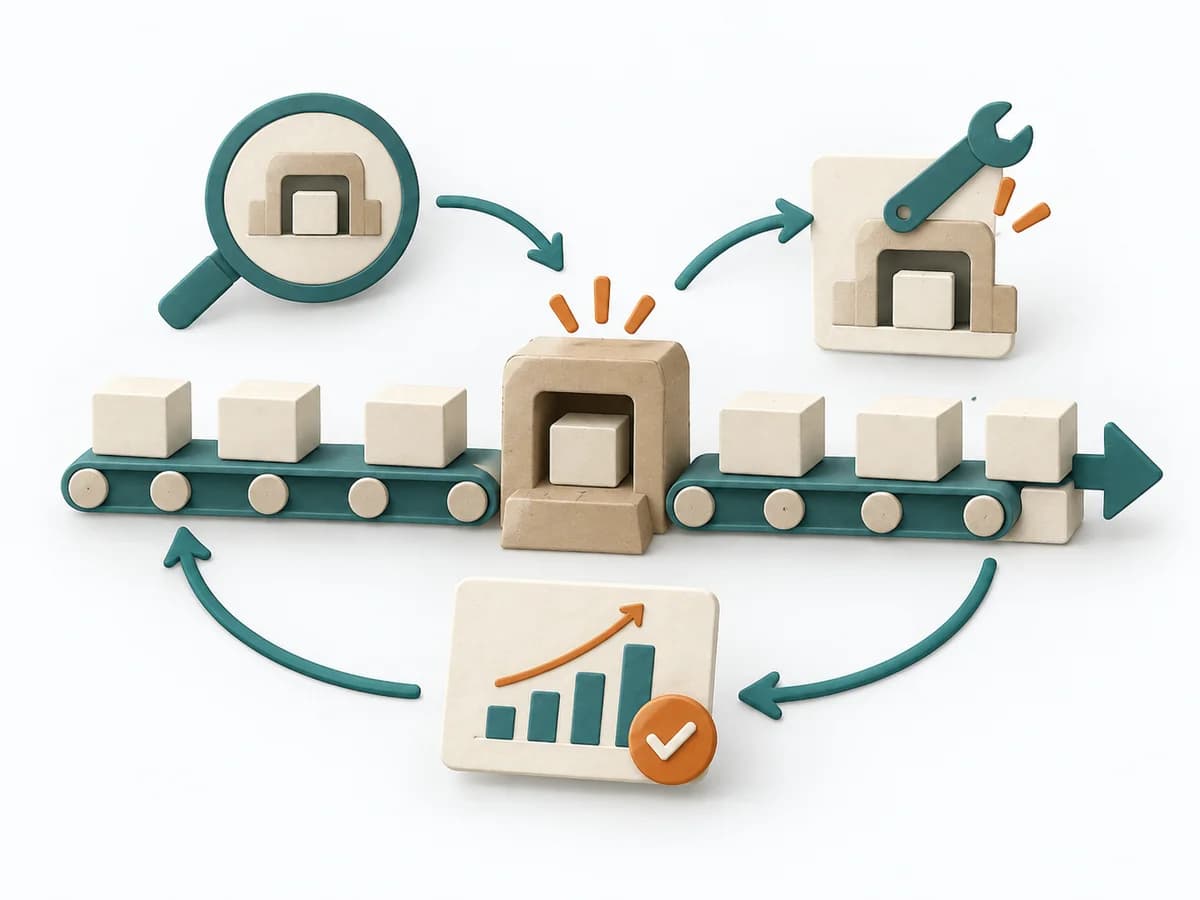
The method helps clarify workflows, data, causes, and improvements in a concrete way. It looks for patterns, causes, weak spots, or bottlenecks and derives actions. The result is captured as a bottleneck map, flow metrics, and improvement options.

Cadence

weekly

Owner and Participation

  • Owner: open
  • Participants: 3-8
  • Mode: synchronous

Flow per Iteration

  1. Phase 1: Consolidate data (30-45 min) Enter cycle time, WIP before the step, waiting time, and throughput per process step. Document the data source and period. Mark gaps.
  2. Phase 2: Identify the bottleneck (30-45 min) Find the step with the highest WIP before it and throughput below demand. If several candidates exist, use Little's Law as a test. Agree on one bottleneck.
  3. Phase 3: Clarify bottleneck character (30-45 min) Classify the bottleneck type: capacity (people, machine), variability (swings break flow), quality (returns), policy (rule that limits throughput). Base the classification on evidence.
  4. Phase 4: Develop measures (45-60 min) Create suitable measures for each bottleneck type. Order: utilization (no interruptions), subordination (adapt the rest to the bottleneck), elevation (increase capacity). Assign owner and date to each measure.
  5. Phase 5: Impact review (30 min, after 2-4 weeks) Measure again: has the bottleneck been relieved, moved, or stayed the same. If it moved, identify the new bottleneck and start the next iteration. If it stayed, review the measures.

Success Signals

Bottleneck Map, Flow Metrics, Improvement Options, Follow-up Measures

Review

4 weeks