View methods side by side.
Choose up to four methods. Add them using the search and share the comparison by copying its link.
| Criterion | 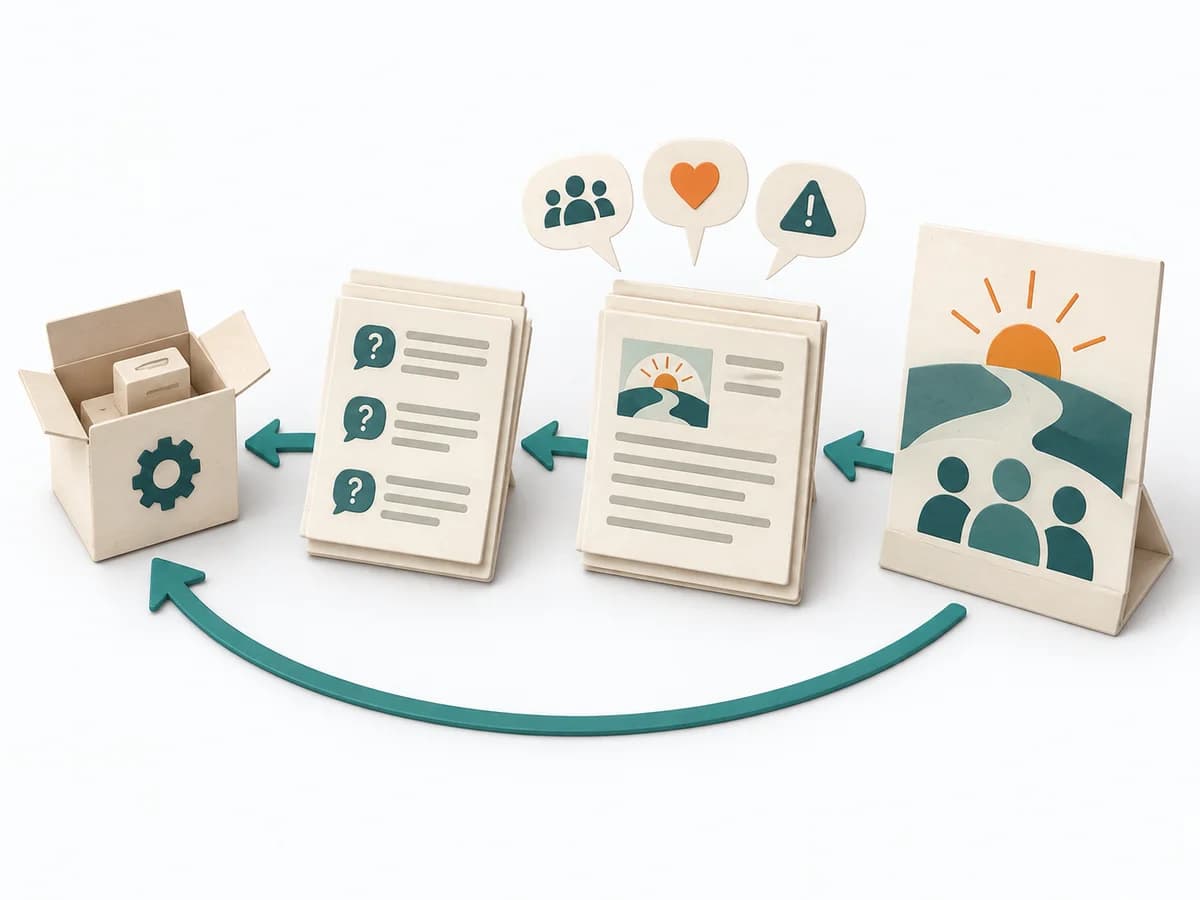 Product Discovery Working Backwards |  Decision Making Decision Rights Mapping |  Operations Kepner-Tregoe |  Operations 5 Whys |
|---|---|---|---|---|
Purposedifferent | When the target state and benefit need to be clear first, it thinks backward from the desired outcome into the product logic. It sharpens vision, objections, and value proposition before elaboration. | In organizations with many stakeholders, it often blurs who actually decides and who is merely consulted. It separates options, evaluation criteria, and open risks. The result is captured as a Decision Rights matrix and an agreement. | For a disturbance that's hard to pin down, the method cleanly separates problem, cause, and decision. It reduces mixing when symptoms allow several interpretations. | For a single, hard-to-explain deviation, the method exposes the causal chain behind the visible symptom. It keeps the cause open until a controllable condition emerges instead of a mere description. |
Complexitydifferent | Medium | Medium | High | Low |
Timedifferent | 4-8 h, mehrere Iterationen | 90-180 min | 2-8 h | 15-30 min |
Participantsdifferent | 2-6 | 4-12 | 2-8 | 2-6 |
Formatdifferent | Workshop + async | Workshop | Workshop + async | Workshop |
Outputdifferent | Future Press Release, FAQ, Vision Statement | Decision Rights Matrix, Agreement | Problem Analysis, Decision Analysis, Risk Plan | Root cause notes, Countermeasures |
Tagsno overlap | VisionNarrativeAlignment | DecisionGovernanceAlignmentResponsibility | Problem solvingRoot causeDecisionOperations | Root causeIncidentLeanProblem solving |