View methods side by side.
Choose up to four methods. Add them using the search and share the comparison by copying its link.
| Criterion | 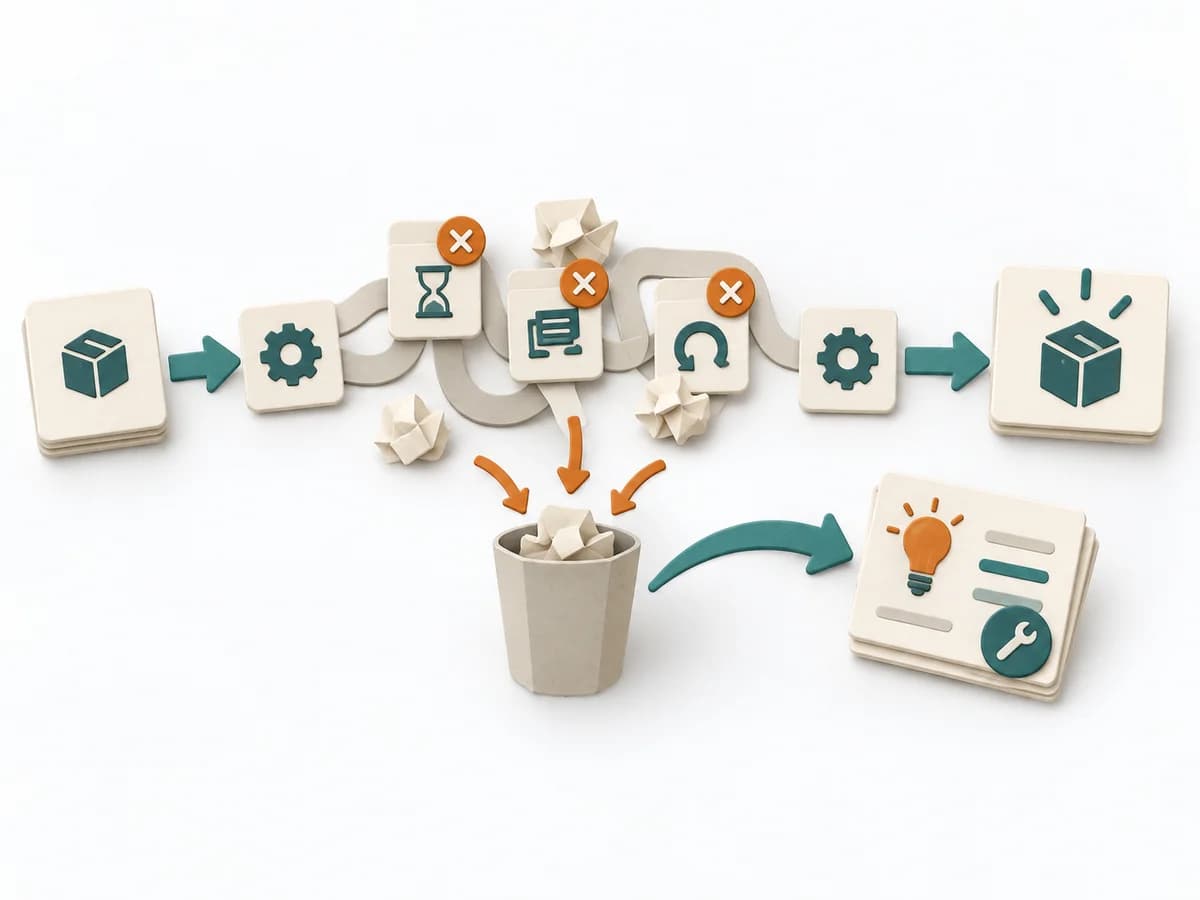 Operations Waste Analysis |  Decision Making Delphi Method |  Domain Modeling Bounded Context Canvas |  Product Strategy DIBB |
|---|---|---|---|---|
Purposedifferent | For a process that keeps people busy but creates little value, the method exposes waste. It directs attention to unnecessary movement, waiting times, rework, and overdelivery. | When knowledge is distributed and direct dominance should be avoided, groups quickly fall under the sway of their opinion leaders. The Delphi Method gathers assessments iteratively and gradually brings expert judgments closer together. | When a business context is still loosely outlined, it shapes language, responsibility, and integration space. It clarifies what belongs together and where a boundary needs to hold. | DIBB helps clarify target groups, value, goals, and priorities by making the logic behind a decision explicit. It captures results as a DIBB document, belief list, bet list, and learning report. |
Complexitydifferent | Low | High | Medium | Low |
Timedifferent | 45-120 min | 1-4 Wochen | 1-3 h | 1-2 h |
Participantsdifferent | 2-8 | 6-30 Experten | 3-8 | 2-8 |
Formatdifferent | Workshop | Async | Workshop + async | Workshop + async |
Outputdifferent | Waste Map, Prioritized Waste, Improvement Backlog | Expert Forecast, Consensus Range, Assumption Notes | Context Canvas, Glossary, Integration Notes | DIBB document, Belief list, Bet list, Learning report |
Tagsno overlap | WasteLeanProcess improvement | ForecastingExpertsDecisionStrategy | Domain-Driven DesignBoundariesModeling | StrategyDecisionAssumptionsHypothesis |