View methods side by side.
Choose up to four methods. Add them using the search and share the comparison by copying its link.
| Criterion | 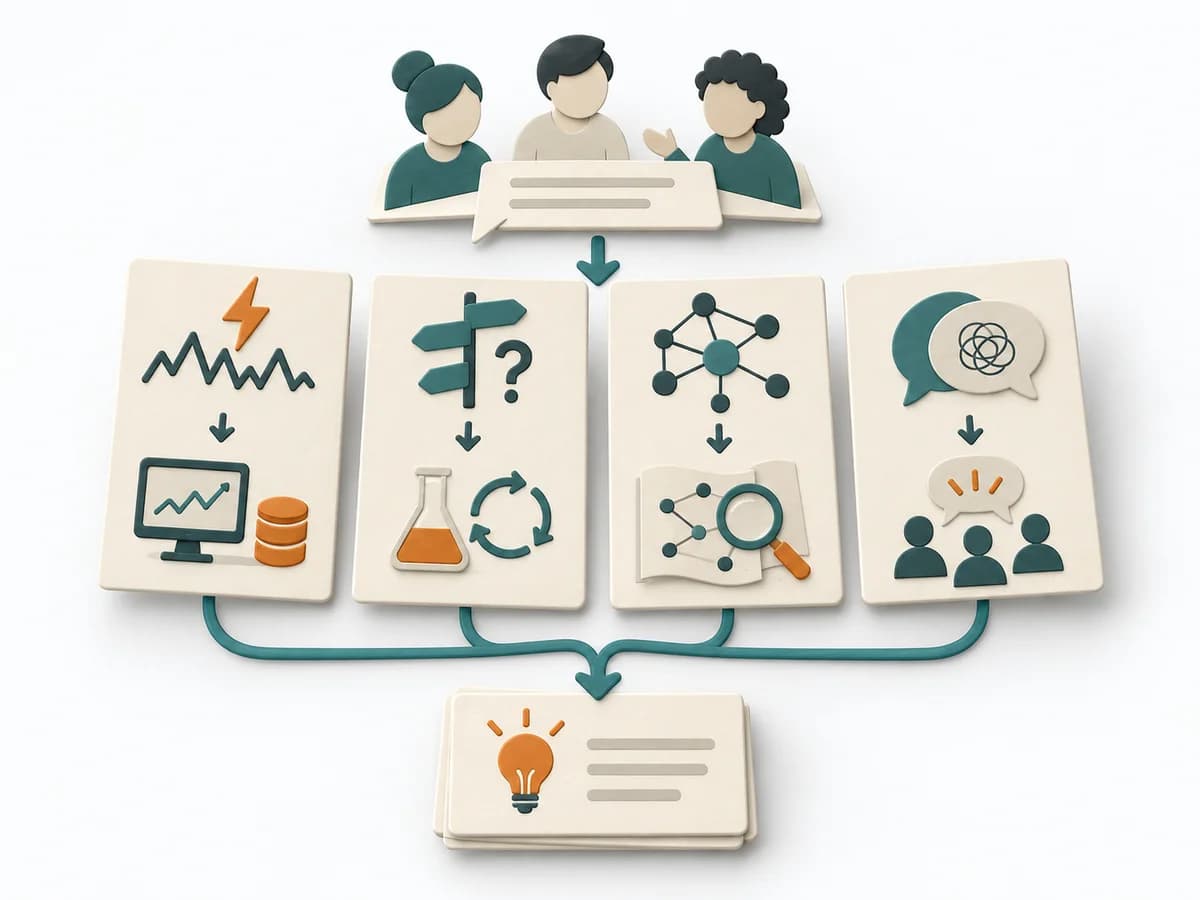 Systems Thinking VUCA Scan |  Decision Making Pre-Mortem |  Decision Making Argument Mapping |  Decision Making Assumption Surfacing |
|---|---|---|---|---|
Purposedifferent | The VUCA Scan helps read difficult situations more precisely. Instead of treating unclarity as generally complicated, the method separates fast change, missing knowledge, systemic entanglement, and ambiguous interpretation. | In early initiatives with many uncertainties, planning quickly turns too optimistic. A pre-mortem makes the expected failure visible in advance and sharpens the view of causes, gaps, and countermeasures. | When statements, evidence, and counterarguments get mixed up, a debate quickly loses its structure. Argument Mapping breaks a thesis down into its reasoning and makes visible what it really rests on. | Plans often contain assumptions that were never openly stated and remain dangerous precisely because of that. Assumption Surfacing makes these silent premises visible and prioritizes which of them carry the initiative or could sink it. |
Complexitydifferent | Low | Low | Medium | Low |
Timedifferent | 30-90 min | 20–45 min | 1-3 h | 45-90 min |
Participantsdifferent | 1-10 | Small cross-functional group | 1-8 | 2-8 |
Formatdifferent | Workshop + async | Workshop | Workshop + async | Workshop + async |
Outputdifferent | VUCA Map, Response Options, Signal and Learning Plan | Risk list, Mitigation plan, Assumption log | Argument Map, Evidence Gaps, Decision Rationale | Assumption List, Critical Assumptions, Learning Plan |
Tagsno overlap | SensemakingUncertaintyComplexityStrategyForesight | RiskDecisionFailurePlanning | SensemakingDecisionRationale | AssumptionsRiskDecisionDiscovery |