View methods side by side.
Choose up to four methods. Add them using the search and share the comparison by copying its link.
| Criterion | 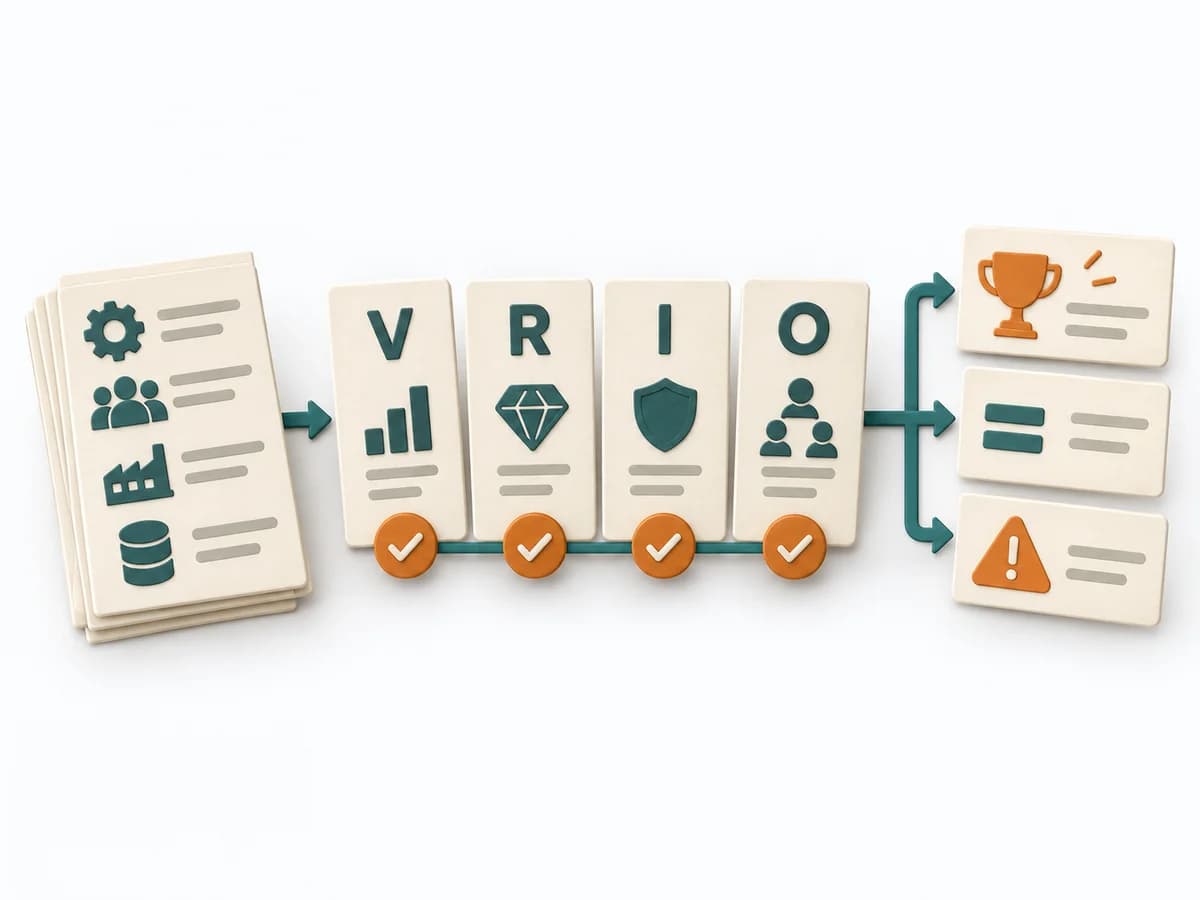 Business Strategy VRIO Framework |  Product Strategy Lean Canvas |  Facilitation Power Interest Grid |  Facilitation Stakeholder Salience Model |
|---|---|---|---|---|
Purposedifferent | The VRIO Framework rates resources and capabilities on whether they are Valuable, Rare, Inimitable, and Organized. It compares strengths, risks, market logic, and courses of action. The result is captured as a VRIO table and strategic actions. | When an early product bet still has too many open points, it brings target group, problem, and assumptions into a single view. It condenses the idea so core risks become nameable. | When many stakeholders compete for attention at once, the Power Interest Grid sorts them by influence and stake. It turns individual contributions into a visible selection. The result is captured as a Power Interest Grid and a stakeholder-specific strategy. | When stakeholders appear to matter very differently, the Stakeholder Salience Model rates their actual priority through power, legitimacy, and urgency. It turns individual contributions into a visible selection. The result is captured as a Salience diagram and a class-based strategy. |
Complexitydifferent | Medium | Medium | Low | Medium |
Timedifferent | 90-180 min | 45-90 min | 30-60 min | 60-90 min |
Participantsdifferent | 3-6 | 1-6 | 2-8 | 3-6 |
Formatdifferent | Workshop | Workshop + async | Workshop | Workshop |
Outputdifferent | VRIO Table, Strategic Actions | Lean Canvas, Core Assumptions, Experiment Backlog | Power Interest Grid, Strategy per Stakeholder | Salience Diagram, Strategy per Class |
Tagsno overlap | StrategyDiagnosisBusiness modelCapability | StartupLeanAssumptionsBusiness model | StakeholdersFacilitationAlignmentPlanning | StakeholdersFacilitationAlignmentGovernance |