View methods side by side.
Choose up to four methods. Add them using the search and share the comparison by copying its link.
| Criterion | 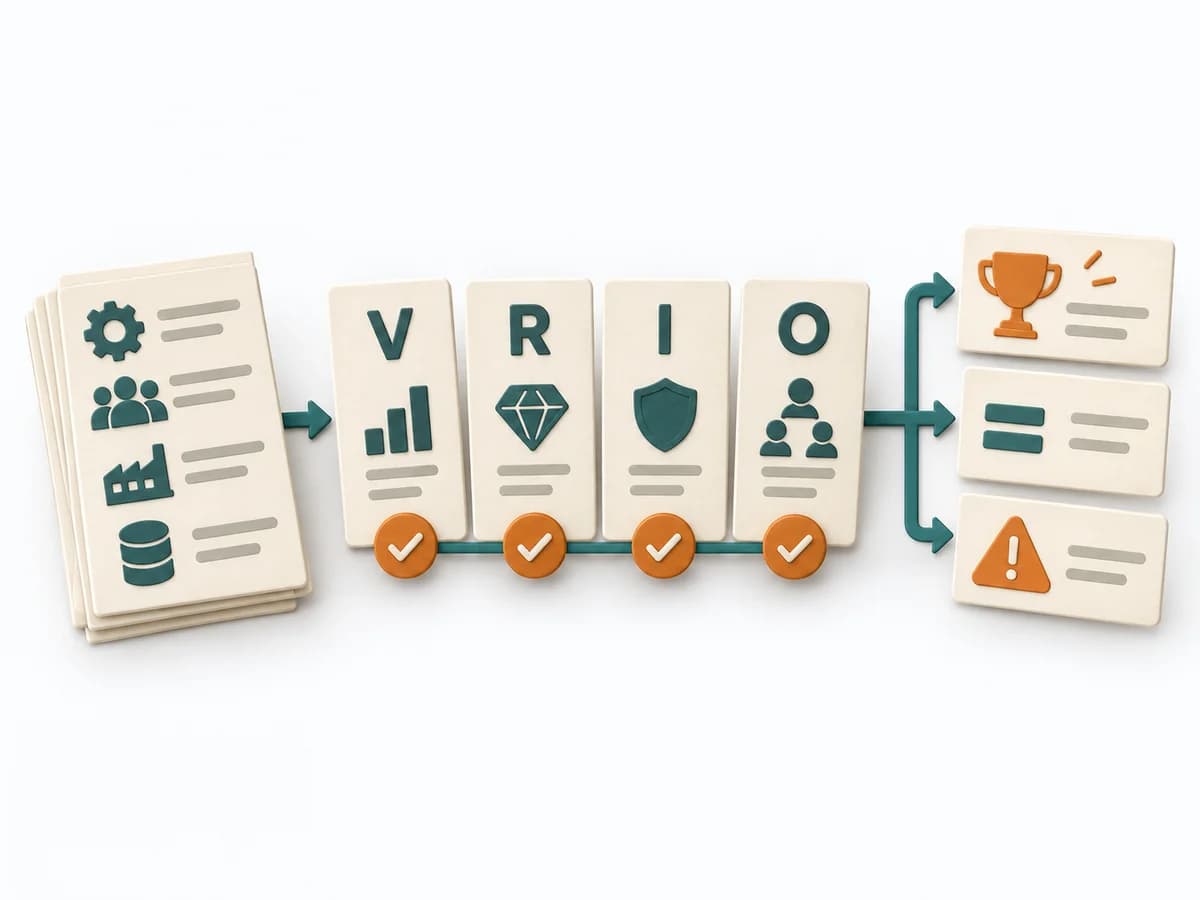 Business Strategy VRIO Framework |  Domain Modeling Context Map |  Facilitation Stakeholder Salience Model |  Business Strategy Business Model Stress Test |
|---|---|---|---|---|
Purposedifferent | The VRIO Framework rates resources and capabilities on whether they are Valuable, Rare, Inimitable, and Organized. It compares strengths, risks, market logic, and courses of action. The result is captured as a VRIO table and strategic actions. | When several contexts need to talk to each other, it makes their relationships and dependencies legible. It helps sort integration pressure and responsibilities across system boundaries. | When stakeholders appear to matter very differently, the Stakeholder Salience Model rates their actual priority through power, legitimacy, and urgency. It turns individual contributions into a visible selection. The result is captured as a Salience diagram and a class-based strategy. | A Business Model Stress Test checks how well a business model holds up under pressure and headwinds. It compares strengths, risks, market logic, and courses of action. The result is captured as a stress-test report and action plan per scenario. |
Complexitydifferent | Medium | Medium | Medium | High |
Timedifferent | 90-180 min | 1-3 h | 60-90 min | Half day |
Participantsdifferent | 3-6 | 2-8 | 3-6 | 3-8 |
Formatdifferent | Workshop | Workshop + async | Workshop | Workshop |
Outputdifferent | VRIO Table, Strategic Actions | Context Map, Integration Patterns, Boundary Notes | Salience Diagram, Strategy per Class | Stress Test Report, Action Plan per Scenario |
Tagsno overlap | StrategyDiagnosisBusiness modelCapability | Domain-Driven DesignBoundariesStrategy | StakeholdersFacilitationAlignmentGovernance | StrategyBusiness modelRiskDiagnosis |