View methods side by side.
Choose up to four methods. Add them using the search and share the comparison by copying its link.
| Criterion | 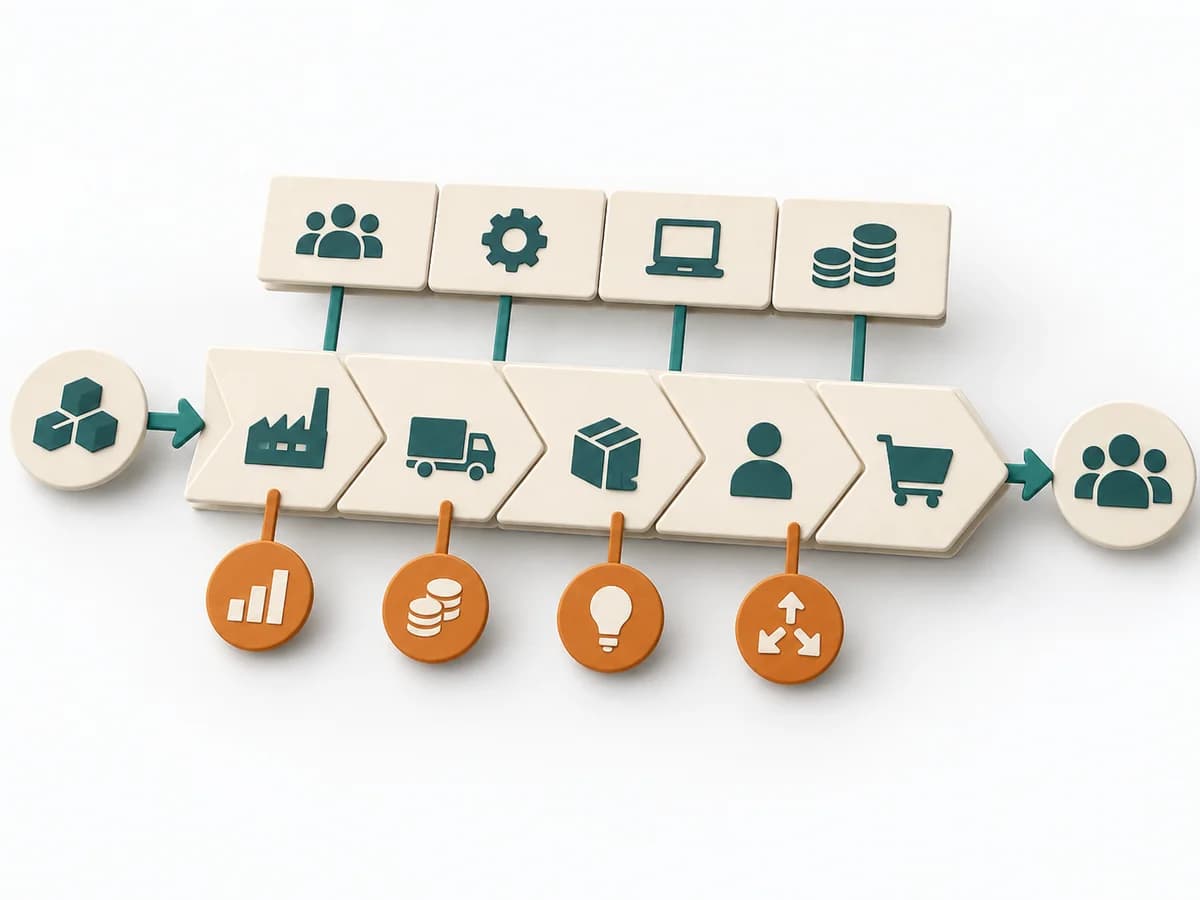 Business Strategy Value Chain Analysis |  Decision Making RAPID |  Facilitation Stakeholder Salience Model |  Decision Making Decision Rights Mapping |
|---|---|---|---|---|
Purposedifferent | Value Chain Analysis shows where value is created, costs accrue, and differentiation becomes possible along the process. It compares strengths, risks, market logic, and courses of action. The result is captured as a value-chain map and lever list. | In complex management decisions, clarity is often missing about who recommends, who agrees, and who makes the decision. RAPID creates this assignment and stabilizes decisions across several levels. | When stakeholders appear to matter very differently, the Stakeholder Salience Model rates their actual priority through power, legitimacy, and urgency. It turns individual contributions into a visible selection. The result is captured as a Salience diagram and a class-based strategy. | In organizations with many stakeholders, it often blurs who actually decides and who is merely consulted. It separates options, evaluation criteria, and open risks. The result is captured as a Decision Rights matrix and an agreement. |
Complexitydifferent | High | Medium | Medium | Medium |
Timedifferent | Half day | 45-90 min | 60-90 min | 90-180 min |
Participantsdifferent | 3-8 | 3-12 | 3-6 | 4-12 |
Formatdifferent | Workshop | Workshop + async | Workshop | Workshop |
Outputdifferent | Value Chain Map, Lever List | RAPID Role Map, Recommendation, Decision Log | Salience Diagram, Strategy per Class | Decision Rights Matrix, Agreement |
Tagsno overlap | StrategyBusiness modelDiagnosisAnalysis | DecisionRolesGovernance | StakeholdersFacilitationAlignmentGovernance | DecisionGovernanceAlignmentResponsibility |