View methods side by side.
Choose up to four methods. Add them using the search and share the comparison by copying its link.
Selected:Value Chain AnalysisFault IsolationSAAM (Software Architecture Analysis Method)ARID (Active Reviews for Intermediate Designs)
| Criterion |  Business Strategy Value Chain Analysis | 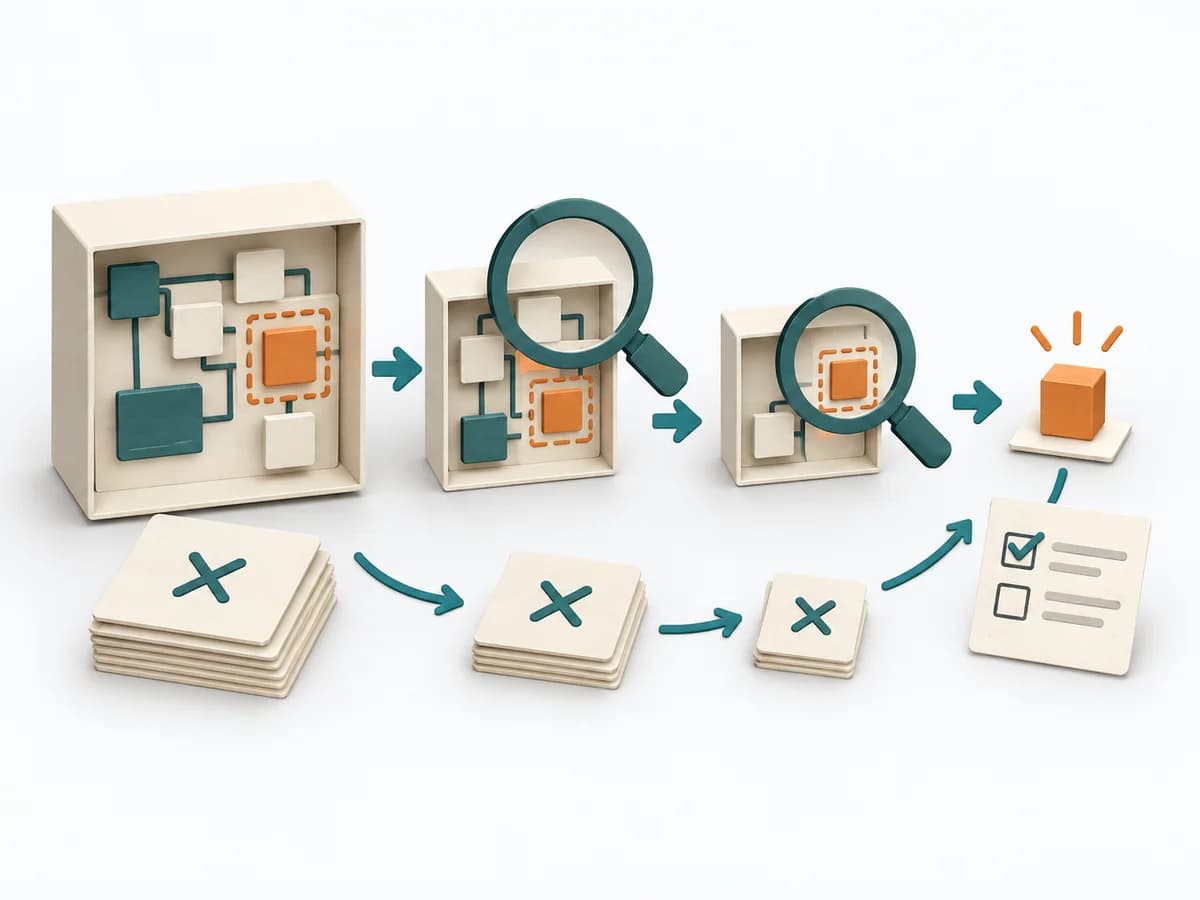 Engineering Fault Isolation |  Architecture SAAM (Software Architecture Analysis Method) |  Architecture ARID (Active Reviews for Intermediate Designs) |
|---|---|---|---|---|
Purposedifferent | Value Chain Analysis shows where value is created, costs accrue, and differentiation becomes possible along the process. It compares strengths, risks, market logic, and courses of action. The result is captured as a value-chain map and lever list. | In technical failures, the visible symptom often gets mixed up with the actual cause. Fault Isolation narrows the fault space and progressively reduces which part of the system is truly affected. | SAAM helps teams judge an architecture’s suitability for selected tasks and changes. It is particularly useful for examining modifiability and comparing architecture alternatives with clear reasoning. | ARID examines how well developers can work with a technical design. It focuses on a part of the system that can still be revised, between the architecture overview and the detailed specification. |
Complexitydifferent | High | Medium | High | Medium |
Timedifferent | Half day | 30-180 min | Preparation, scenario analysis, and findings review; effort depends on scope | 2–4 h review as a planning range; preparation and evaluation additional |
Participantsdifferent | 3-8 | 1-6 | Architecture experts and stakeholders for scenarios and weighting | Designers, developers as users, and facilitation |
Formatdifferent | Workshop | Workshop + async | Workshop + async | Workshop + async |
Outputdifferent | Value Chain Map, Lever List | Fault Isolation Map, Test Log, Excluded Hypotheses, Narrowed Fault Area | Domain functions mapped to components and connections, Quality attributes and evaluation criteria, Typical tasks and their effects on the architecture, Reasoned evaluation or comparison of alternatives | Prioritized development tasks, Jointly produced code or pseudocode, Observed difficulties and open design questions, Proposed design revisions |
Tagsno overlap | StrategyBusiness modelDiagnosisAnalysis | TroubleshootingDiagnosisEngineering | ArchitectureChangeAnalysisComparisonQuality | ArchitectureEngineeringFeedbackValidationTasks |