View methods side by side.
Choose up to four methods. Add them using the search and share the comparison by copying its link.
| Criterion |  UX Research User Interviews |  Systems Thinking Leverage Points |  Product Discovery Assumption Mapping | 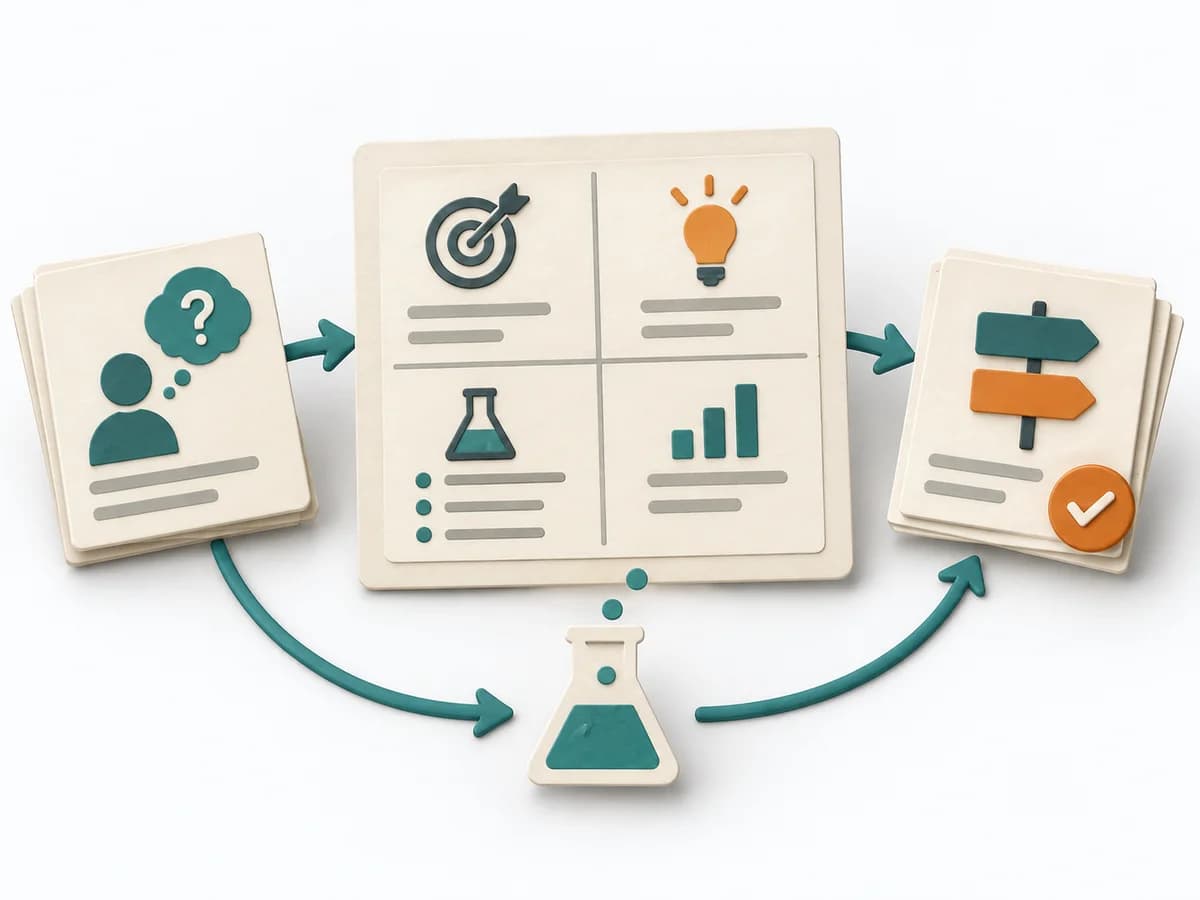 Product Discovery Experiment Canvas |
|---|---|---|---|---|
Purposedifferent | When teams derive needs only from assumptions and real motives are missing, user interviews give direct access to behavior and meaning. Conversations from the target group's everyday life make patterns, tensions, and open questions solidly visible. | Leverage Points show exactly where interventions in a system produce a disproportionate effect. It draws relationships, patterns, and feedback loops. The result is captured as a leverage map and action strategy. | When assumptions still sit unordered in the room, it weighs uncertainty against leverage. It makes visible which hypotheses should be checked first. | When experiments become unreadable after the fact, it arranges hypothesis, signal, and learning goal on a single canvas. It separates problem, assumption, solution, and evidence. The result is captured as a Completed Experiment Canvas and a Success Metric. |
Complexitydifferent | Low | High | Medium | Low |
Timedifferent | 30–60 min per interview | Half day | 45-60 min | 30-60 min |
Participantsdifferent | 1 participant per interview | 3-12 | 2-8 | 1-5 |
Formatdifferent | Workshop + async | Workshop | Workshop + async | Workshop + async |
Outputdifferent | Interview Notes, Themes, Insight Summary | Leverage Map, Action Strategy | Assumption map, Test backlog, Risk ranking | Completed Experiment Canvas, Success Metric |
Tagsno overlap | QualitativeResearchCustomerDiscovery | Systems thinkingChangeStrategy | AssumptionsRiskExperimentsValidation | ExperimentsValidationDiscoveryHypothesis |