View methods side by side.
Choose up to four methods. Add them using the search and share the comparison by copying its link.
| Criterion |  UX Research User Interviews |  Product Strategy DIBB |  Decision Making Risk Matrix | 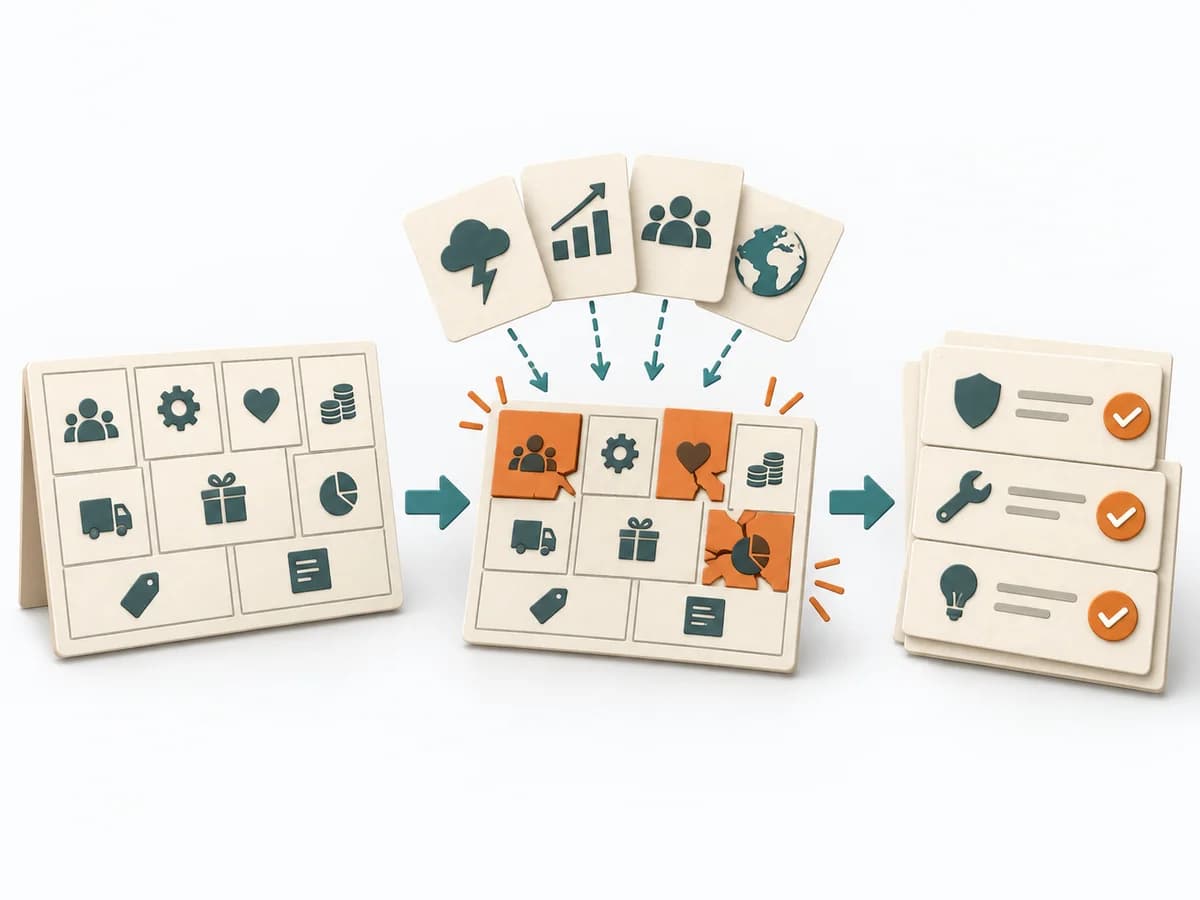 Business Strategy Business Model Stress Test |
|---|---|---|---|---|
Purposedifferent | When teams derive needs only from assumptions and real motives are missing, user interviews give direct access to behavior and meaning. Conversations from the target group's everyday life make patterns, tensions, and open questions solidly visible. | DIBB helps clarify target groups, value, goals, and priorities by making the logic behind a decision explicit. It captures results as a DIBB document, belief list, bet list, and learning report. | When a project faces many possible disruptions, it quickly becomes unclear which risks deserve attention first. It separates options, evaluation criteria, and open risks. The result is captured as a Risk Matrix and a Top Risk List. | A Business Model Stress Test checks how well a business model holds up under pressure and headwinds. It compares strengths, risks, market logic, and courses of action. The result is captured as a stress-test report and action plan per scenario. |
Complexitydifferent | Low | Low | Low | High |
Timedifferent | 30–60 min per interview | 1-2 h | 30-60 min | Half day |
Participantsdifferent | 1 participant per interview | 2-8 | 3-10 | 3-8 |
Formatdifferent | Workshop + async | Workshop + async | Workshop + async | Workshop |
Outputdifferent | Interview Notes, Themes, Insight Summary | DIBB document, Belief list, Bet list, Learning report | Risk Matrix, Top Risk List | Stress Test Report, Action Plan per Scenario |
Tagsno overlap | QualitativeResearchCustomerDiscovery | StrategyDecisionAssumptionsHypothesis | RiskDecisionPrioritizationAssessment | StrategyBusiness modelRiskDiagnosis |