View methods side by side.
Choose up to four methods. Add them using the search and share the comparison by copying its link.
| Criterion | 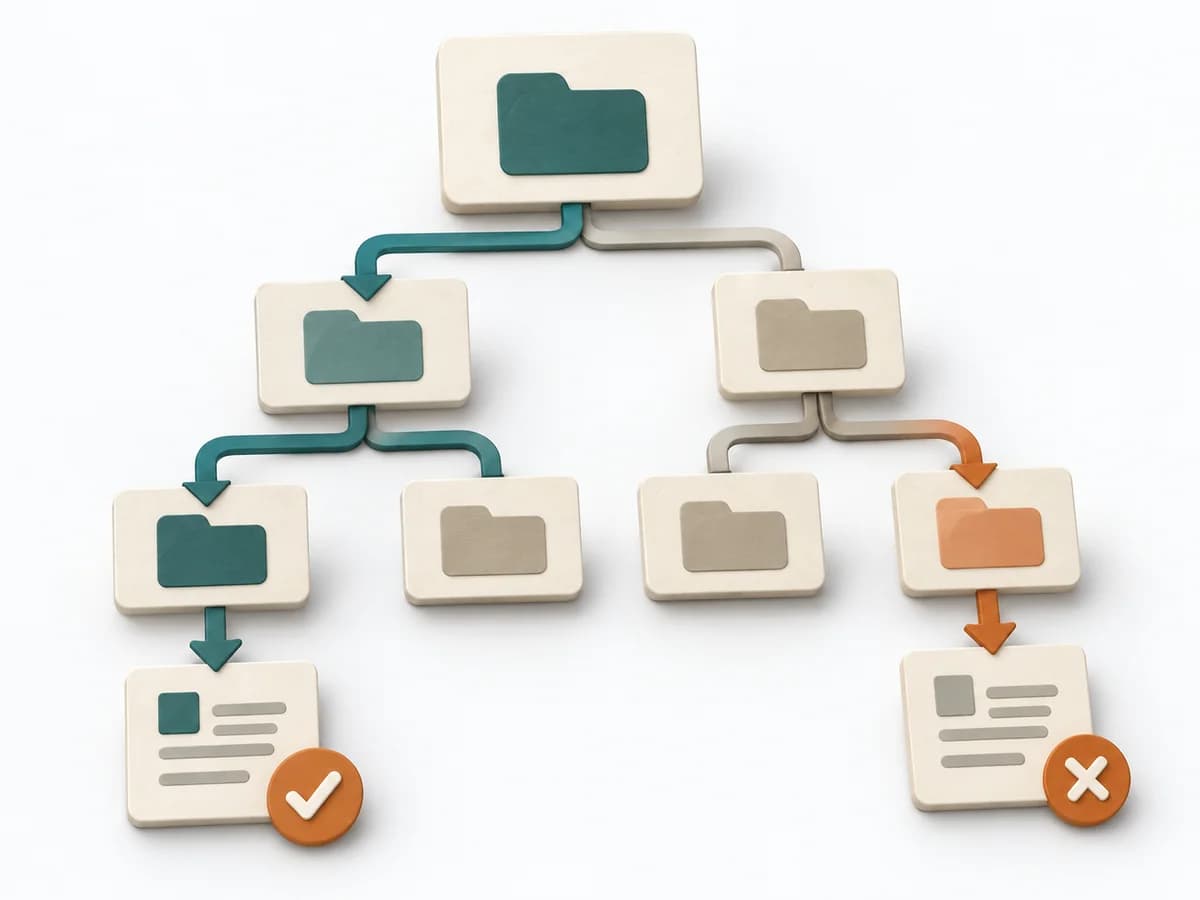 UX Research Tree Testing |  UX Research First-click Testing |  Decision Making OODA Loop |  Product Strategy DIBB |
|---|---|---|---|---|
Purposedifferent | When a navigation exists but search paths still fail, tree testing checks findability without visual distraction. The method shows whether labels, levels, and paths really lead to the intended destination. | When users immediately turn the wrong way on a screen or wireframe, first click testing checks initial orientation at high speed. The first click shows early whether expectation, labeling, and wayfinding fit together. | In dynamic situations, decisions become outdated faster than they can be prepared. The OODA Loop holds observing, orienting, deciding, and acting together as a recurring rhythm so reaction does not slide into inertia. | DIBB helps clarify target groups, value, goals, and priorities by making the logic behind a decision explicit. It captures results as a DIBB document, belief list, bet list, and learning report. |
Complexitydifferent | Medium | Low | Medium | Low |
Timedifferent | 1-2 Tage | 1-2 Tage | 15-60 min je Zyklus | 1-2 h |
Participantsdifferent | Based on research question | 10-30 | 1-8 | 2-8 |
Formatdifferent | Async | Async | Workshop + async | Workshop + async |
Outputdifferent | Findability Metrics, Path Analysis, Revised IA | Click Heatmap, Success Rate, Design Recommendations | Situation Assessment, Decision Loop, Action Updates | DIBB document, Belief list, Bet list, Learning report |
Tagsno overlap | Information architectureNavigationFindability | UXNavigationFindabilityValidation | DecisionChangeLearningStrategy | StrategyDecisionAssumptionsHypothesis |