View methods side by side.
Choose up to four methods. Add them using the search and share the comparison by copying its link.
| Criterion | 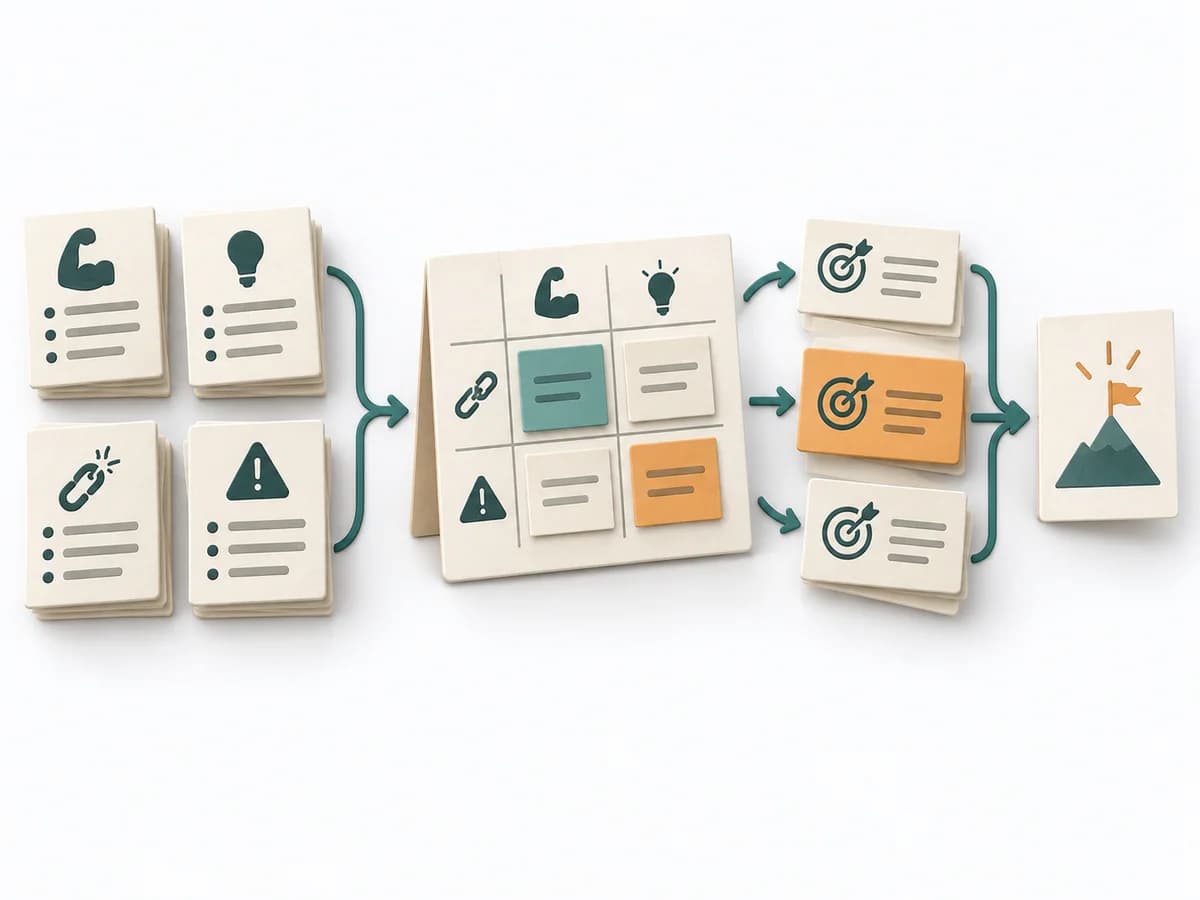 Business Strategy TOWS Matrix |  UX Design Lean UX Canvas |  Business Strategy GAP Analysis |  Product Strategy DIBB |
|---|---|---|---|---|
Purposedifferent | The TOWS Matrix connects internal strengths and weaknesses with external opportunities and threats into action-oriented strategies. It goes a step further than a pure stocktaking. | The Lean UX Canvas helps clarify user behavior, touchpoints, and concept decisions. It makes assumptions and desired outcomes visible and captures the result as a completed canvas, hypothesis list, and first experiment. | GAP Analysis compares the current state with a target picture and makes the distance manageable. It becomes useful when, ahead of new initiatives, it must become clear which capabilities, processes, or resources are missing. | DIBB helps clarify target groups, value, goals, and priorities by making the logic behind a decision explicit. It captures results as a DIBB document, belief list, bet list, and learning report. |
Complexitydifferent | Medium | Medium | Medium | Low |
Timedifferent | 1-2 h | 2-3 h | 1-3 h | 1-2 h |
Participantsdifferent | 3-10 | 3-8 | 2-8 | 2-8 |
Formatdifferent | Workshop | Workshop + async | Workshop + async | Workshop + async |
Outputdifferent | TOWS Matrix, Strategic Options, Priority Actions | Completed Lean UX Canvas, Hypothesis list, First experiment | Gap Matrix, Action Plan, Risk Notes | DIBB document, Belief list, Bet list, Learning report |
Tagsno overlap | StrategyAnalysisOptions | CanvasHypothesisOutcomesDiscovery | StrategyAnalysisPlanning | StrategyDecisionAssumptionsHypothesis |