View methods side by side.
Choose up to four methods. Add them using the search and share the comparison by copying its link.
| Criterion | 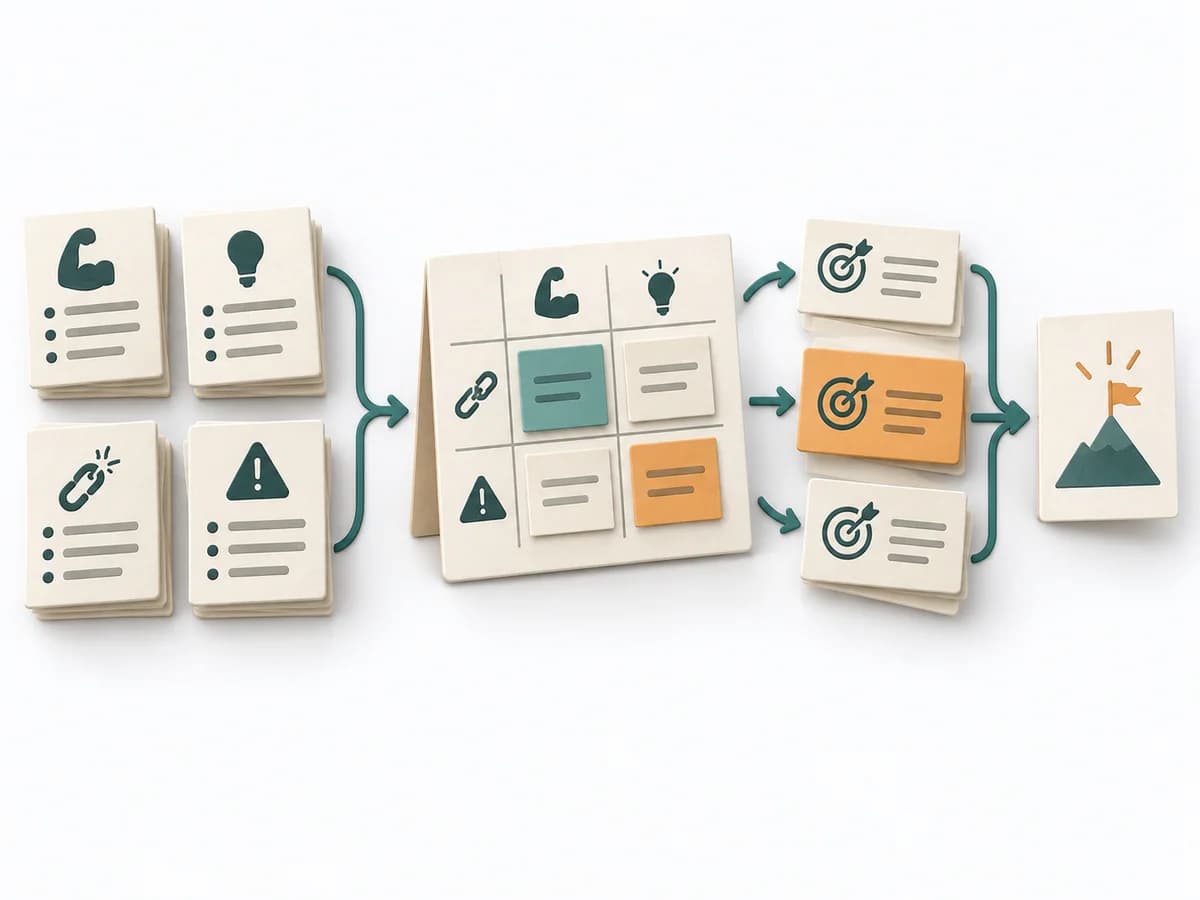 Business Strategy TOWS Matrix |  UX Design Lean UX Canvas |  Product Strategy DIBB |  Decision Making Constraint Analysis |
|---|---|---|---|---|
Purposedifferent | The TOWS Matrix connects internal strengths and weaknesses with external opportunities and threats into action-oriented strategies. It goes a step further than a pure stocktaking. | The Lean UX Canvas helps clarify user behavior, touchpoints, and concept decisions. It makes assumptions and desired outcomes visible and captures the result as a completed canvas, hypothesis list, and first experiment. | DIBB helps clarify target groups, value, goals, and priorities by making the logic behind a decision explicit. It captures results as a DIBB document, belief list, bet list, and learning report. | When an initiative stalls, the limit often lies not in the idea but in hard or soft boundary conditions. Constraint Analysis separates these limits and shows which of them can actually be shaped. |
Complexitydifferent | Medium | Medium | Low | Low |
Timedifferent | 1-2 h | 2-3 h | 1-2 h | 30-90 min |
Participantsdifferent | 3-10 | 3-8 | 2-8 | 2-8 |
Formatdifferent | Workshop | Workshop + async | Workshop + async | Workshop + async |
Outputdifferent | TOWS Matrix, Strategic Options, Priority Actions | Completed Lean UX Canvas, Hypothesis list, First experiment | DIBB document, Belief list, Bet list, Learning report | Constraint List, Hard/Soft Classification, Option Impact Notes, Decision Boundaries |
Tagsno overlap | StrategyAnalysisOptions | CanvasHypothesisOutcomesDiscovery | StrategyDecisionAssumptionsHypothesis | ConstraintsDecisionPlanningOptions |