View methods side by side.
Choose up to four methods. Add them using the search and share the comparison by copying its link.
| Criterion | 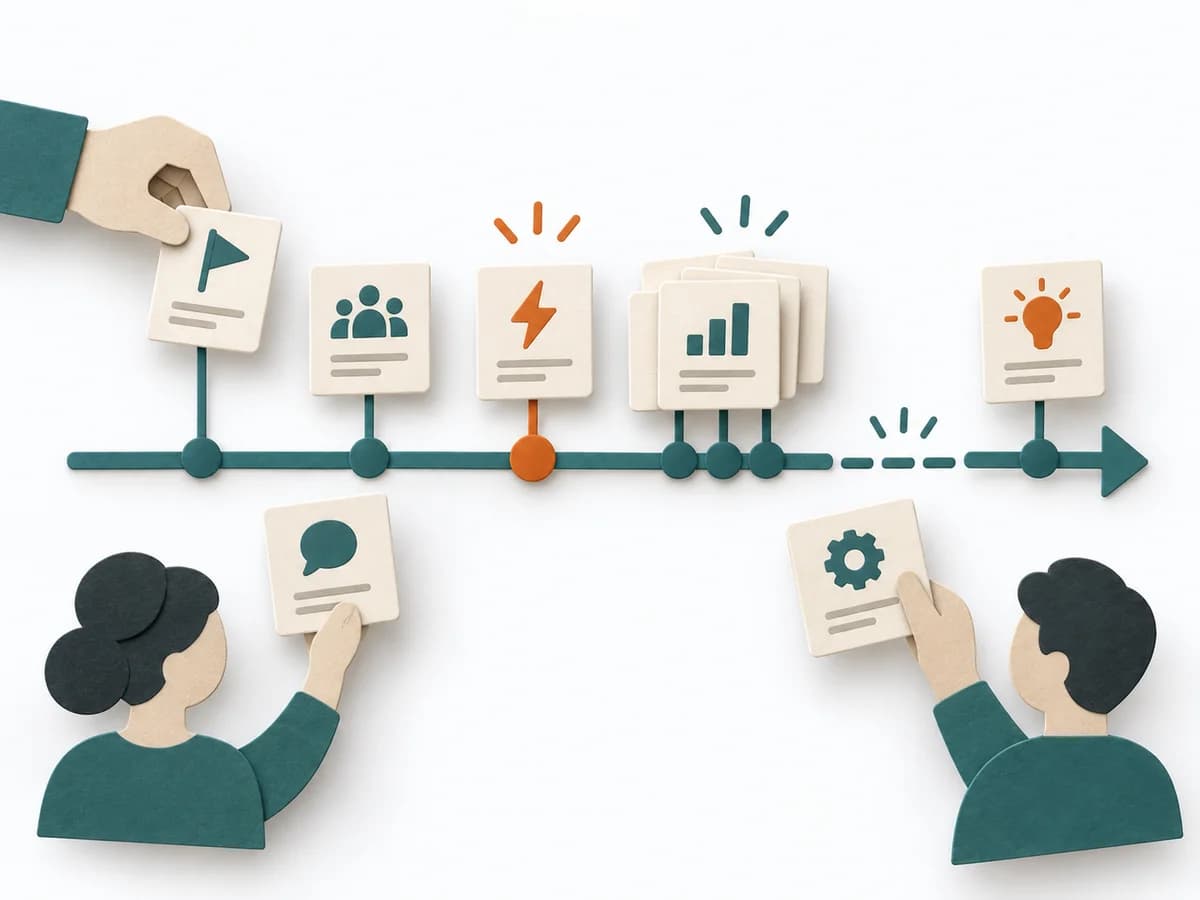 Facilitation Timeline |  Knowledge Modeling Knowledge Mapping |  Facilitation Nominal Group Technique |  Facilitation Mind Mapping |
|---|---|---|---|---|
Purposedifferent | When a project, incident, or change process is only remembered in fragments, Timeline brings the sequence back into a readable form. It makes turning points, precursors, and after-effects recognizable over the course of time. | Knowledge Mapping makes knowledge, gaps, and transfer paths visible across a field. It fits when expertise should not just exist but also be findable and transferable. | When loud voices could dominate a round, Nominal Group Technique protects individual thinking time from group effects. It collects ideas separately first and only then enables shared weighting. | When a topic is still unclear and too many thoughts surface at once, Mind Mapping creates an open surface for ordering them. It makes connections, subtopics, and starting points visible without fixing them too early. |
Complexitydifferent | Low | Medium | Medium | Low |
Timedifferent | 30-90 min | 1-3 h | 60-120 min | 15-45 min |
Participantsdifferent | 2-12 | 3-12 | 5-12 | 1-10 |
Formatdifferent | Workshop + async | Workshop | Workshop | Workshop + async |
Outputdifferent | Timeline, Milestones, Insight Notes | Knowledge Map, Critical Knowledge Areas, Transfer Plan | Ranked Ideas, Clarified Options, Group Priority | Mind Map, Topic Clusters, Open Questions |
Tagsno overlap | TimelineFacilitationSequence | KnowledgeMappingRisk | FacilitationPrioritizationVotingInclusion | BrainstormingIdeasMappingStructureFacilitation |