View methods side by side.
Choose up to four methods. Add them using the search and share the comparison by copying its link.
| Criterion | 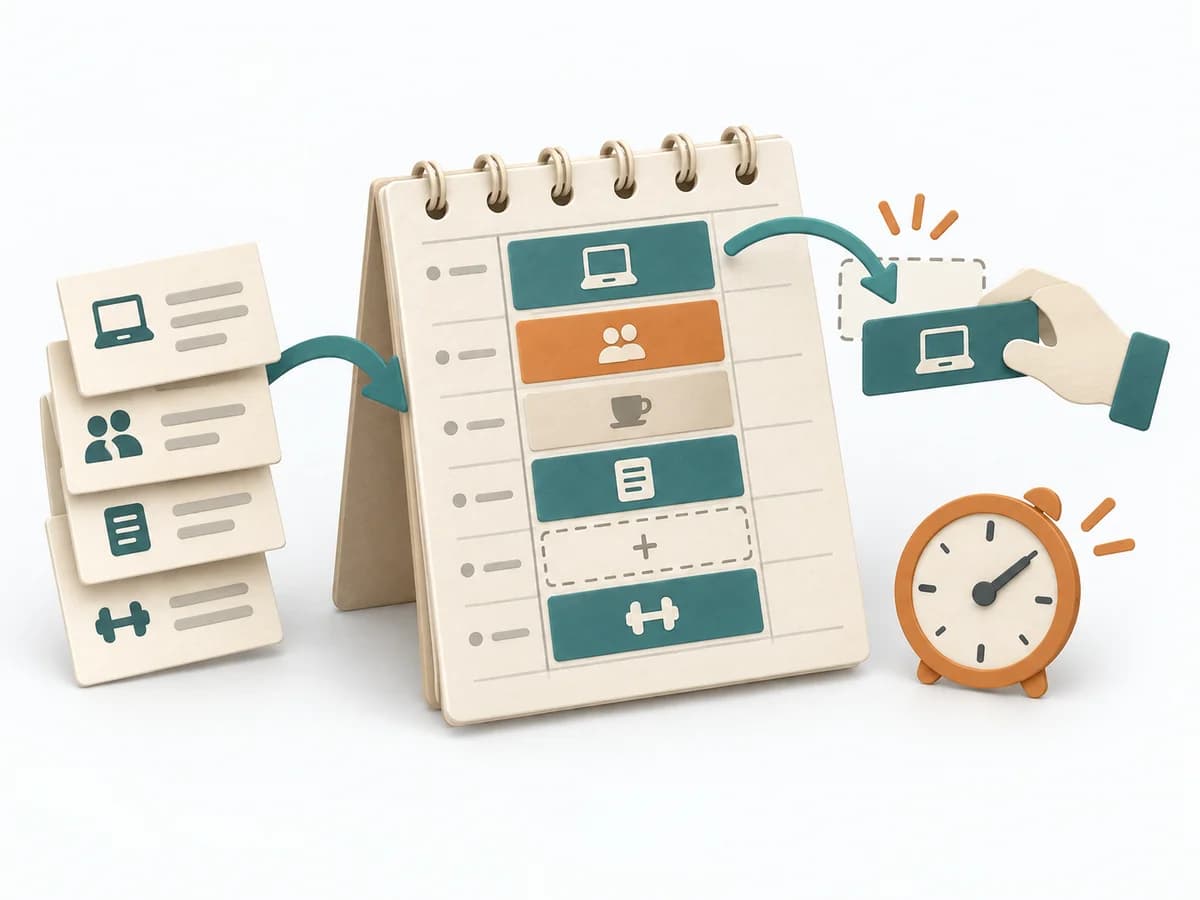 Operations Time Blocking |  UX Research Surveys |  Innovation Design Thinking |  Operations ALPEN Method |
|---|---|---|---|---|
Purposedifferent | With a calendar that grows on request, the method makes available time explicit again. It combines appointments, focus work, and buffer into a more realistic day structure. | When a topic needs to be validated broadly and many people can answer the same question, surveys gather structured feedback in a scalable form. Answers become comparable and segmentable instead of remaining merely anecdotal. | For complex user problems with an uncertain cause, the method connects observation, interpretation, and experiment into a learning cycle. It keeps the focus on real needs and avoids premature solution language. This produces robust decisions for product and service. | With an overloaded day full of too many tasks, a realistic picture of the day emerges. The method connects estimating, deciding, and buffer thinking so planning fits available energy and time. |
Complexitydifferent | Low | Medium | High | Low |
Timedifferent | 15-30 min Planung, laufend | 3-14 Tage | 1 Tag bis mehrere Wochen | 10-20 min daily |
Participantsdifferent | 1 | 50+ | 4-10 | 1 |
Formatdifferent | Async | Async | Workshop | Async |
Outputdifferent | Blocked Calendar, Capacity View, Focus Plan | Survey Results, Charts, Segment Insights | Problem Statement, Prototype, Test Learnings | Daily Plan, Time Estimates, Review Notes |
Tagsno overlap | PlanningTime managementFocus | QuantitativeResearchValidation | InnovationPrototypeResearch | PlanningTime managementProductivityOperations |