View methods side by side.
Choose up to four methods. Add them using the search and share the comparison by copying its link.
| Criterion | 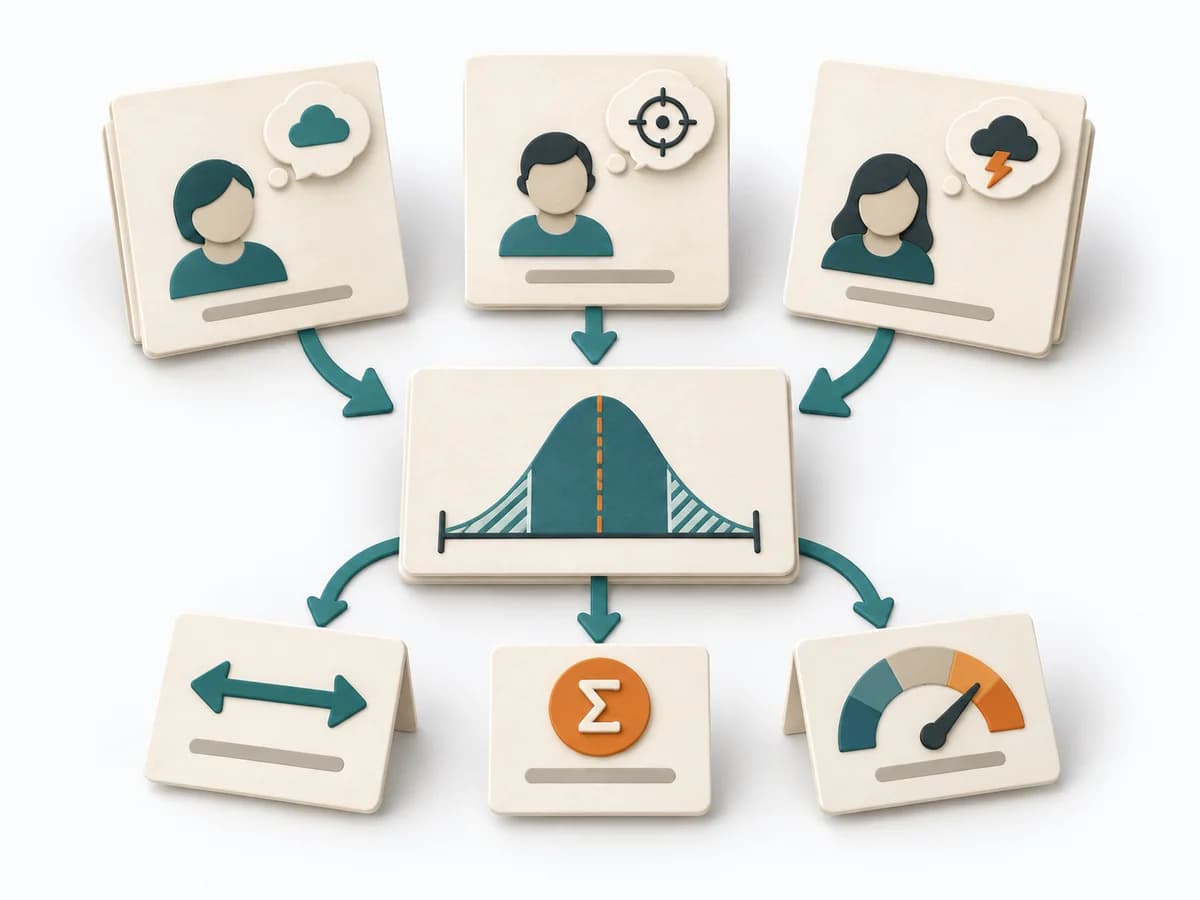 Decision Making Three-Point Estimation |  Decision Making Force Field Analysis |  Domain Modeling Bounded Context Canvas |  Domain Modeling Context Map |
|---|---|---|---|---|
Purposedifferent | A single estimate for effort, time, or risk often looks too smooth for the real uncertainty behind it. It separates options, evaluation criteria, and open risks. The result is captured as a Three-Point Estimate, Risk Range, and Assumption Notes. | In change initiatives, supporting and restraining forces sit at the table at the same time. Force Field Analysis makes these tensions explicit and shows where change can be pushed forward by strengthening or relieving. | When a business context is still loosely outlined, it shapes language, responsibility, and integration space. It clarifies what belongs together and where a boundary needs to hold. | When several contexts need to talk to each other, it makes their relationships and dependencies legible. It helps sort integration pressure and responsibilities across system boundaries. |
Complexitydifferent | Medium | Low | Medium | Medium |
Timedifferent | 10-30 min je Item | 45-90 min | 1-3 h | 1-3 h |
Participantsdifferent | 1-8 | 3-12 | 3-8 | 2-8 |
Formatdifferent | Workshop + async | Workshop | Workshop + async | Workshop + async |
Outputdifferent | Three-Point Estimate, Risk Range, Assumption Notes | Force Field Map, Change Levers, Risk Notes | Context Canvas, Glossary, Integration Notes | Context Map, Integration Patterns, Boundary Notes |
Tagsno overlap | EstimationUncertaintyForecasting | ChangeDecisionStrategy | Domain-Driven DesignBoundariesModeling | Domain-Driven DesignBoundariesStrategy |