View methods side by side.
Choose up to four methods. Add them using the search and share the comparison by copying its link.
| Criterion | 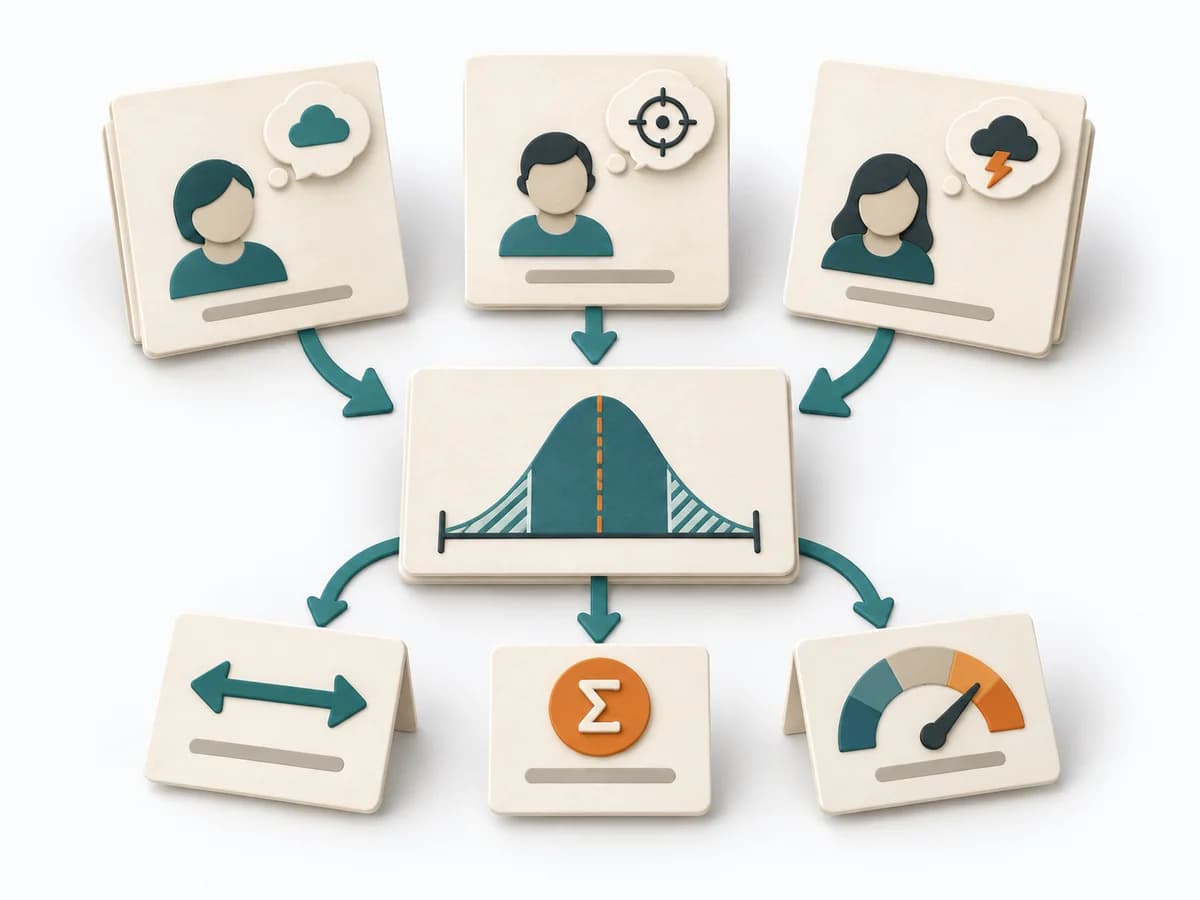 Decision Making Three-Point Estimation |  Product Strategy DIBB |  Domain Modeling Context Map |  Domain Modeling Domain Context Map |
|---|---|---|---|---|
Purposedifferent | A single estimate for effort, time, or risk often looks too smooth for the real uncertainty behind it. It separates options, evaluation criteria, and open risks. The result is captured as a Three-Point Estimate, Risk Range, and Assumption Notes. | DIBB helps clarify target groups, value, goals, and priorities by making the logic behind a decision explicit. It captures results as a DIBB document, belief list, bet list, and learning report. | When several contexts need to talk to each other, it makes their relationships and dependencies legible. It helps sort integration pressure and responsibilities across system boundaries. | When a domain model and its associated contexts need to be thought through together, it creates a shared overview. It connects the business view and organizational boundary into a readable whole. |
Complexitydifferent | Medium | Low | Medium | Medium |
Timedifferent | 10-30 min je Item | 1-2 h | 1-3 h | 1-3 h |
Participantsdifferent | 1-8 | 2-8 | 2-8 | 3-10 |
Formatdifferent | Workshop + async | Workshop + async | Workshop + async | Workshop |
Outputdifferent | Three-Point Estimate, Risk Range, Assumption Notes | DIBB document, Belief list, Bet list, Learning report | Context Map, Integration Patterns, Boundary Notes | Domain Context Map, Boundary Notes, Ownership Map |
Tagsno overlap | EstimationUncertaintyForecasting | StrategyDecisionAssumptionsHypothesis | Domain-Driven DesignBoundariesStrategy | Domain-Driven DesignContextBoundaries |