View methods side by side.
Choose up to four methods. Add them using the search and share the comparison by copying its link.
Selected:Three-Point EstimationArgument MappingArchitecture Communication CanvasArchitecture Decision Record
| Criterion | 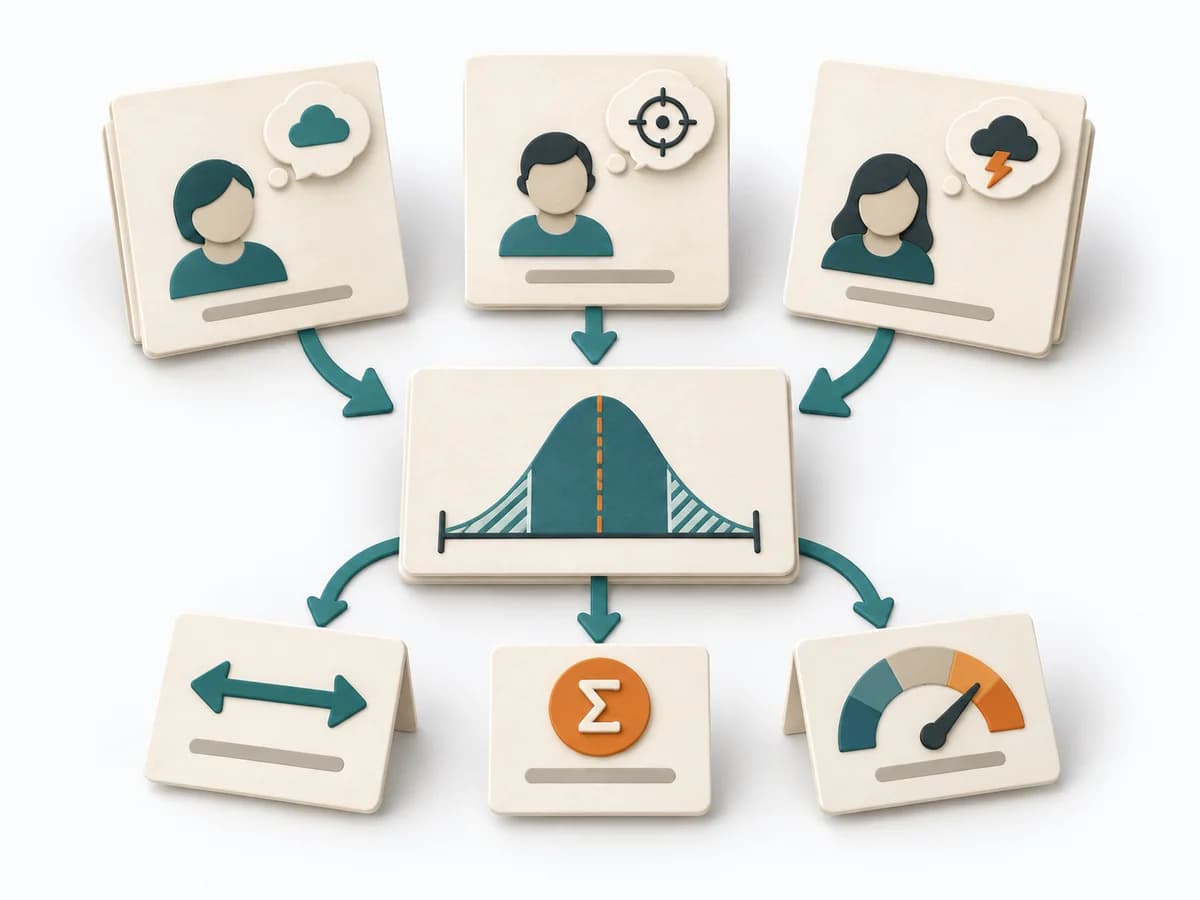 Decision Making Three-Point Estimation |  Decision Making Argument Mapping |  Architecture Architecture Communication Canvas |  Architecture Architecture Decision Record |
|---|---|---|---|---|
Purposedifferent | A single estimate for effort, time, or risk often looks too smooth for the real uncertainty behind it. It separates options, evaluation criteria, and open risks. The result is captured as a Three-Point Estimate, Risk Range, and Assumption Notes. | When statements, evidence, and counterarguments get mixed up, a debate quickly loses its structure. Argument Mapping breaks a thesis down into its reasoning and makes visible what it really rests on. | The Architecture Communication Canvas plans architecture communication so the right people receive the right message. The method turns technical complexity into deliberate communication design. | An ADR permanently records an architecture decision with context, trade-offs, and consequence. It creates continuity for later changes because the decision path stays traceable. |
Complexitydifferent | Medium | Medium | Medium | Low |
Timedifferent | 10-30 min je Item | 1-3 h | 60-120 min | 15-45 min |
Participantsdifferent | 1-8 | 1-8 | 2-8 | 1-3 |
Formatdifferent | Workshop + async | Workshop + async | Workshop + async | Async |
Outputdifferent | Three-Point Estimate, Risk Range, Assumption Notes | Argument Map, Evidence Gaps, Decision Rationale | Communication Canvas, Stakeholder Messages, Architecture Communication Plan | ADR File, Decision Log, Rationale |
Tagsno overlap | EstimationUncertaintyForecasting | SensemakingDecisionRationale | ArchitectureCommunicationStakeholdersCanvas | ArchitectureRationaleDocumentationGovernance |