View methods side by side.
Choose up to four methods. Add them using the search and share the comparison by copying its link.
| Criterion | 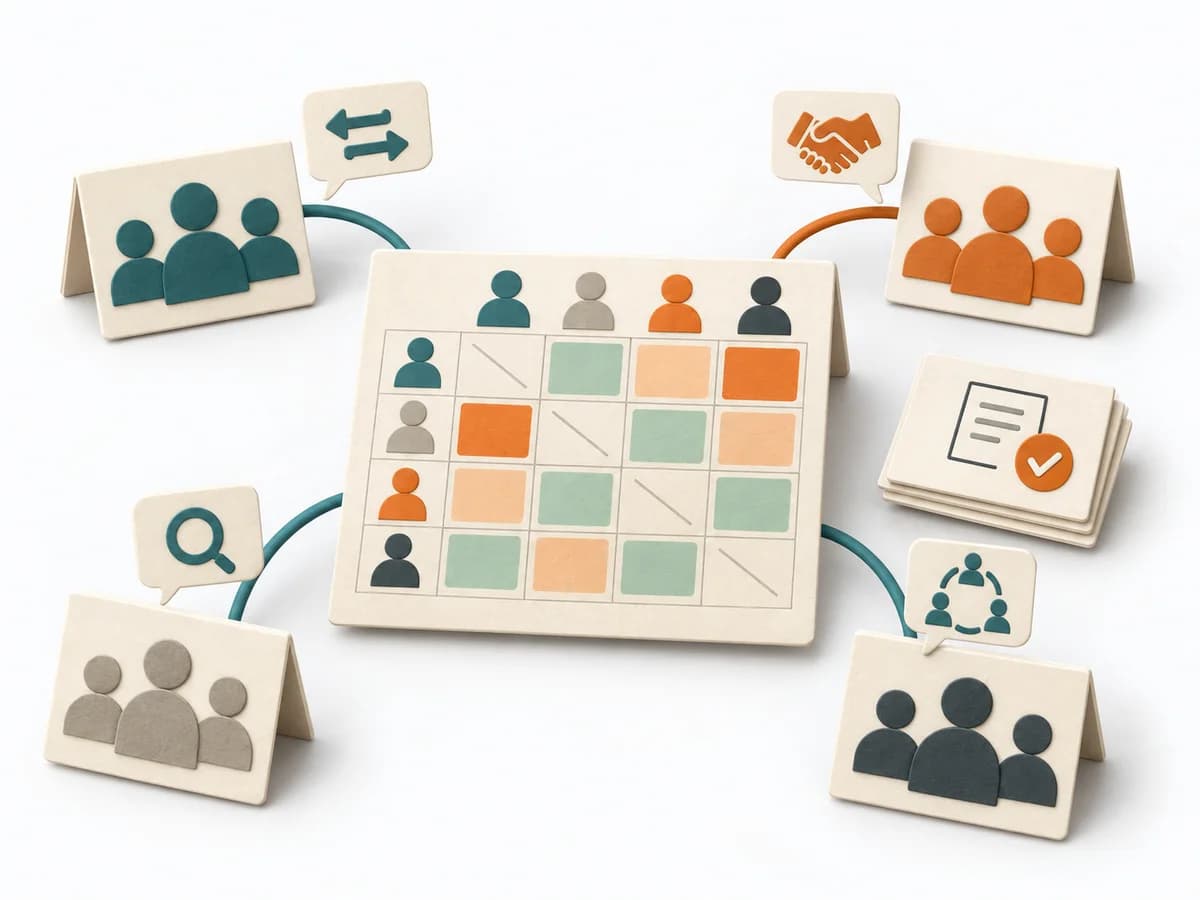 Team Design Team Topologies Interaction Modes |  Knowledge Modeling IBIS |  Decision Making Argument Mapping |  Knowledge Modeling Concept Mapping |
|---|---|---|---|---|
Purposedifferent | When several teams collaborate repeatedly, it describes the right interaction mode for each interface between them. It clarifies responsibility, interaction, and load between teams. The result is captured as an interaction heat map and pairwise agreements. | IBIS structures thinking about complex questions as a sequence of issues, ideas, and arguments. The method keeps discussions open without forcing them into premature consensus. | When statements, evidence, and counterarguments get mixed up, a debate quickly loses its structure. Argument Mapping breaks a thesis down into its reasoning and makes visible what it really rests on. | Concept Mapping arranges terms and relationships in a network that makes subject-matter connections tangible. It fits when a topic needs to be understood structurally rather than linearly. |
Complexitysame | Medium | Medium | Medium | Medium |
Timedifferent | Half day | 1-3 h | 1-3 h | 1-2 h |
Participantsdifferent | Team-Leads plus Architecture | 2-8 | 1-8 | 1-8 |
Formatdifferent | Workshop | Workshop + async | Workshop + async | Workshop + async |
Outputdifferent | Interaction Heat Map, Agreements per Pair | Issue Map, Positions, Argument Notes | Argument Map, Evidence Gaps, Decision Rationale | Concept Map, Relationship Labels, Knowledge Gaps |
Tagsno overlap | TeamAlignmentCollaborationOrganization | RationaleKnowledgeDecision | SensemakingDecisionRationale | KnowledgeConceptsMappingSensemaking |