View methods side by side.
Choose up to four methods. Add them using the search and share the comparison by copying its link.
| Criterion | 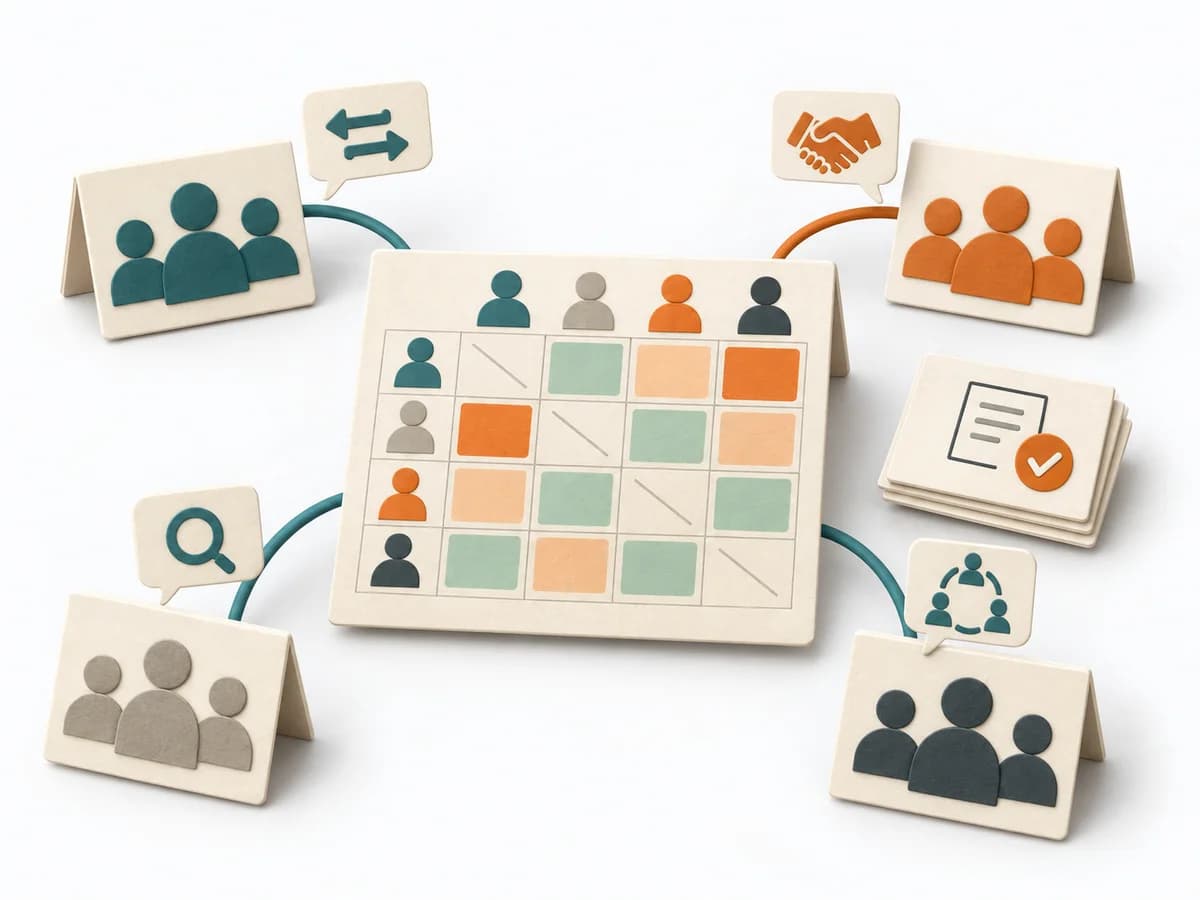 Team Design Team Topologies Interaction Modes |  Decision Making Argument Mapping |  Facilitation Team Charter |  Decision Making Decision Rights Mapping |
|---|---|---|---|---|
Purposedifferent | When several teams collaborate repeatedly, it describes the right interaction mode for each interface between them. It clarifies responsibility, interaction, and load between teams. The result is captured as an interaction heat map and pairwise agreements. | When statements, evidence, and counterarguments get mixed up, a debate quickly loses its structure. Argument Mapping breaks a thesis down into its reasoning and makes visible what it really rests on. | When a team is starting fresh or working past each other, Team Charter clarifies the shared working basis. It visibly sets out how collaboration, decision paths, and mutual conduct should work day to day. | In organizations with many stakeholders, it often blurs who actually decides and who is merely consulted. It separates options, evaluation criteria, and open risks. The result is captured as a Decision Rights matrix and an agreement. |
Complexitysame | Medium | Medium | Medium | Medium |
Timedifferent | Half day | 1-3 h | 2-4 h | 90-180 min |
Participantsdifferent | Team-Leads plus Architecture | 1-8 | 3-12 | 4-12 |
Formatdifferent | Workshop | Workshop + async | Workshop | Workshop |
Outputdifferent | Interaction Heat Map, Agreements per Pair | Argument Map, Evidence Gaps, Decision Rationale | Team Charter, Working Norms, Role Notes | Decision Rights Matrix, Agreement |
Tagsno overlap | TeamAlignmentCollaborationOrganization | SensemakingDecisionRationale | TeamAlignmentCollaboration | DecisionGovernanceAlignmentResponsibility |