View methods side by side.
Choose up to four methods. Add them using the search and share the comparison by copying its link.
| Criterion |  Knowledge Modeling Teach-back |  Decision Making Constraint Analysis |  Product Discovery Assumption Mapping | 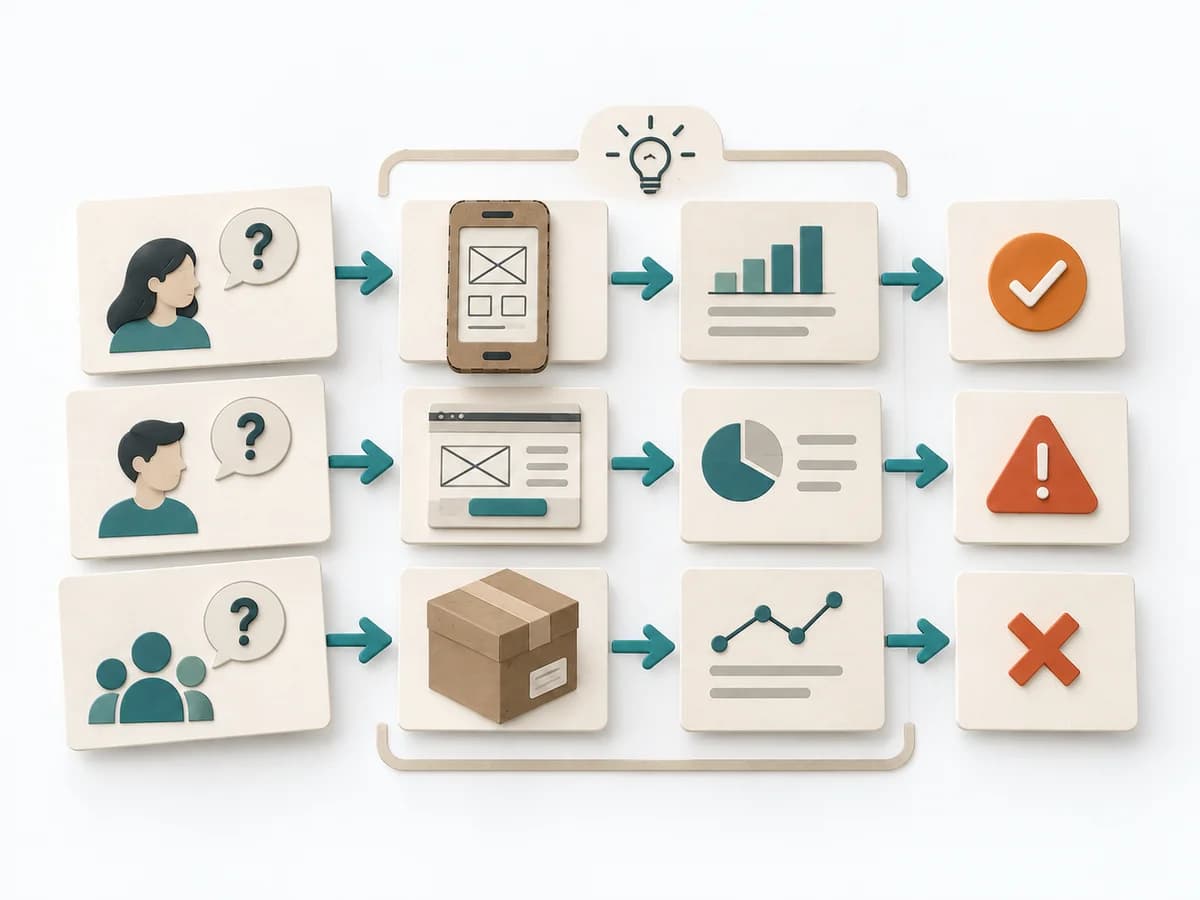 Product Discovery MVP Test Matrix |
|---|---|---|---|---|
Purposedifferent | Teach-back checks whether an explanation actually got through to the other person. The method makes misunderstandings visible early and strengthens shared understanding in advisory and learning situations. | When an initiative stalls, the limit often lies not in the idea but in hard or soft boundary conditions. Constraint Analysis separates these limits and shows which of them can actually be shaped. | When assumptions still sit unordered in the room, it weighs uncertainty against leverage. It makes visible which hypotheses should be checked first. | When several minimal variants compete to answer the same question, it makes comparing and choosing between them cleaner. It separates problem, assumption, solution, and evidence. The result is captured as a Test Matrix and a Test Plan. |
Complexitydifferent | Low | Low | Medium | Medium |
Timedifferent | 5-20 min | 30-90 min | 45-60 min | 45-75 min |
Participantssame | 2-8 | 2-8 | 2-8 | 2-8 |
Formatdifferent | Workshop + async | Workshop + async | Workshop + async | Workshop |
Outputdifferent | Understanding Check, Clarification Notes, Learning Gaps | Constraint List, Hard/Soft Classification, Option Impact Notes, Decision Boundaries | Assumption map, Test backlog, Risk ranking | Test Matrix, Test Plan |
Tagsno overlap | LearningUnderstandingCommunication | ConstraintsDecisionPlanningOptions | AssumptionsRiskExperimentsValidation | ExperimentsValidationDiscoveryOptions |