View methods side by side.
Choose up to four methods. Add them using the search and share the comparison by copying its link.
Selected:System Dynamics SimulationDesign SprintARID (Active Reviews for Intermediate Designs)Design Thinking
| Criterion | 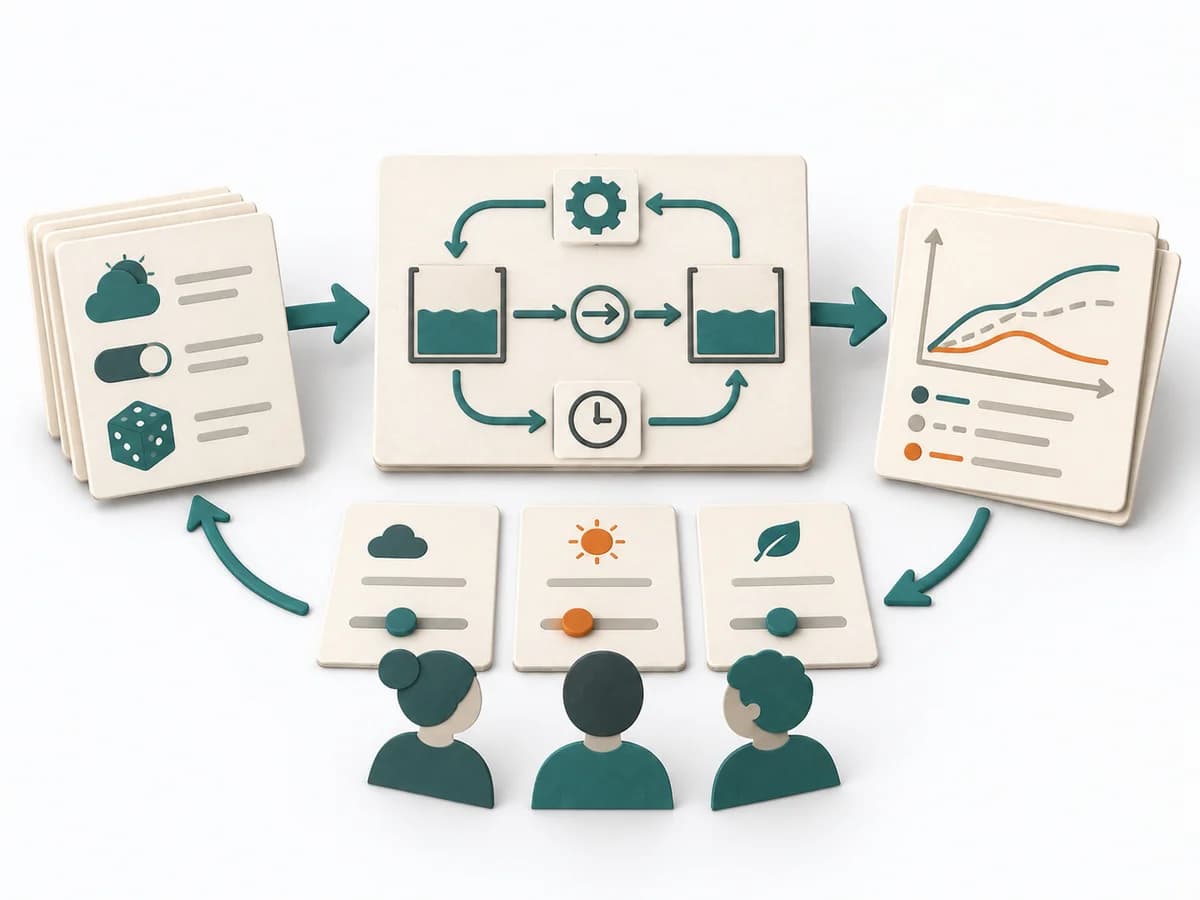 Systems Thinking System Dynamics Simulation |  Innovation Design Sprint |  Architecture ARID (Active Reviews for Intermediate Designs) |  Innovation Design Thinking |
|---|---|---|---|---|
Purposedifferent | System Dynamics Simulation makes assumptions about time, delay, and feedback testable through experiments. It draws relationships, patterns, and feedback loops. The result is captured as a simulation model and scenario reports. | When the product question is unclear and time pressure is high, the method takes a team from an open idea to a testable solution. It connects problem understanding, decision, and learning in one compact format, lowering the risk of spending a lot of energy on a mere guess. | ARID examines how well developers can work with a technical design. It focuses on a part of the system that can still be revised, between the architecture overview and the detailed specification. | For complex user problems with an uncertain cause, the method connects observation, interpretation, and experiment into a learning cycle. It keeps the focus on real needs and avoids premature solution language. This produces robust decisions for product and service. |
Complexitydifferent | High | High | Medium | High |
Timedifferent | Mehrere Tage bis Wochen | 4-5 Tage | 2–4 h review as a planning range; preparation and evaluation additional | 1 Tag bis mehrere Wochen |
Participantsdifferent | 1-5 Modellierende, Stakeholder asynchron | 5-8 | Designers, developers as users, and facilitation | 4-10 |
Formatdifferent | Async | Workshop | Workshop + async | Workshop |
Outputdifferent | Simulation Model, Scenario Reports | Prototype, Test Findings, Decision Rationale | Prioritized development tasks, Jointly produced code or pseudocode, Observed difficulties and open design questions, Proposed design revisions | Problem Statement, Prototype, Test Learnings |
Tagsno overlap | Systems thinkingDynamicsSimulationAnalysis | Design sprintPrototypeValidationInnovation | ArchitectureEngineeringFeedbackValidationTasks | InnovationPrototypeResearch |