View methods side by side.
Choose up to four methods. Add them using the search and share the comparison by copying its link.
| Criterion |  UX Research Surveys |  Operations Root Cause Analysis |  Operations Causal Factor Analysis | 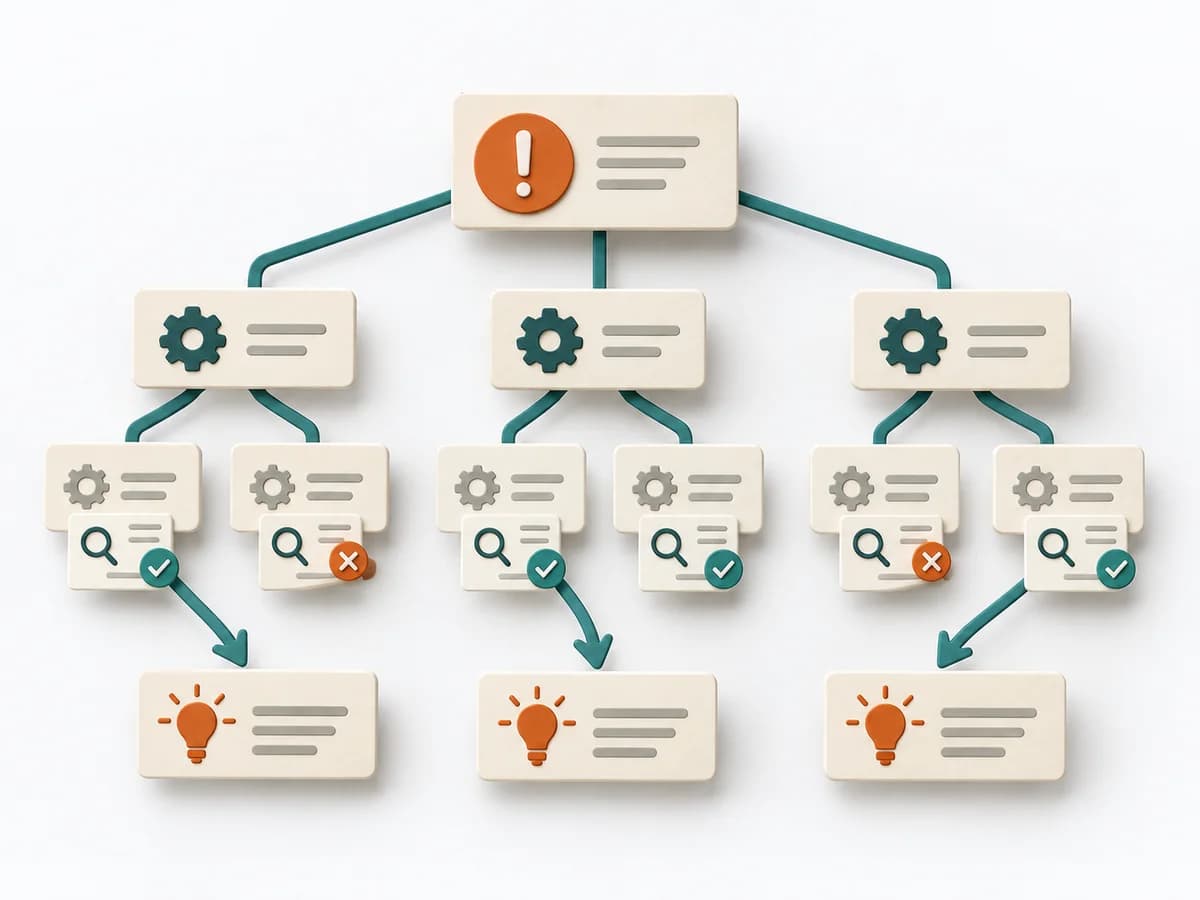 Operations Root Cause Tree Analysis |
|---|---|---|---|---|
Purposedifferent | When a topic needs to be validated broadly and many people can answer the same question, surveys gather structured feedback in a scalable form. Answers become comparable and segmentable instead of remaining merely anecdotal. | When a problem keeps recurring and the cause stays unclear, the method exposes the underlying mechanism. It separates symptom, guess, and robust explanation from one another. | For an event with a complicated course, the method breaks down the contributing factors along the timeline. It shows how conditions, decisions, and reactions together produce a course of events. | For a problem with several suspected causes, the method builds a causal structure instead of a mere list. It makes visible how causes connect and where the strongest points of leverage lie. |
Complexitydifferent | Medium | Medium | High | Medium |
Timedifferent | 3-14 Tage | 1-4 h | 2-6 h | 1-3 h |
Participantsdifferent | 50+ | 3-8 | 3-10 | 2-8 |
Formatdifferent | Async | Workshop + async | Workshop + async | Workshop |
Outputdifferent | Survey Results, Charts, Segment Insights | Problem Statement, Cause Hypotheses, Confirmed Causes, Action Plan | Event Timeline, Causal Factor Chart, Cause List, Corrective Actions | Cause Tree, Evidence Notes, Countermeasures |
Tagsno overlap | QuantitativeResearchValidation | Root causeProblem solvingQualityIncident | CausalityIncidentRoot causeTimeline | Root causeTreeIncidentQuality |