View methods side by side.
Choose up to four methods. Add them using the search and share the comparison by copying its link.
| Criterion |  UX Research Surveys |  Operations Gemba Walk |  Product Discovery Experiment Canvas | 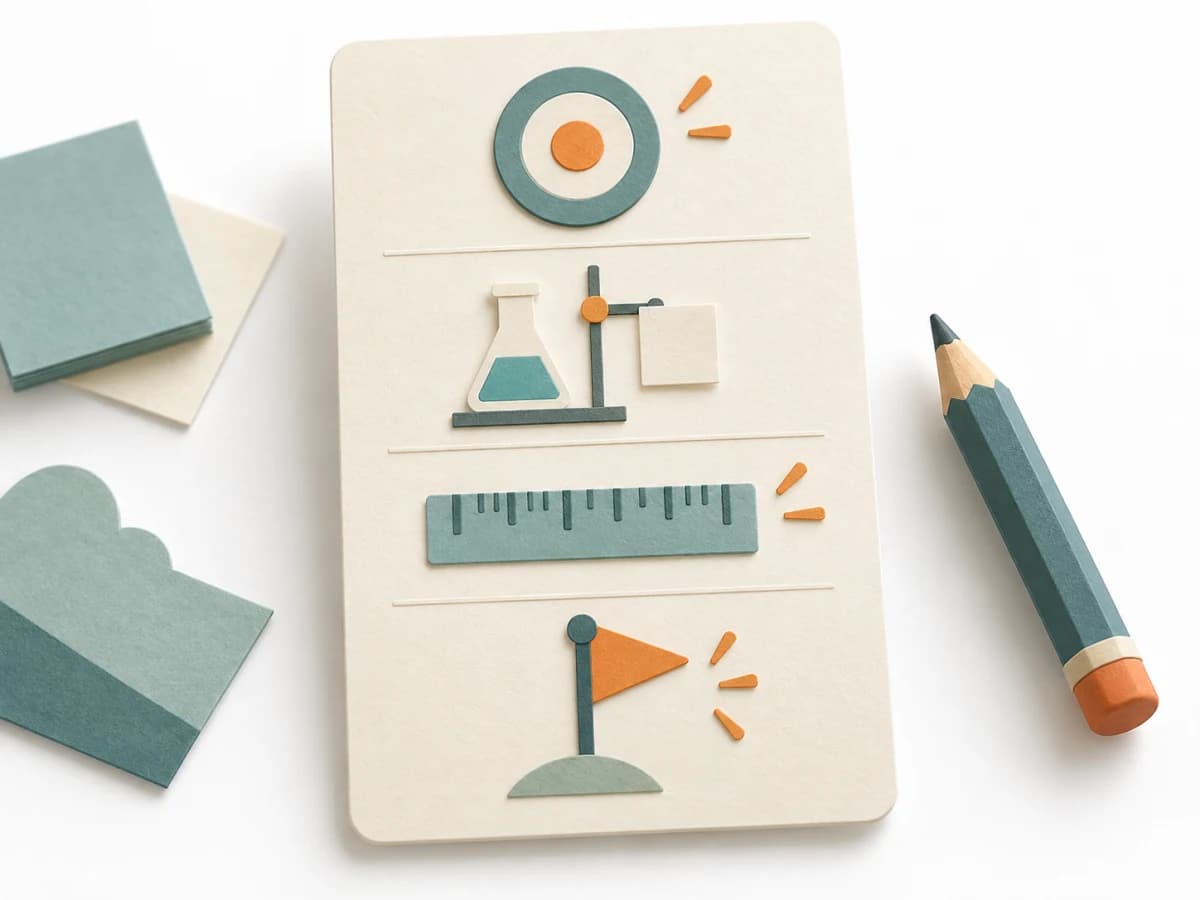 Product Discovery Test Card |
|---|---|---|---|---|
Purposedifferent | When a topic needs to be validated broadly and many people can answer the same question, surveys gather structured feedback in a scalable form. Answers become comparable and segmentable instead of remaining merely anecdotal. | When there is uncertainty about the real course of a process, the method brings observation to the place where work happens. It combines perception, follow-up questions, and process knowledge so decisions rest on actual workflows instead of assumptions. | When experiments become unreadable after the fact, it arranges hypothesis, signal, and learning goal on a single canvas. It separates problem, assumption, solution, and evidence. The result is captured as a Completed Experiment Canvas and a Success Metric. | The Test Card turns a critical assumption into a testable claim and specifies in advance which result counts as success. |
Complexitydifferent | Medium | Low | Low | Low |
Timedifferent | 3-14 Tage | 30-120 min | 30-60 min | 20-35 min |
Participantsdifferent | 50+ | 2-6 | 1-5 | 1-5 |
Formatdifferent | Async | Workshop | Workshop + async | Workshop + async |
Outputdifferent | Survey Results, Charts, Segment Insights | Observation Notes, Improvement Ideas | Completed Experiment Canvas, Success Metric | Test Card with a pre-set threshold |
Tagsno overlap | QuantitativeResearchValidation | LeanObservationProcessOperations | ExperimentsValidationDiscoveryHypothesis | ExperimentsValidationDiscoveryHypothesis |