View methods side by side.
Choose up to four methods. Add them using the search and share the comparison by copying its link.
| Criterion | 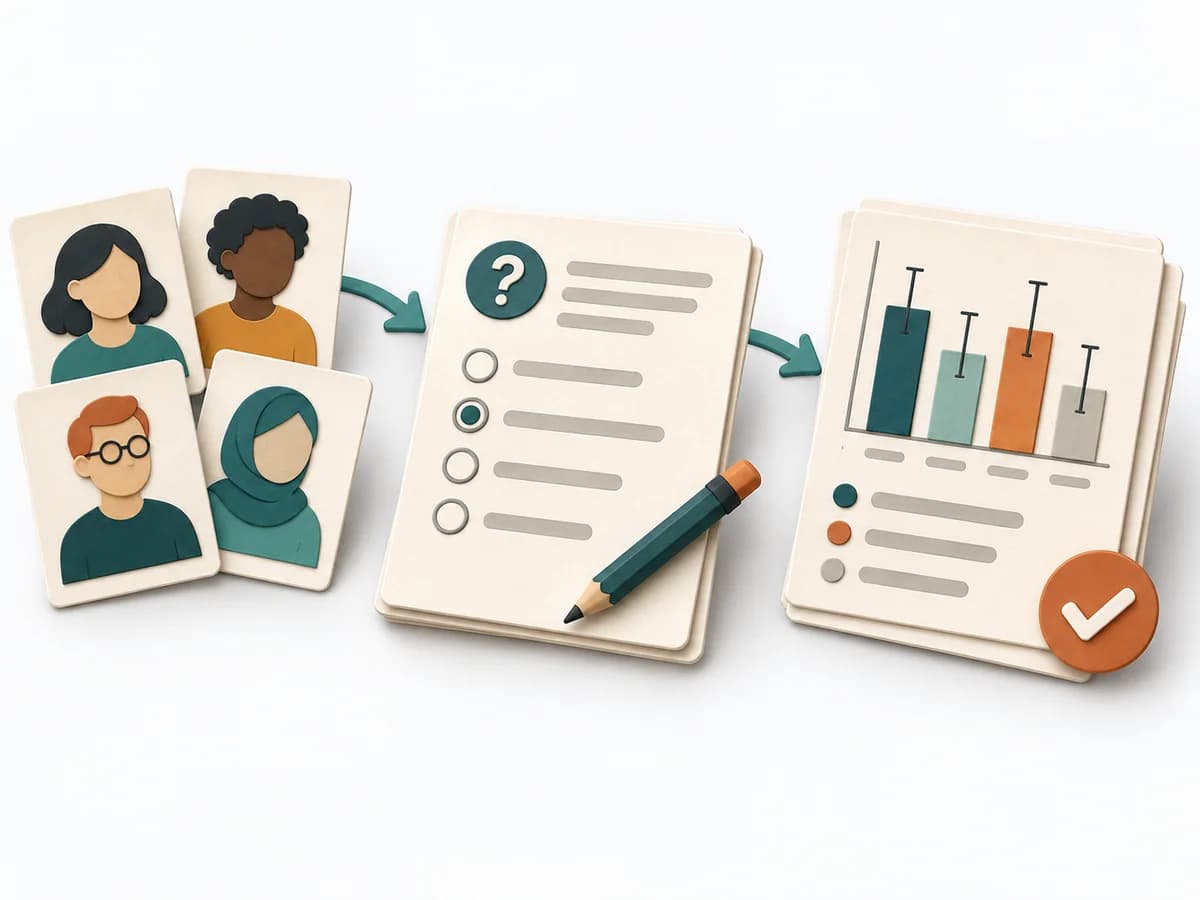 UX Research Surveys |  Operations Gemba Walk |  Product Discovery Assumption Mapping |  Growth A/B Testing |
|---|---|---|---|---|
Purposedifferent | When a topic needs to be validated broadly and many people can answer the same question, surveys gather structured feedback in a scalable form. Answers become comparable and segmentable instead of remaining merely anecdotal. | When there is uncertainty about the real course of a process, the method brings observation to the place where work happens. It combines perception, follow-up questions, and process knowledge so decisions rest on actual workflows instead of assumptions. | When assumptions still sit unordered in the room, it weighs uncertainty against leverage. It makes visible which hypotheses should be checked first. | When two variants compete, discussions quickly decide by taste rather than effect. A/B Testing checks behavior under controlled conditions and separates real improvement from chance or expectation effects. |
Complexitydifferent | Medium | Low | Medium | High |
Timedifferent | 3-14 Tage | 30-120 min | 45-60 min | 1-4 Wochen |
Participantsdifferent | 50+ | 2-6 | 2-8 | 1-6 |
Formatdifferent | Async | Workshop | Workshop + async | Async |
Outputdifferent | Survey Results, Charts, Segment Insights | Observation Notes, Improvement Ideas | Assumption map, Test backlog, Risk ranking | Experiment results, Decision log, Learning summary |
Tagsno overlap | QuantitativeResearchValidation | LeanObservationProcessOperations | AssumptionsRiskExperimentsValidation | ExperimentsGrowthAnalyticsValidation |