View methods side by side.
Choose up to four methods. Add them using the search and share the comparison by copying its link.
| Criterion |  UX Research Surveys |  Facilitation Dot Voting |  Facilitation Decision Jam | 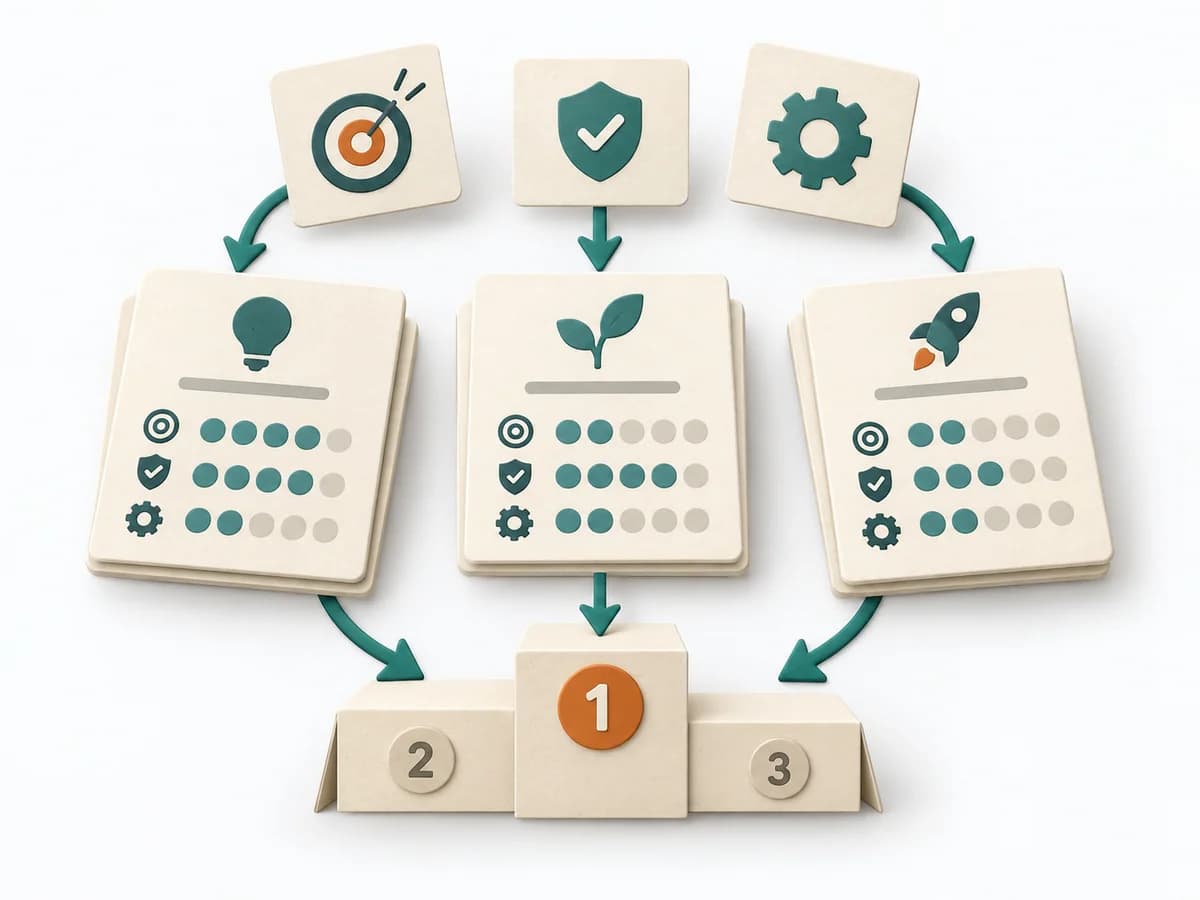 Product Strategy ICE Scoring |
|---|---|---|---|---|
Purposedifferent | When a topic needs to be validated broadly and many people can answer the same question, surveys gather structured feedback in a scalable form. Answers become comparable and segmentable instead of remaining merely anecdotal. | When a workshop has produced too many options and the group needs to condense quickly, dot voting makes preferences visible in a short time. It bundles individual votes into a solid signal for the next selection. | When a decision is stuck, Decision Jam loosens the knot through structured separation of problem, idea, and selection. The format creates movement without jumping prematurely at the first seemingly elegant answer. | When ideas need sorting quickly, it condenses impact, confidence, and effort into one compact score. It connects customer value, product logic, and decision priorities. The result is captured as an ICE table and top-ideas list. |
Complexitydifferent | Medium | Low | Low | Low |
Timedifferent | 3-14 Tage | 5-15 min | 60-90 min | 30-60 min |
Participantsdifferent | 50+ | 3-20 | 4-10 | 2-8 |
Formatdifferent | Async | Workshop | Workshop | Workshop + async |
Outputdifferent | Survey Results, Charts, Segment Insights | Ranked list, Consensus signal, Shortlist | Problem Cluster, Prioritized Challenge, Experiment | ICE Table, Top Idea List |
Tagsno overlap | QuantitativeResearchValidation | FacilitationVotingConsensusPrioritization | FacilitationDecisionProblem solvingWorkshop | PrioritizationScoringGrowthDecision |