View methods side by side.
Choose up to four methods. Add them using the search and share the comparison by copying its link.
| Criterion | 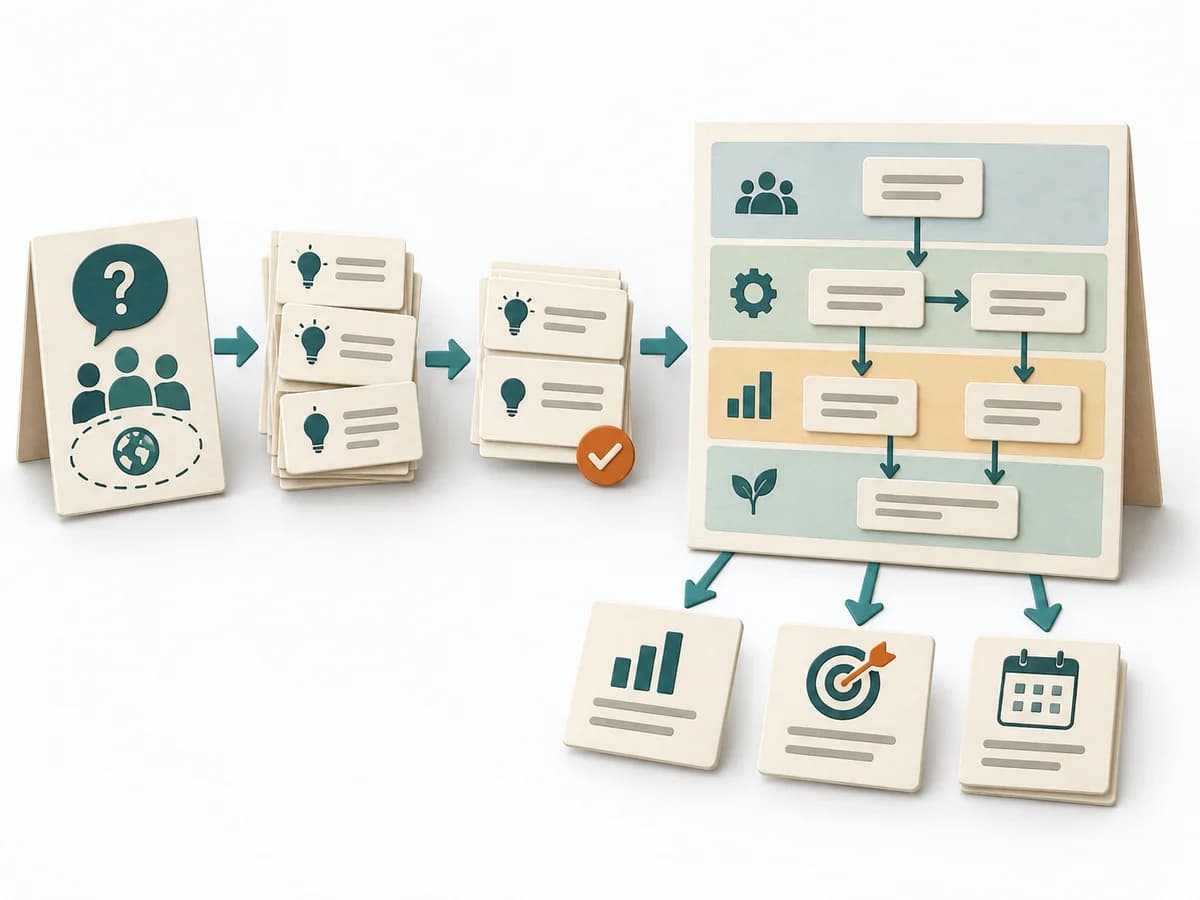 Business Strategy Strategy Map |  Facilitation Alignment Mapping |  Innovation Design Charrette |  Facilitation Power Interest Grid |
|---|---|---|---|---|
Purposedifferent | A Strategy Map translates strategy into a few connected objectives across perspectives such as finance, customers, processes, and learning. This makes visible which capabilities and activities are meant to drive which results. | When several people work toward one goal but hold different mental maps, Alignment Mapping makes the discrepancies visible. It arranges goals, assumptions, and priorities so shared direction becomes verifiable. | In a tightly timed design process with many participants, the method pools several lines of thinking in a short time. It brings parallel design energy without letting the discussion tip into endless coordination. This quickly produces solid directions for architecture or space. | When many stakeholders compete for attention at once, the Power Interest Grid sorts them by influence and stake. It turns individual contributions into a visible selection. The result is captured as a Power Interest Grid and a stakeholder-specific strategy. |
Complexitydifferent | Medium | Medium | Medium | Low |
Timedifferent | 2-4 h workshop plus review | 1-2 h | Halber Tag bis mehrere Tage | 30-60 min |
Participantsdifferent | 4-10 | 4-12 | 10-50 | 2-8 |
Formatsame | Workshop | Workshop | Workshop | Workshop |
Outputdifferent | Strategy Map, Objective Set, Cause-Effect Hypotheses | Alignment Map, Open Issues, Decision Questions | Sketches and Concepts, Consolidated Solution Sketch, Prioritized Direction | Power Interest Grid, Strategy per Stakeholder |
Tagsno overlap | AlignmentExecutionGoalsCausality | AlignmentStakeholdersStrategyFacilitation | BrainstormingWorkshopCollaborationIdeation | StakeholdersFacilitationAlignmentPlanning |