View methods side by side.
Choose up to four methods. Add them using the search and share the comparison by copying its link.
| Criterion |  Business Strategy Strategy Execution Loop |  Agile Specification by Example |  Agile Three Amigos | 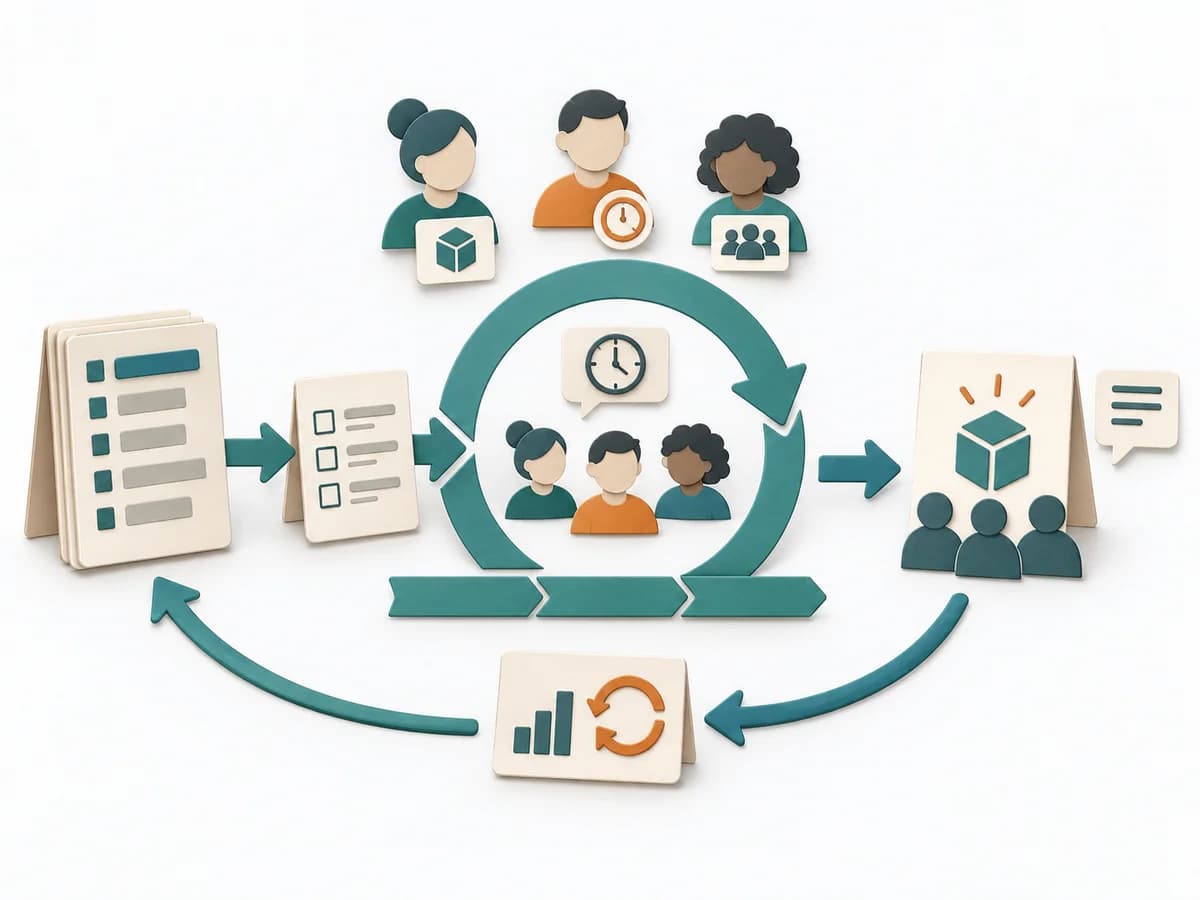 Agile Scrum |
|---|---|---|---|---|
Purposedifferent | The Strategy Execution Loop helps avoid treating strategy as a one-off document. It makes visible how strategic decisions are turned into objectives, initiatives, operational work, measurement, and learning. | When business rules need to become precise, it ties language, example, and test together. It sorts work by value, risk, and delivery ability. The result is captured as an Example Table and Acceptance Tests. | When story, test, and implementation could drift apart, it brings business perspective, engineering, and quality together early. It prevents a story from being read differently only late in the process. | When a team needs to work in a fixed delivery rhythm, it stabilizes cadence, responsibility, and feedback loops. It makes collaboration reliable across sprint boundaries. |
Complexitydifferent | High | Medium | Low | Medium |
Timedifferent | Initial 3-6 h, then monthly or quarterly reviews | 60-90 min pro Feature | 15-30 min | 1-4 Wochen je Sprint, laufend |
Participantsdifferent | 5-12 | 3-6 | 3 | 3-10 (Scrum Team) |
Formatdifferent | Workshop + async | Workshop | Workshop + async | Workshop + async |
Outputdifferent | Execution Loop, Review Cadence, Strategic Learning Log | Example Table, Acceptance Tests | Clarified Story, Test Examples, Open Questions | Product Backlog, Sprint Backlog, Increment, Sprint Goal |
Tagsno overlap | ExecutionCadenceLearningGovernance | AgileRequirementsExamplesBehavior-Driven Development | CollaborationBehavior-Driven DevelopmentQualityRefinement | AgileIterationCadence |