View methods side by side.
Choose up to four methods. Add them using the search and share the comparison by copying its link.
| Criterion |  Business Strategy Strategy Execution Loop |  Decision Making OODA Loop | 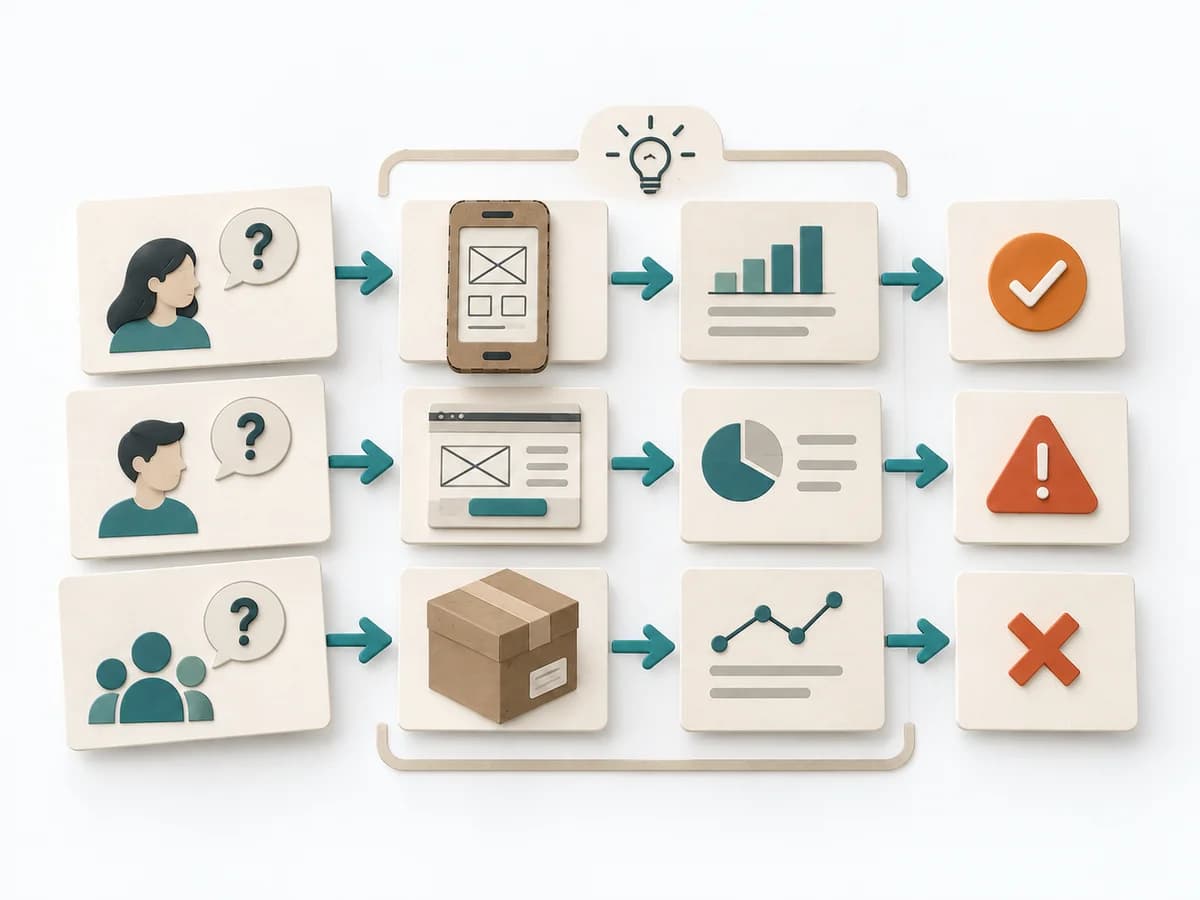 Product Discovery MVP Test Matrix |  Product Discovery Experiment Canvas |
|---|---|---|---|---|
Purposedifferent | The Strategy Execution Loop helps avoid treating strategy as a one-off document. It makes visible how strategic decisions are turned into objectives, initiatives, operational work, measurement, and learning. | In dynamic situations, decisions become outdated faster than they can be prepared. The OODA Loop holds observing, orienting, deciding, and acting together as a recurring rhythm so reaction does not slide into inertia. | When several minimal variants compete to answer the same question, it makes comparing and choosing between them cleaner. It separates problem, assumption, solution, and evidence. The result is captured as a Test Matrix and a Test Plan. | When experiments become unreadable after the fact, it arranges hypothesis, signal, and learning goal on a single canvas. It separates problem, assumption, solution, and evidence. The result is captured as a Completed Experiment Canvas and a Success Metric. |
Complexitydifferent | High | Medium | Medium | Low |
Timedifferent | Initial 3-6 h, then monthly or quarterly reviews | 15-60 min je Zyklus | 45-75 min | 30-60 min |
Participantsdifferent | 5-12 | 1-8 | 2-8 | 1-5 |
Formatdifferent | Workshop + async | Workshop + async | Workshop | Workshop + async |
Outputdifferent | Execution Loop, Review Cadence, Strategic Learning Log | Situation Assessment, Decision Loop, Action Updates | Test Matrix, Test Plan | Completed Experiment Canvas, Success Metric |
Tagsno overlap | ExecutionCadenceLearningGovernance | DecisionChangeLearningStrategy | ExperimentsValidationDiscoveryOptions | ExperimentsValidationDiscoveryHypothesis |