View methods side by side.
Choose up to four methods. Add them using the search and share the comparison by copying its link.
Selected:Strategic, Tactical and Operational PlanningAssumption MappingLearning CardStrategy Execution Loop
| Criterion | 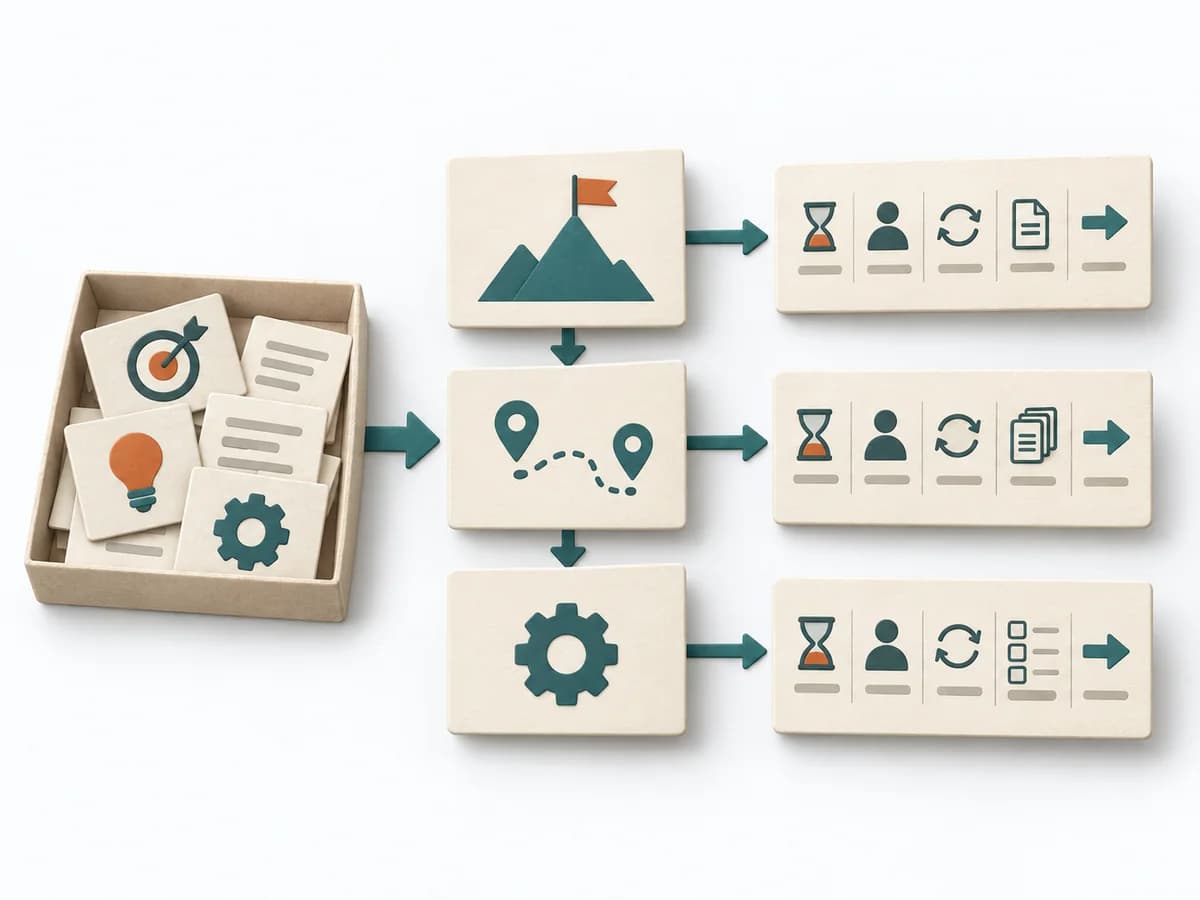 Business Strategy Strategic, Tactical and Operational Planning |  Product Discovery Assumption Mapping |  Product Discovery Learning Card |  Business Strategy Strategy Execution Loop |
|---|---|---|---|---|
Purposedifferent | It places decisions and artifacts at the right level. Strategic planning clarifies direction, tactical planning translates it into programs, and operational planning steers concrete processes. | When assumptions still sit unordered in the room, it weighs uncertainty against leverage. It makes visible which hypotheses should be checked first. | The Learning Card connects traceable test results to a reasoned next action while keeping the limits of the insight visible. | The Strategy Execution Loop helps avoid treating strategy as a one-off document. It makes visible how strategic decisions are turned into objectives, initiatives, operational work, measurement, and learning. |
Complexitydifferent | Medium | Medium | Low | High |
Timedifferent | 90-180 min | 45-60 min | 25-40 min | Initial 3-6 h, then monthly or quarterly reviews |
Participantsdifferent | 4-12 | 2-8 | 1-5 | 5-12 |
Formatdifferent | Workshop | Workshop + async | Workshop + async | Workshop + async |
Outputdifferent | Planning Levels Map, Cadence Model, Planning Artifact Inventory | Assumption map, Test backlog, Risk ranking | Learning Card with evidence and next action | Execution Loop, Review Cadence, Strategic Learning Log |
Tagsno overlap | CadenceGovernanceExecution | AssumptionsRiskExperimentsValidation | ExperimentsValidationDiscoveryLearning | ExecutionCadenceLearningGovernance |