View methods side by side.
Choose up to four methods. Add them using the search and share the comparison by copying its link.
| Criterion |  Agile Story Points |  Agile Planning Poker | 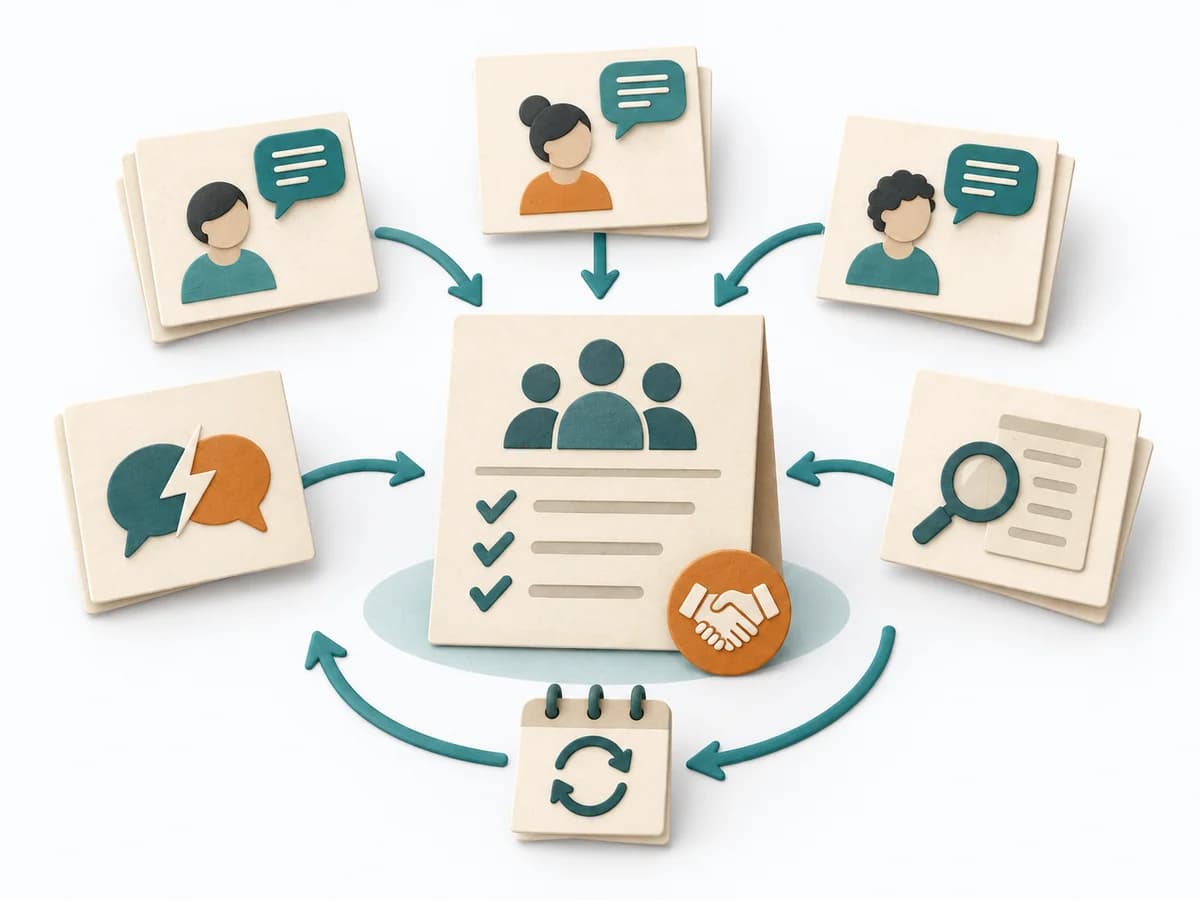 Agile Working Agreements |  Agile T-Shirt Sizing |
|---|---|---|---|---|
Purposedifferent | When teams want to rate complexity rather than hours, it creates a shared, relative scale. It sorts work by value, risk, and delivery ability. The result is captured as Point Estimates, Reference Stories, and Velocity Data. | When estimates within the team diverge too much, it puts differing expectations on a common test bench. It separates rough complexity from unspoken assumptions. | When collaboration needs more than implicit expectations, it lays out shared ground rules openly. It creates reliability for conduct, availability, and decision paths. | When effort only needs to be classified roughly, it makes comparability more important than false precision. It helps sort work quickly into manageable sizes. |
Complexitydifferent | Medium | Low | Low | Low |
Timedifferent | laufend, 1-5 min je Item | 2-5 min je Item | 45-90 min | 15-45 min |
Participantsdifferent | 3-9 | 3-9 | 3-12 | 2-12 |
Formatdifferent | Workshop + async | Workshop + async | Workshop | Workshop + async |
Outputdifferent | Point Estimates, Reference Stories, Velocity Data | Relative Estimates, Assumption Notes, Split Candidates | Working Agreements, Team Norms, Review Cadence | Size Buckets, Rough Backlog Map, Split Candidates |
Tags1 shared | EstimationAgileMeasurement | EstimationAgileRelative sizingTeam | TeamCollaborationAgile | EstimationAgileRoadmap |