View methods side by side.
Choose up to four methods. Add them using the search and share the comparison by copying its link.
| Criterion |  Facilitation Stakeholder Salience Model |  Facilitation Stakeholder Mapping | 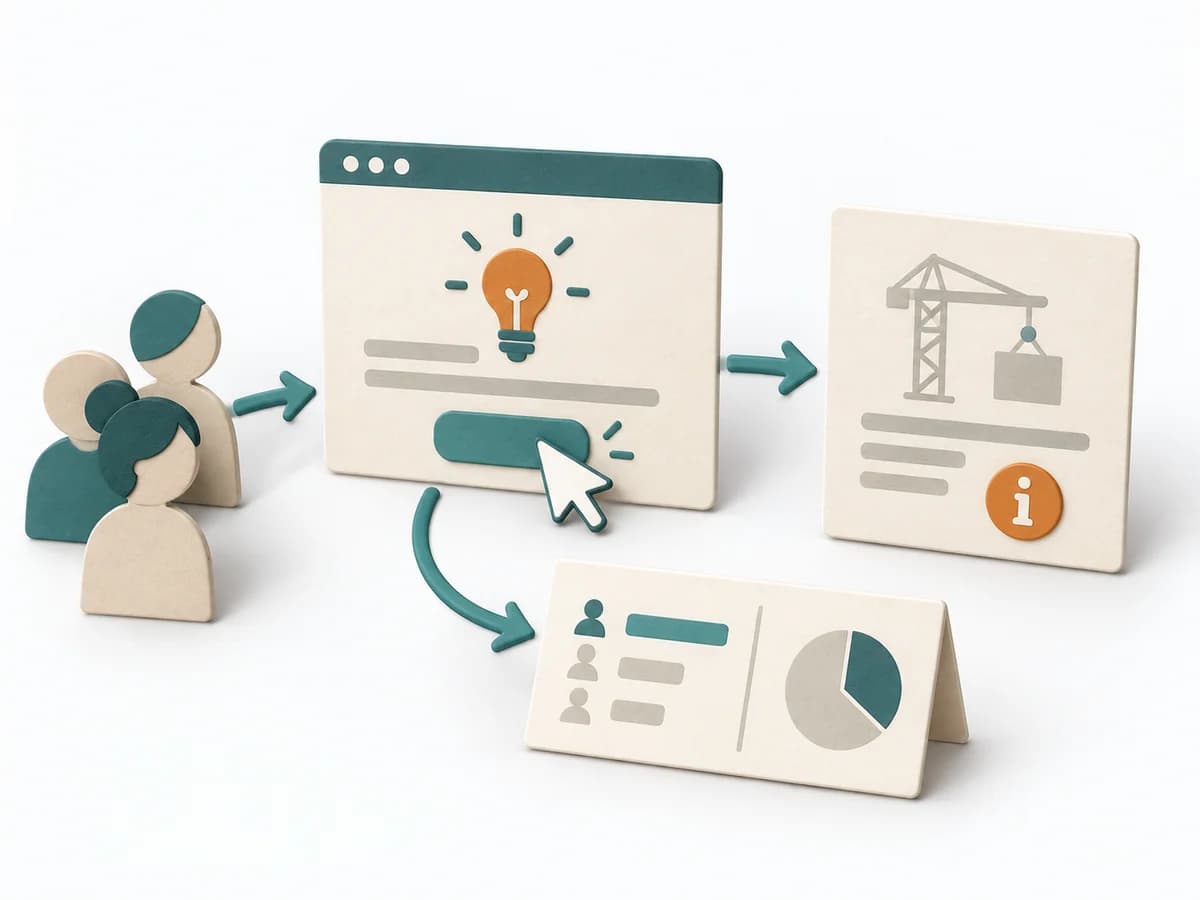 Product Discovery Fake Door Test |  Product Discovery Experiment Canvas |
|---|---|---|---|---|
Purposedifferent | When stakeholders appear to matter very differently, the Stakeholder Salience Model rates their actual priority through power, legitimacy, and urgency. It turns individual contributions into a visible selection. The result is captured as a Salience diagram and a class-based strategy. | When an initiative depends on many people, interests, and power dynamics, Stakeholder Mapping systematically orders the environment. It shows who influences, who is affected, and where relationship management or safeguarding matters first. | When demand is still unclear, it measures interest in a feature before it is built. It separates real behavior from polite agreement and deliberately keeps build effort small. | When experiments become unreadable after the fact, it arranges hypothesis, signal, and learning goal on a single canvas. It separates problem, assumption, solution, and evidence. The result is captured as a Completed Experiment Canvas and a Success Metric. |
Complexitydifferent | Medium | Low | Medium | Low |
Timedifferent | 60-90 min | 60–90 min | 1-5 Tage | 30-60 min |
Participantsdifferent | 3-6 | 2-8 | Nutzertraffic | 1-5 |
Formatdifferent | Workshop | Workshop + async | Async | Workshop + async |
Outputdifferent | Salience Diagram, Strategy per Class | Stakeholder Map, Engagement Plan, Risk Notes | Click Data, Interest Signal, Learning Decision | Completed Experiment Canvas, Success Metric |
Tagsno overlap | StakeholdersFacilitationAlignmentGovernance | StakeholdersAlignmentFacilitationChange | ValidationExperimentsDemandDiscovery | ExperimentsValidationDiscoveryHypothesis |