View methods side by side.
Choose up to four methods. Add them using the search and share the comparison by copying its link.
| Criterion |  Facilitation Stakeholder Salience Model |  Facilitation Alignment Mapping | 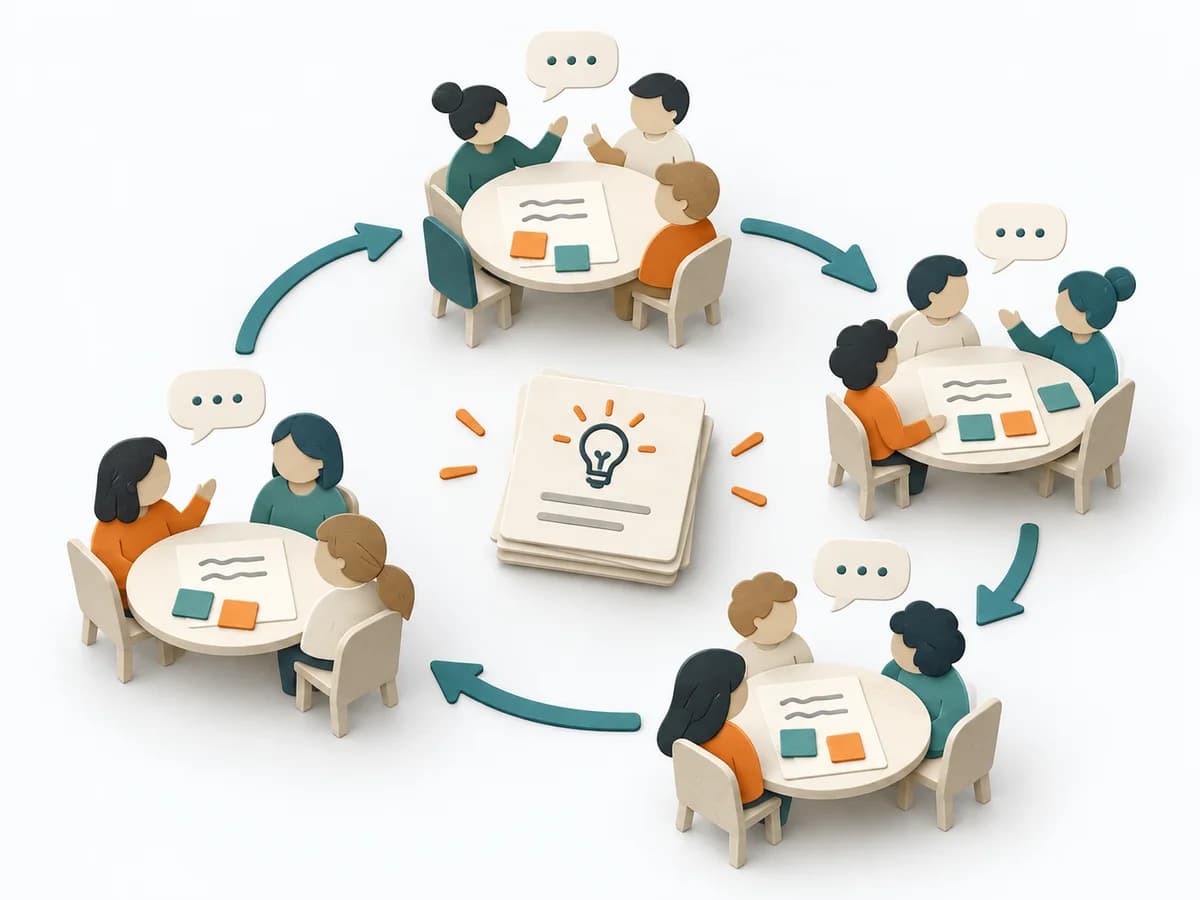 Facilitation World Café |  Facilitation Stakeholder Mapping |
|---|---|---|---|---|
Purposedifferent | When stakeholders appear to matter very differently, the Stakeholder Salience Model rates their actual priority through power, legitimacy, and urgency. It turns individual contributions into a visible selection. The result is captured as a Salience diagram and a class-based strategy. | When several people work toward one goal but hold different mental maps, Alignment Mapping makes the discrepancies visible. It arranges goals, assumptions, and priorities so shared direction becomes verifiable. | When a group needs to connect many viewpoints in a short time, World Café creates a calm alternation between closeness and rotation. It sets thinking in motion without forcing the conversation into full-plenary rigidity. | When an initiative depends on many people, interests, and power dynamics, Stakeholder Mapping systematically orders the environment. It shows who influences, who is affected, and where relationship management or safeguarding matters first. |
Complexitydifferent | Medium | Medium | Medium | Low |
Timedifferent | 60-90 min | 1-2 h | 60-180 min | 60–90 min |
Participantsdifferent | 3-6 | 4-12 | 12-100+ | 2-8 |
Formatdifferent | Workshop | Workshop | Workshop | Workshop + async |
Outputdifferent | Salience Diagram, Strategy per Class | Alignment Map, Open Issues, Decision Questions | Table Notes, Emergent Themes, Shared Questions | Stakeholder Map, Engagement Plan, Risk Notes |
Tags1 shared | StakeholdersFacilitationAlignmentGovernance | AlignmentStakeholdersStrategyFacilitation | FacilitationDialogueLarge groupSensemaking | StakeholdersAlignmentFacilitationChange |