View methods side by side.
Choose up to four methods. Add them using the search and share the comparison by copying its link.
| Criterion | 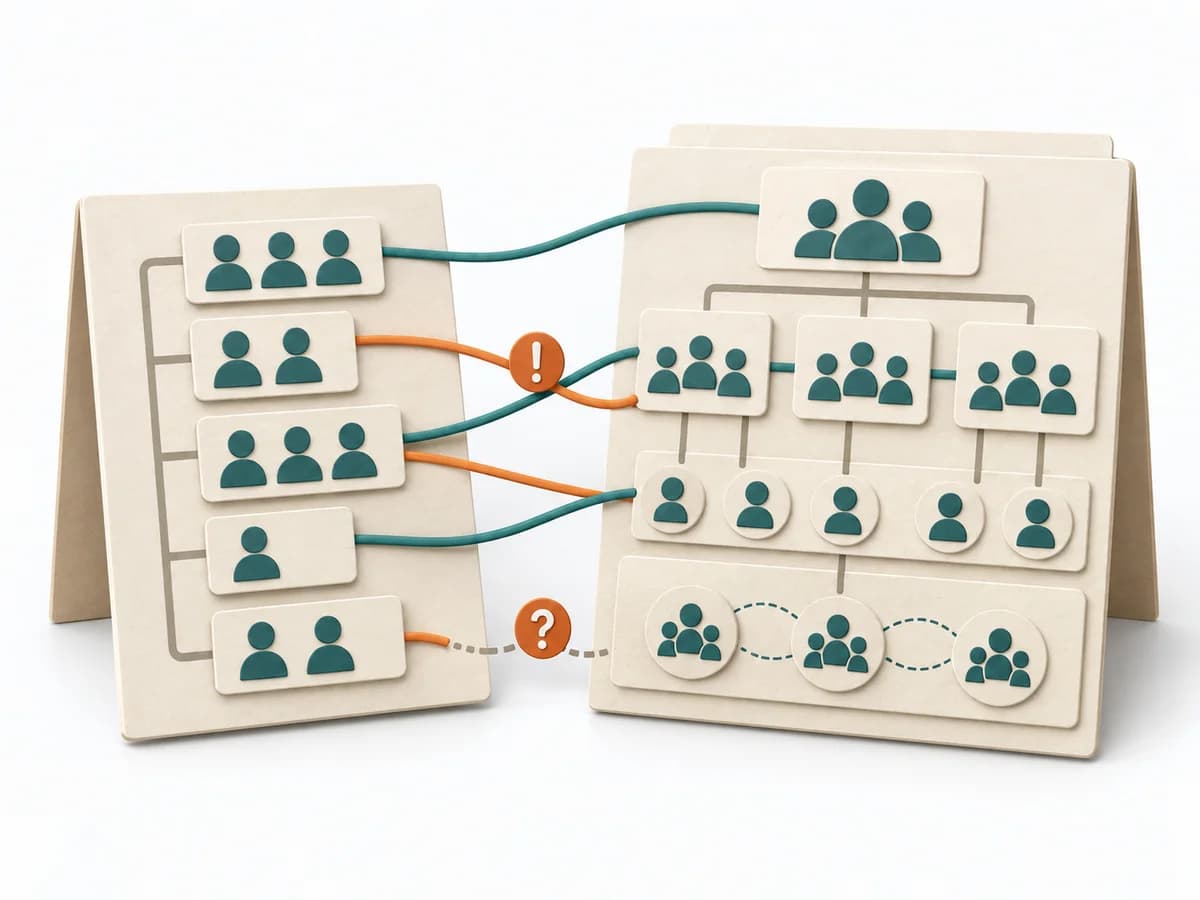 Team Design Spotify Model Mapping |  UX Research Customer Journey Mapping |  Facilitation Stakeholder Salience Model |  Facilitation Stakeholder Mapping |
|---|---|---|---|---|
Purposedifferent | When a team landscape has grown without clear grouping, it maps roles and relationships onto the Spotify model. It clarifies responsibility, interaction, and load between teams. The result is captured as a Spotify model map and action list. | When a user journey falls apart across many touchpoints, customer journey mapping makes the experience visible as a coherent arc. Phases, emotions, and breaks become legible enough to prioritize critical moments deliberately. | When stakeholders appear to matter very differently, the Stakeholder Salience Model rates their actual priority through power, legitimacy, and urgency. It turns individual contributions into a visible selection. The result is captured as a Salience diagram and a class-based strategy. | When an initiative depends on many people, interests, and power dynamics, Stakeholder Mapping systematically orders the environment. It shows who influences, who is affected, and where relationship management or safeguarding matters first. |
Complexitydifferent | Medium | Medium | Medium | Low |
Timedifferent | 90-180 min | 2-4 h | 60-90 min | 60–90 min |
Participantsdifferent | 5-15 | 4-10 | 3-6 | 2-8 |
Formatdifferent | Workshop | Workshop | Workshop | Workshop + async |
Outputdifferent | Spotify Model Map, Action List | Journey Map, Pain-point List, Opportunity Backlog | Salience Diagram, Strategy per Class | Stakeholder Map, Engagement Plan, Risk Notes |
Tagsno overlap | TeamOrganizationAlignmentDiagnosis | JourneyServiceService design | StakeholdersFacilitationAlignmentGovernance | StakeholdersAlignmentFacilitationChange |