View methods side by side.
Choose up to four methods. Add them using the search and share the comparison by copying its link.
| Criterion | 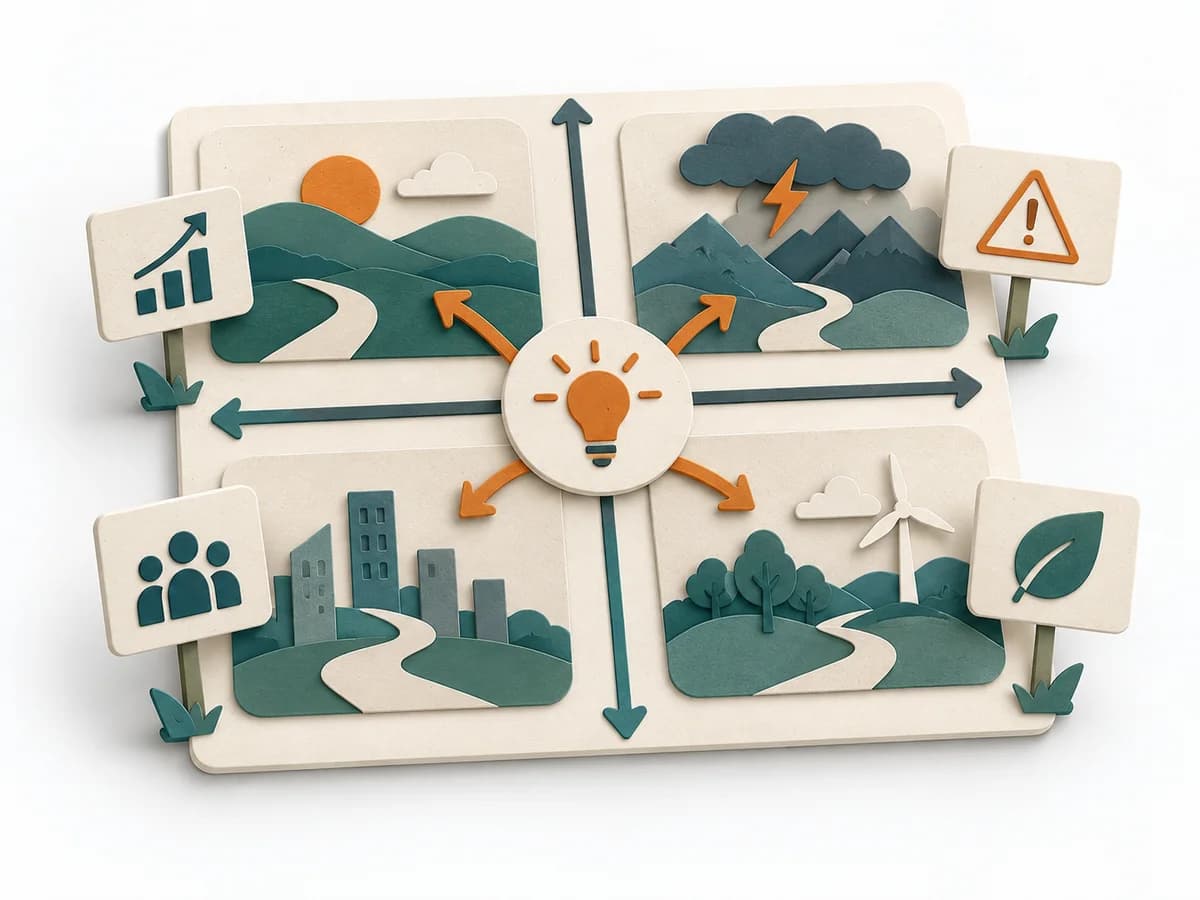 Business Strategy Scenario Planning |  Growth Flywheel |  Business Strategy GAP Analysis |  Growth Funnel Analysis |
|---|---|---|---|---|
Purposedifferent | Scenario Planning opens the view to several plausible futures instead of a single forecast. The method protects strategies from depending on too narrow an expected path. | Growth often breaks down where a reinforcing mechanism builds up too much friction. A Flywheel shows the cycle of value, repetition, and reinforcement meant to sustain growth. | GAP Analysis compares the current state with a target picture and makes the distance manageable. It becomes useful when, ahead of new initiatives, it must become clear which capabilities, processes, or resources are missing. | When many visitors or users drop off along the way, the reason behind the number often stays hidden. Funnel Analysis exposes these transitions and makes visible exactly where the path collapses. |
Complexitydifferent | High | Medium | Medium | Medium |
Timedifferent | 0.5-2 Tage | 60-120 min | 1-3 h | 1-3 h |
Participantsdifferent | 4-12 | 3-8 | 2-8 | 1-5 |
Formatdifferent | Workshop | Workshop | Workshop + async | Async |
Outputdifferent | Scenario Set, Strategic Implications, Robust Options | Flywheel Map, Friction Points, Growth Levers, Experiment Backlog | Gap Matrix, Action Plan, Risk Notes | Funnel report, Drop-off analysis, Optimization hypotheses |
Tagsno overlap | StrategyUncertaintyPlanning | GrowthRetentionConversion | StrategyAnalysisPlanning | AnalyticsConversionGrowth |