View methods side by side.
Choose up to four methods. Add them using the search and share the comparison by copying its link.
| Criterion | 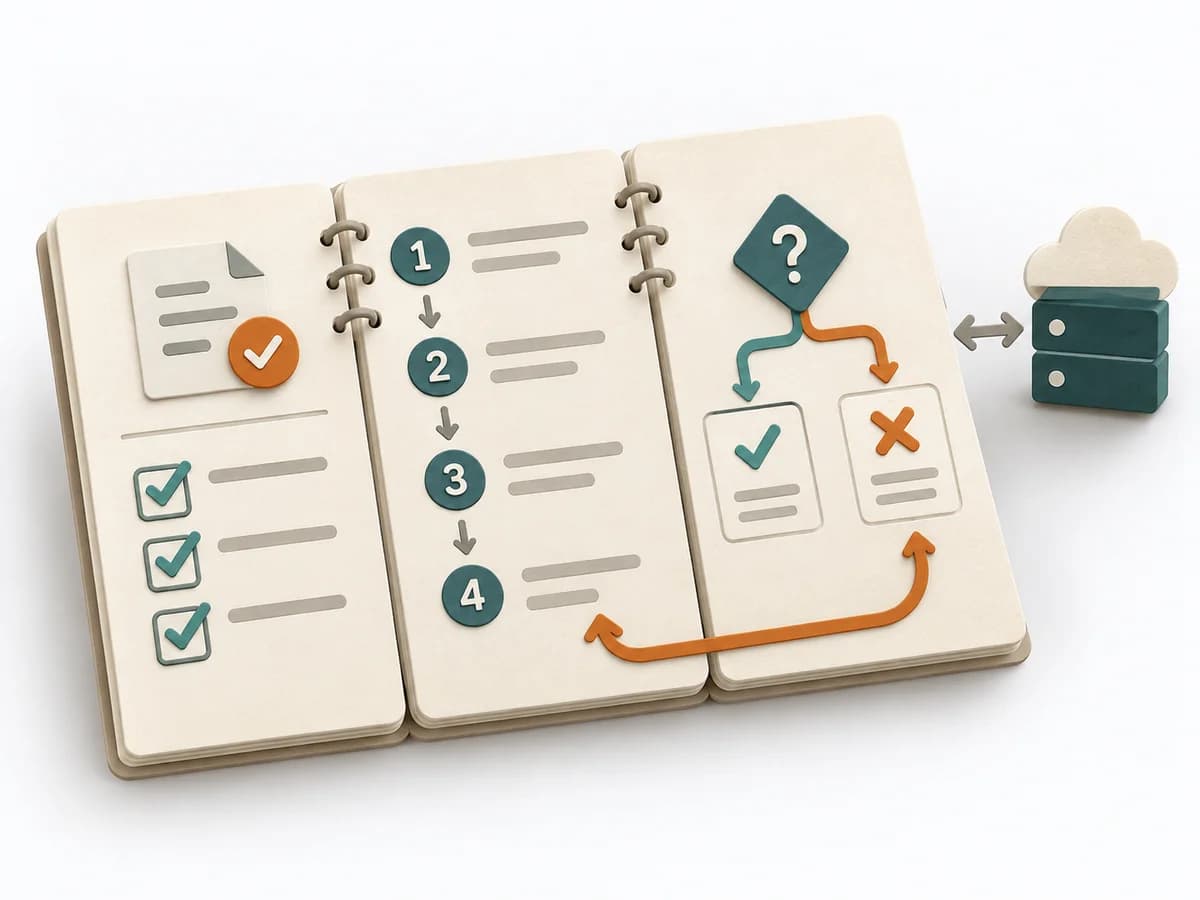 Operations Runbook |  Decision Making Force Field Analysis |  Decision Making Assumption Surfacing |  Product Discovery Assumption Mapping |
|---|---|---|---|---|
Purposedifferent | For recurring operational tasks or incidents, the method keeps solid action logic ready. It reduces uncertainty when time pressure, role changes, or rare situations demand fast access. | In change initiatives, supporting and restraining forces sit at the table at the same time. Force Field Analysis makes these tensions explicit and shows where change can be pushed forward by strengthening or relieving. | Plans often contain assumptions that were never openly stated and remain dangerous precisely because of that. Assumption Surfacing makes these silent premises visible and prioritizes which of them carry the initiative or could sink it. | When assumptions still sit unordered in the room, it weighs uncertainty against leverage. It makes visible which hypotheses should be checked first. |
Complexitydifferent | Low | Low | Low | Medium |
Timedifferent | 20-60 min | 45-90 min | 45-90 min | 45-60 min |
Participantsdifferent | 1-4 | 3-12 | 2-8 | 2-8 |
Formatdifferent | Async | Workshop | Workshop + async | Workshop + async |
Outputdifferent | Runbook, Checklist, Escalation Path | Force Field Map, Change Levers, Risk Notes | Assumption List, Critical Assumptions, Learning Plan | Assumption map, Test backlog, Risk ranking |
Tagsno overlap | OperationsReliabilityDocumentation | ChangeDecisionStrategy | AssumptionsRiskDecisionDiscovery | AssumptionsRiskExperimentsValidation |