View methods side by side.
Choose up to four methods. Add them using the search and share the comparison by copying its link.
| Criterion | 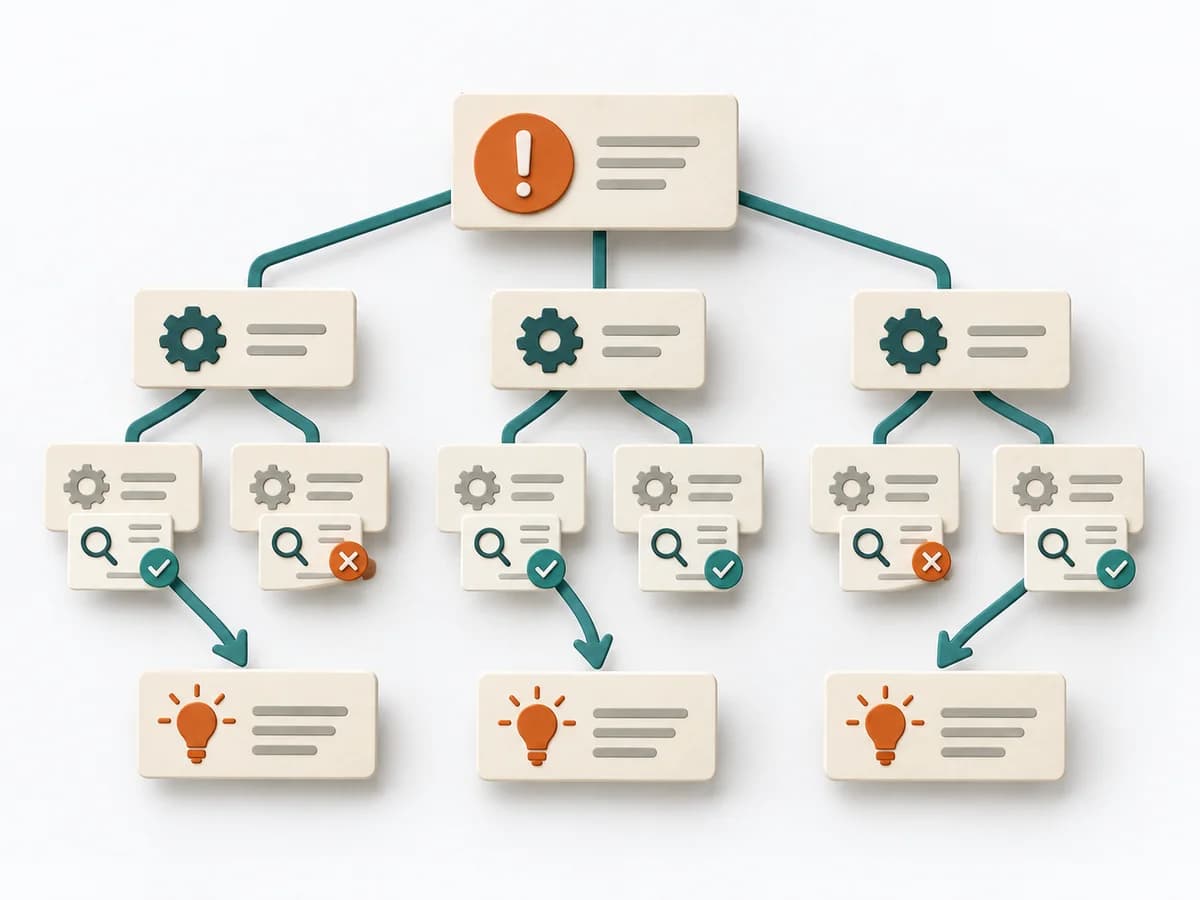 Operations Root Cause Tree Analysis |  Operations MORT Analysis |  Decision Making OODA Loop |  Operations Root Cause Analysis |
|---|---|---|---|---|
Purposedifferent | For a problem with several suspected causes, the method builds a causal structure instead of a mere list. It makes visible how causes connect and where the strongest points of leverage lie. | For a safety-relevant event or a system with high protection requirements, the method examines where controls failed. It exposes both technical and organizational gaps. | In dynamic situations, decisions become outdated faster than they can be prepared. The OODA Loop holds observing, orienting, deciding, and acting together as a recurring rhythm so reaction does not slide into inertia. | When a problem keeps recurring and the cause stays unclear, the method exposes the underlying mechanism. It separates symptom, guess, and robust explanation from one another. |
Complexitydifferent | Medium | High | Medium | Medium |
Timedifferent | 1-3 h | Mehrere Tage bis Wochen | 15-60 min je Zyklus | 1-4 h |
Participantsdifferent | 2-8 | 2-6 | 1-8 | 3-8 |
Formatdifferent | Workshop | Workshop + async | Workshop + async | Workshop + async |
Outputdifferent | Cause Tree, Evidence Notes, Countermeasures | MORT Worksheets, Findings per Branch, Corrective Actions, Systemic Recommendations | Situation Assessment, Decision Loop, Action Updates | Problem Statement, Cause Hypotheses, Confirmed Causes, Action Plan |
Tagsno overlap | Root causeTreeIncidentQuality | Root causeSafetySystemicIncident | DecisionChangeLearningStrategy | Root causeProblem solvingQualityIncident |