View methods side by side.
Choose up to four methods. Add them using the search and share the comparison by copying its link.
| Criterion | 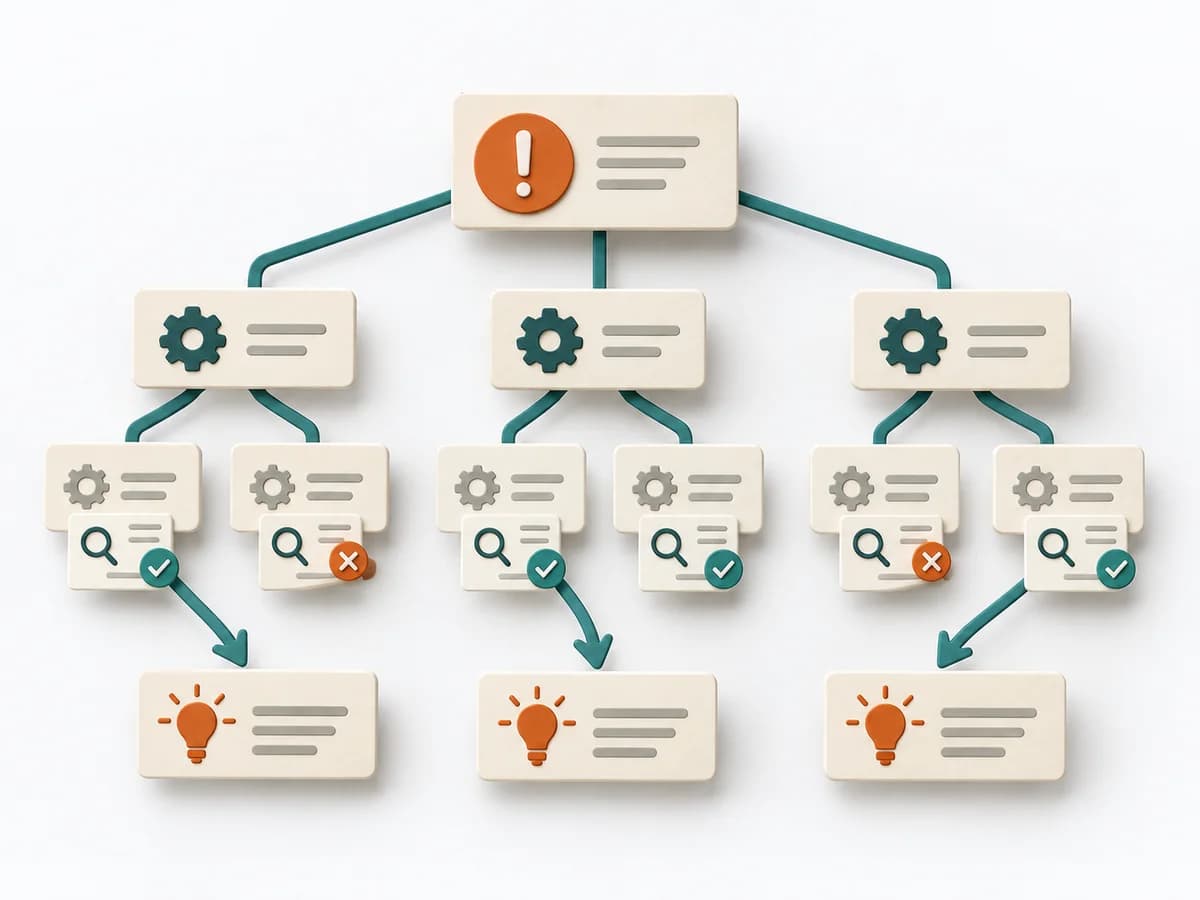 Operations Root Cause Tree Analysis |  Innovation Design Charrette |  Innovation Starbursting |  Operations Root Cause Analysis |
|---|---|---|---|---|
Purposedifferent | For a problem with several suspected causes, the method builds a causal structure instead of a mere list. It makes visible how causes connect and where the strongest points of leverage lie. | In a tightly timed design process with many participants, the method pools several lines of thinking in a short time. It brings parallel design energy without letting the discussion tip into endless coordination. This quickly produces solid directions for architecture or space. | Helps clarify ideas, open questions, and testable next steps in concrete terms. It opens the thinking space, collects ideas, and leads to testable options. The result is captured as a star-shaped question map, question list, and assumption list. | When a problem keeps recurring and the cause stays unclear, the method exposes the underlying mechanism. It separates symptom, guess, and robust explanation from one another. |
Complexitydifferent | Medium | Medium | Low | Medium |
Timedifferent | 1-3 h | Halber Tag bis mehrere Tage | 30-60 min | 1-4 h |
Participantsdifferent | 2-8 | 10-50 | 3-10 | 3-8 |
Formatdifferent | Workshop | Workshop | Workshop + async | Workshop + async |
Outputdifferent | Cause Tree, Evidence Notes, Countermeasures | Sketches and Concepts, Consolidated Solution Sketch, Prioritized Direction | Star-Shaped Question Map, Question List, Assumption List | Problem Statement, Cause Hypotheses, Confirmed Causes, Action Plan |
Tagsno overlap | Root causeTreeIncidentQuality | BrainstormingWorkshopCollaborationIdeation | BrainstormingIdeationWorkshopDiscovery | Root causeProblem solvingQualityIncident |