View methods side by side.
Choose up to four methods. Add them using the search and share the comparison by copying its link.
| Criterion |  Agile ROAM Board | 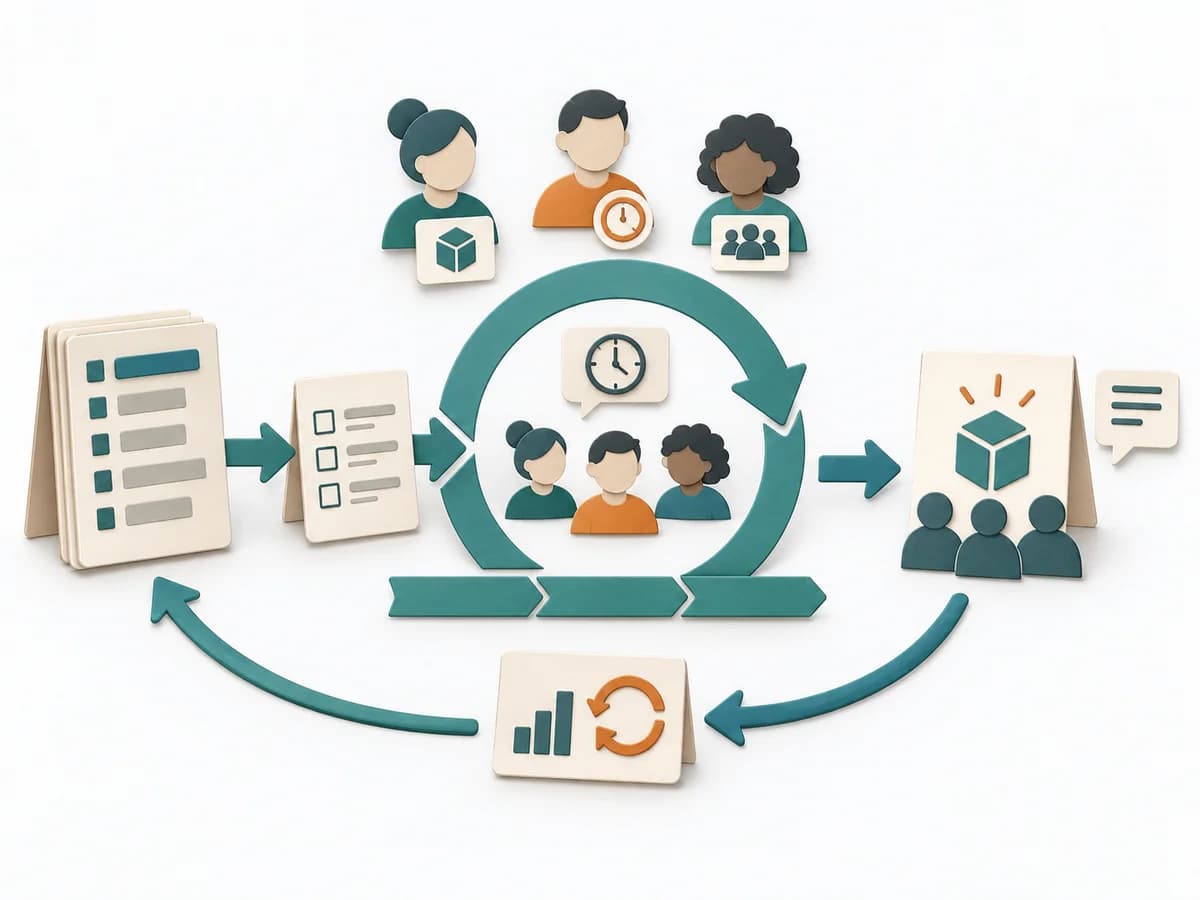 Agile Scrum |  Decision Making Decision Rights Mapping |  Decision Making Assumption Surfacing |
|---|---|---|---|---|
Purposedifferent | When work needs to move between different states or columns, it makes that movement and its handoffs legible. It sorts work by value, risk, and delivery ability. The result is captured as a ROAM Board and an Owner List. | When a team needs to work in a fixed delivery rhythm, it stabilizes cadence, responsibility, and feedback loops. It makes collaboration reliable across sprint boundaries. | In organizations with many stakeholders, it often blurs who actually decides and who is merely consulted. It separates options, evaluation criteria, and open risks. The result is captured as a Decision Rights matrix and an agreement. | Plans often contain assumptions that were never openly stated and remain dangerous precisely because of that. Assumption Surfacing makes these silent premises visible and prioritizes which of them carry the initiative or could sink it. |
Complexitydifferent | Low | Medium | Medium | Low |
Timedifferent | 20-40 min initial, dann laufend | 1-4 Wochen je Sprint, laufend | 90-180 min | 45-90 min |
Participantsdifferent | 3-15 | 3-10 (Scrum Team) | 4-12 | 2-8 |
Formatdifferent | Workshop + async | Workshop + async | Workshop | Workshop + async |
Outputdifferent | ROAM Board, Owner List | Product Backlog, Sprint Backlog, Increment, Sprint Goal | Decision Rights Matrix, Agreement | Assumption List, Critical Assumptions, Learning Plan |
Tagsno overlap | RiskAgileTrackingAlignment | AgileIterationCadence | DecisionGovernanceAlignmentResponsibility | AssumptionsRiskDecisionDiscovery |