View methods side by side.
Choose up to four methods. Add them using the search and share the comparison by copying its link.
| Criterion |  Agile ROAM Board | 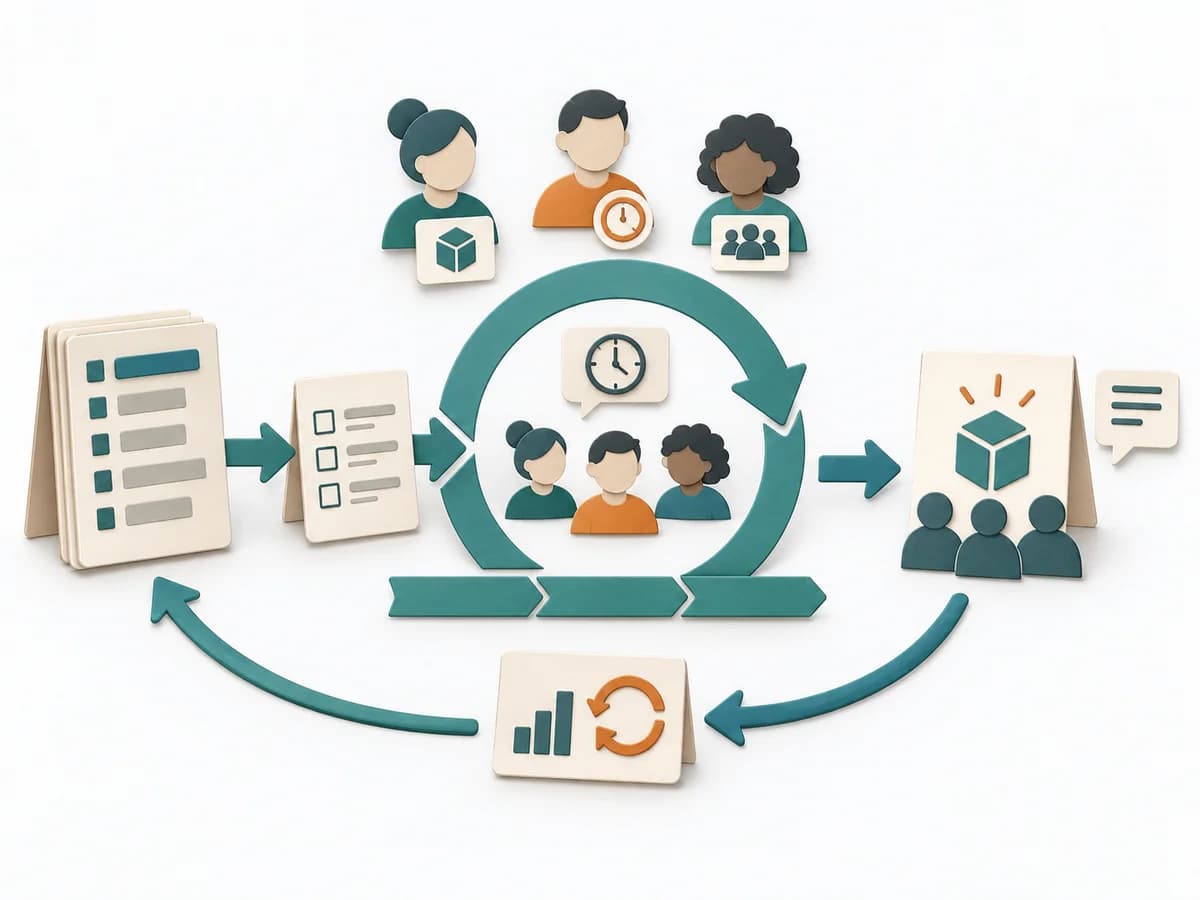 Agile Scrum |  Growth A/B Testing |  Product Discovery Experiment Canvas |
|---|---|---|---|---|
Purposedifferent | When work needs to move between different states or columns, it makes that movement and its handoffs legible. It sorts work by value, risk, and delivery ability. The result is captured as a ROAM Board and an Owner List. | When a team needs to work in a fixed delivery rhythm, it stabilizes cadence, responsibility, and feedback loops. It makes collaboration reliable across sprint boundaries. | When two variants compete, discussions quickly decide by taste rather than effect. A/B Testing checks behavior under controlled conditions and separates real improvement from chance or expectation effects. | When experiments become unreadable after the fact, it arranges hypothesis, signal, and learning goal on a single canvas. It separates problem, assumption, solution, and evidence. The result is captured as a Completed Experiment Canvas and a Success Metric. |
Complexitydifferent | Low | Medium | High | Low |
Timedifferent | 20-40 min initial, dann laufend | 1-4 Wochen je Sprint, laufend | 1-4 Wochen | 30-60 min |
Participantsdifferent | 3-15 | 3-10 (Scrum Team) | 1-6 | 1-5 |
Formatdifferent | Workshop + async | Workshop + async | Async | Workshop + async |
Outputdifferent | ROAM Board, Owner List | Product Backlog, Sprint Backlog, Increment, Sprint Goal | Experiment results, Decision log, Learning summary | Completed Experiment Canvas, Success Metric |
Tagsno overlap | RiskAgileTrackingAlignment | AgileIterationCadence | ExperimentsGrowthAnalyticsValidation | ExperimentsValidationDiscoveryHypothesis |