View methods side by side.
Choose up to four methods. Add them using the search and share the comparison by copying its link.
| Criterion |  Agile ROAM Board |  Engineering Hypothesis-Driven Troubleshooting |  Delivery RAID Log | 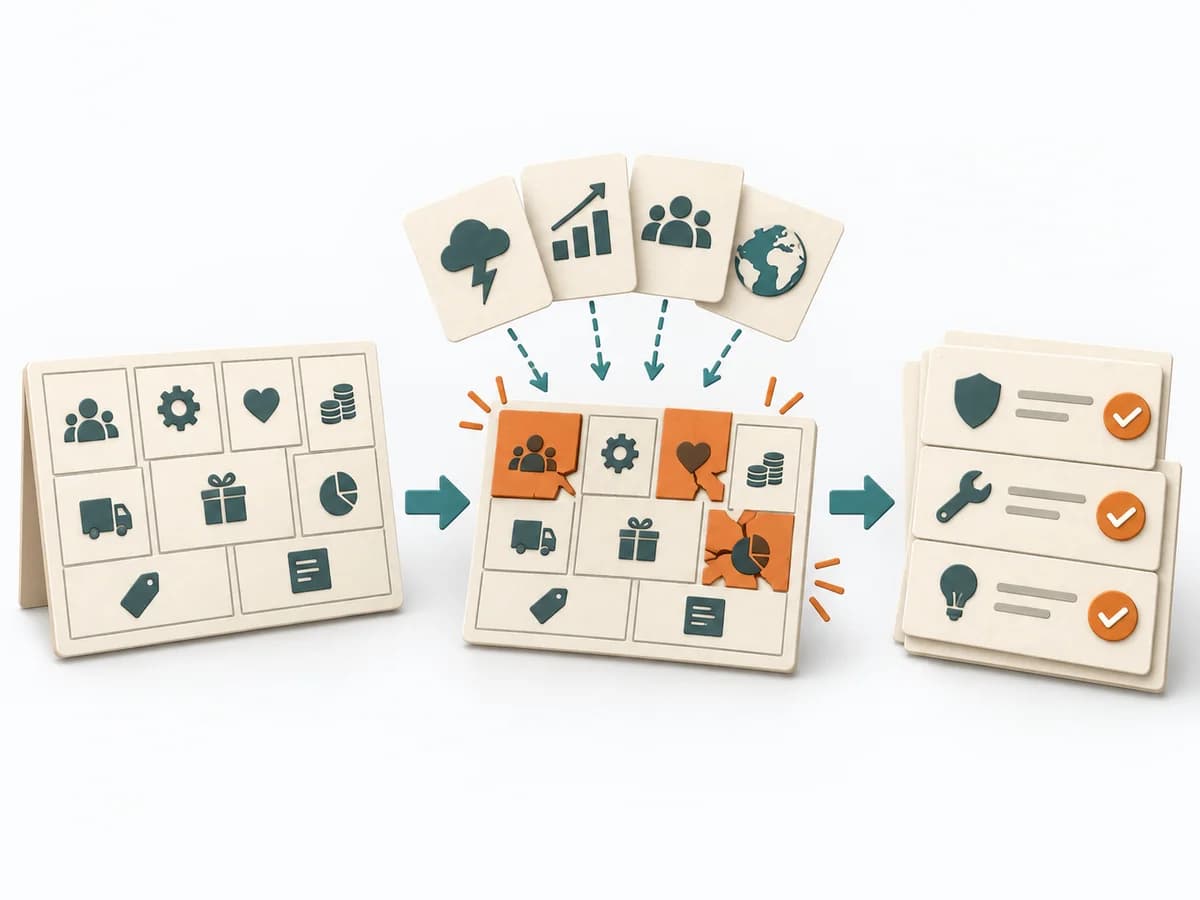 Business Strategy Business Model Stress Test |
|---|---|---|---|---|
Purposedifferent | When work needs to move between different states or columns, it makes that movement and its handoffs legible. It sorts work by value, risk, and delivery ability. The result is captured as a ROAM Board and an Owner List. | When systems fail unexpectedly, spontaneous attempts often produce more noise than insight. Hypothesis-driven Troubleshooting translates symptoms into testable assumptions and makes troubleshooting learnable. | Helps clarify scope, sequence, and delivery flow in concrete terms. It makes work, boundaries, and order steerable. The result is captured as a RAID Log and a source for status reporting. | A Business Model Stress Test checks how well a business model holds up under pressure and headwinds. It compares strengths, risks, market logic, and courses of action. The result is captured as a stress-test report and action plan per scenario. |
Complexitydifferent | Low | Medium | Low | High |
Timedifferent | 20-40 min initial, dann laufend | 30-240 min | 30 min Setup, dann laufend | Half day |
Participantsdifferent | 3-15 | 1-6 | 1-3 maintaining, briefing for everyone | 3-8 |
Formatdifferent | Workshop + async | Workshop + async | Async | Workshop |
Outputdifferent | ROAM Board, Owner List | Hypothesis Log, Test Plan, Evidence Notes, Diagnosis Summary | RAID Log, Status Report Source | Stress Test Report, Action Plan per Scenario |
Tagsno overlap | RiskAgileTrackingAlignment | TroubleshootingProblem solvingDiagnosis | RiskTrackingStakeholdersGovernance | StrategyBusiness modelRiskDiagnosis |